Dermatology billing looks simple only to people who do not understand dermatology billing.
A patient comes in with a rash, acne flare, suspicious mole, skin lesion, cyst, wart, or chronic inflammatory condition. During the same visit, the dermatologist may evaluate the problem, make a diagnosis, prescribe medication, perform a biopsy, destroy a lesion, inject medication, remove a growth, or plan follow-up care.
Clinically, that may feel like one smooth encounter.
From a billing perspective, it is not that simple.
The billing team must decide whether the visit supports an Evaluation and Management service, a procedure code, or both. They also need to know when Modifier 25 is appropriate, when Modifier 59 is appropriate, and when neither modifier should be used. Getting this wrong leads to denials, underpayments, refund requests, audits, and revenue leakage.
Dermatology practices are especially vulnerable because many visits involve both cognitive work and procedural work. A provider may evaluate one condition and treat another. A patient may present with a new complaint but also receive a minor procedure. Multiple lesions may be treated on the same date. Separate body areas may be involved. Different payer rules may apply.
That is why dermatology billing requires more than code selection. It requires clear documentation, correct modifier use, and a strong understanding of what is separately billable.
Understanding E/M Coding in Dermatology
E/M stands for Evaluation and Management. In dermatology, an E/M code is used when the provider evaluates the patient’s condition, makes or updates a diagnosis, considers treatment options, manages medication, reviews history, assesses risk, or creates a care plan.
Examples of dermatology encounters that may support E/M coding include:
- Evaluation of a new rash
- Assessment of acne, rosacea, eczema, psoriasis, or dermatitis
- Evaluation of a changing mole or suspicious lesion
- Medication management for chronic skin disease
- Review of prior treatment failure
- Counseling on treatment options, risks, and follow-up
- Assessment of multiple skin complaints during the same visit
The key issue is medical necessity.
An E/M code is not supported just because the patient spoke with the dermatologist. It is not supported just because a note exists. It is supported when the documentation shows medically necessary evaluation and management work.
CMS states that medical necessity is the main criterion for payment, along with the specific requirements of the CPT or HCPCS code. CMS also explains that, for most E/M visit families, code level selection is based on medical decision making or total time.
For dermatology practices, this means the note must show the actual evaluation. A vague statement such as “lesion checked, biopsy performed” is weak. It does not clearly support a separate E/M service. A stronger note identifies the complaint, relevant history, examination findings, assessment, decision-making, risk, treatment options, and follow-up plan.
The provider does not need to over-document irrelevant details. That creates bloated notes without improving billing strength. The goal is not longer documentation. The goal is precise documentation.
Understanding Procedure Coding in Dermatology
Procedure coding applies when the dermatologist performs a specific service or intervention. Dermatology is procedure-heavy, so this is where many billing errors happen.
Common dermatology procedures include:
- Skin biopsy
- Shave removal
- Lesion excision
- Lesion destruction
- Cryotherapy
- Intralesional injection
- Incision and drainage
- Wound repair
- Mohs surgery
- Wart destruction
- Cyst removal
A procedure code generally includes the normal work required to perform that procedure. This usually includes basic pre-procedure assessment, explanation of the procedure, local preparation, routine post-procedure instructions, and immediate follow-up guidance.
This is the point many practices miss.
You cannot automatically bill an E/M code just because the provider looked at the lesion before performing the procedure. The routine assessment required to perform the procedure is usually part of the procedural service.
For example, if a patient is scheduled for cryotherapy of a known wart and the provider confirms the wart before treating it, that alone does not create a separately billable E/M service. If a patient comes in for a planned biopsy and the provider performs the standard pre-procedure assessment, that also may not support a separate E/M.
Procedure coding becomes more complex when there are multiple lesions, multiple procedures, separate anatomical sites, or additional medical problems addressed during the same encounter. That is where modifiers become critical.
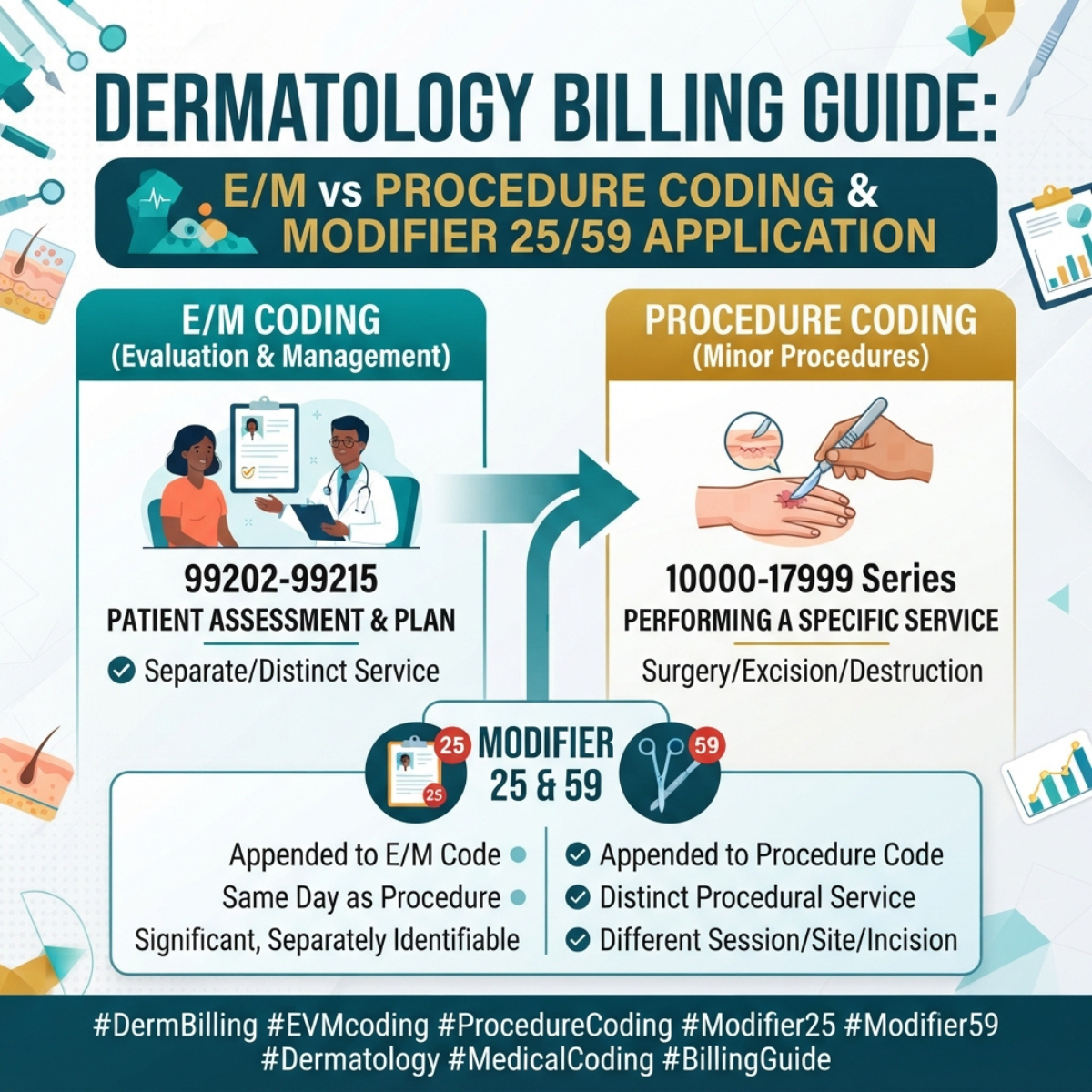
E/M vs Procedure Coding: The Core Difference
The simplest way to understand the difference is this:
E/M coding pays for medically necessary cognitive work.
Procedure coding pays for the technical service performed.
A dermatology visit may include one, the other, or both. The billing question is whether the E/M work is separate and significant beyond the procedure.
Here is a practical example.
A patient presents with a new itchy rash on the arms and also asks about a bleeding lesion on the shoulder. The dermatologist evaluates the rash, reviews history, considers differential diagnoses, prescribes treatment, and gives follow-up instructions. During the same visit, the dermatologist performs a biopsy of the shoulder lesion.
In this case, both an E/M code and a procedure code may be appropriate if the documentation clearly supports both services. The rash evaluation is separate from the biopsy work. Modifier 25 may be needed on the E/M code.
Now compare that with a weaker example.
A patient presents with one suspicious lesion. The dermatologist examines the lesion and performs a biopsy. There is no separately documented evaluation beyond deciding to biopsy that lesion.
In that case, billing both an E/M and procedure code may be risky. The evaluation may be considered part of the procedure.
The difference is not whether the provider “saw the patient.” The difference is whether the provider performed and documented a significant, separately identifiable E/M service.
What Modifier 25 Means in Dermatology Billing
Modifier 25 is used when a significant, separately identifiable E/M service is performed by the same physician or qualified healthcare professional on the same day as a procedure or other service.
CMS explains that Modifier 25 may be appended to an E/M code when reported with another procedure or service on the same date to show a significant and separately identifiable E/M service when appropriate.
In dermatology, Modifier 25 is often used incorrectly. The mistake is assuming that every same-day E/M and procedure automatically qualifies. That is wrong.
Modifier 25 does not mean:
- “The patient had a visit and a procedure.”
- “The provider documented a note.”
- “The procedure was done on the same day.”
- “The clinic wants separate reimbursement.”
- “The payer might deny it without a modifier.”
Modifier 25 means the E/M service was above and beyond the usual work included in the procedure.
A valid Modifier 25 scenario requires clear documentation of separate E/M work. The provider must show what was evaluated, why it was medically necessary, what decisions were made, and how that work was distinct from the procedure.
Correct Use of Modifier 25 in Dermatology
Modifier 25 is appropriate when the dermatologist performs a meaningful E/M service on the same date as a minor procedure.
Here are common dermatology examples.
Example 1: Separate Condition Evaluated
A patient comes in for a suspicious mole on the back. During the same visit, the patient also reports worsening eczema on both arms. The dermatologist evaluates the eczema, reviews prior treatments, assesses severity, prescribes a new topical medication, and schedules follow-up. The dermatologist also biopsies the mole.
This may support an E/M code with Modifier 25 plus the biopsy code.
Why?
Because the eczema evaluation is separate from the mole biopsy.
Example 2: New Complaint Requiring Medical Decision-Making
A patient is scheduled for wart destruction but also presents with a new facial rash. The dermatologist evaluates the rash, considers allergic dermatitis versus rosacea, reviews triggers, prescribes treatment, and provides follow-up guidance. The wart is treated with cryotherapy.
This may support Modifier 25 if the documentation separates the rash evaluation from the wart treatment.
Example 3: Chronic Disease Management Plus Procedure
A patient with psoriasis comes in for medication management and also has a skin tag removed. The dermatologist evaluates psoriasis control, medication response, side effects, and treatment plan. The skin tag removal is separately performed.
This may support E/M with Modifier 25 because the psoriasis management is separate from the procedure.
Incorrect Use of Modifier 25
Modifier 25 is not appropriate when the E/M work is limited to the normal assessment required for the procedure.
Weak examples include:
- “Patient here for lesion removal. Lesion examined. Procedure performed.”
- “Wart checked and treated with cryotherapy.”
- “Biopsy discussed and performed.”
- “Patient tolerated procedure well.”
These statements may support the procedure. They do not necessarily support a separate E/M.
The decision to perform a minor procedure is often included in the payment for that procedure. CMS guidance on E/M services explains that Medicare global surgery rules prevent separate reporting of an E/M service for the work associated with the decision to perform a minor surgical procedure.
That point matters in dermatology because many dermatology procedures are minor procedures. If the only decision made is “perform the biopsy” or “treat the wart,” then a separate E/M may not be defensible.
Documentation Requirements for Modifier 25
Strong Modifier 25 documentation should make the separate E/M obvious.
A good note should answer:
- What separate problem was evaluated?
- What history was reviewed?
- What examination findings mattered?
- What diagnosis or differential diagnosis was considered?
- What treatment decision was made?
- What risk or complexity was involved?
- How was this work separate from the procedure?
The E/M documentation does not need to be in a separate note, but it must be separately identifiable. If an auditor cannot tell where the E/M work ends and the procedure begins, the claim is weak.
A practical documentation structure is:
- Chief complaint or reason for visit
- Separate problems addressed
- Relevant history
- Exam findings
- Assessment and plan for each condition
- Procedure note
- Follow-up instructions
This structure makes the billing logic easier to defend.
What Modifier 59 Means in Dermatology Billing
Modifier 59 is different from Modifier 25.
Modifier 25 applies to E/M services.
Modifier 59 applies to distinct procedural services.
CMS describes Modifier 59 as an NCCI-associated modifier used to show that two or more procedures are separate and distinct, often because they are performed at different anatomic sites or during different patient encounters. CMS also states that Modifier 59 should only be used when no other modifier more appropriately describes the relationship between the services.
This distinction is critical.
Do not use Modifier 59 to separate an E/M service from a procedure. That is what Modifier 25 is for.
Modifier 59 is used when procedure-to-procedure edits would otherwise bundle services, but the clinical facts support separate reporting.
Correct Use of Modifier 59 in Dermatology
Modifier 59 may be appropriate when dermatology procedures are genuinely distinct.
Examples may include:
- Procedures performed on separate lesions
- Procedures performed on different anatomical sites
- Procedures performed during separate encounters on the same date
- Separate procedures that are not normally reported together but are distinct in the documented case
For example, a dermatologist performs a biopsy on one lesion and destroys a separate lesion in a different anatomical location. If the payer’s edit would otherwise bundle the services, Modifier 59 may be appropriate if documentation clearly supports that the procedures were distinct.
Another example: a patient has one procedure performed in the morning and returns later the same day for a separate procedure related to a different issue. If the services are distinct and properly documented, Modifier 59 may be considered.
CMS explains that NCCI Procedure-to-Procedure edits apply to CPT and HCPCS codes reported by the same provider or supplier for the same beneficiary on the same date of service. CMS also notes that if procedures are performed at the same encounter and in contiguous structures in the same organ or anatomical region, NCCI-associated modifiers generally should not be used.
That means Modifier 59 is not a shortcut. It must be supported by separation in the service, site, encounter, lesion, or clinical circumstance.
Incorrect Use of Modifier 59
Modifier 59 should not be used casually to override payer edits.
Common mistakes include:
- Using Modifier 59 just because a claim denied
- Using Modifier 59 without reviewing the code pair
- Using Modifier 59 when procedures were performed on the same lesion
- Using Modifier 59 when documentation does not prove distinctness
- Using Modifier 59 instead of a more specific modifier
- Using Modifier 59 on an E/M code
This is one of the fastest ways to create audit risk.
Modifier 59 is powerful because it tells the payer the services are distinct. If the documentation does not support that statement, the claim is vulnerable.
Modifier 25 vs Modifier 59: The Clean Difference
Here is the simplest way to remember it:
Modifier 25 separates an E/M service from a procedure.
Modifier 59 separates one procedure from another procedure.
Modifier 25 goes on the E/M code.
Modifier 59 goes on the appropriate procedure code when distinct procedural services are supported.
Modifier 25 is about separate evaluation and management.
Modifier 59 is about separate procedural work.
Confusing these two modifiers causes unnecessary denials. It also creates compliance problems because the modifier tells the payer a specific story. If the modifier story does not match the documentation, the claim is weak.
Dermatology Scenarios
Scenario 1: E/M Only
A patient presents with worsening acne. The dermatologist reviews medication history, evaluates severity, discusses treatment options, prescribes medication, and schedules follow-up. No procedure is performed.
Billing approach: E/M code only.
No Modifier 25 or Modifier 59 is needed.
Scenario 2: Procedure Only
A patient presents for scheduled wart cryotherapy. The dermatologist confirms the wart and performs treatment. No separate condition is evaluated.
Billing approach: Procedure code only.
Modifier 25 is likely not supported because there is no separate E/M service.
Scenario 3: E/M Plus Procedure
A patient presents with a new rash and a suspicious lesion. The dermatologist evaluates the rash, prescribes treatment, and separately performs a biopsy of the suspicious lesion.
Billing approach: E/M code with Modifier 25 plus procedure code.
The E/M is separate from the biopsy if documentation supports it.
Scenario 4: Two Distinct Procedures
A patient has a biopsy of one lesion and destruction of a separate lesion at a different anatomical site. The documentation clearly identifies each lesion and location.
Billing approach: Procedure codes may be billed with Modifier 59 if required by payer edits and supported by documentation.
Scenario 5: Weak Modifier Use
A provider documents: “Suspicious lesion evaluated. Biopsy performed.”
Billing approach: Be careful.
This may support the biopsy, but it may not support a separate E/M with Modifier 25 unless the documentation shows significant, separately identifiable evaluation and management.
Why Dermatology Billing Denials Happen
Dermatology denials often happen because the claim says more than the documentation proves.
The most common causes include:
- Missing lesion location
- Unclear number of lesions treated
- E/M billed without separate documentation
- Modifier 25 used automatically
- Modifier 59 used to bypass edits without support
- Procedure note missing size, site, or method
- Diagnosis does not support medical necessity
- Incomplete payer-specific authorization requirements
- Weak assessment and plan
- Lack of linkage between diagnosis and service
These problems are preventable.
Most dermatology billing issues do not come from one major failure. They come from small documentation gaps repeated across hundreds of claims.
That is revenue leakage.
Best Practices for Dermatology Practices
Dermatology practices should create a consistent billing workflow that protects both reimbursement and compliance.
1. Separate the E/M from the Procedure in the Note
Do not mix everything into one vague paragraph. Make the evaluation clear. Make the procedure clear. If Modifier 25 is used, the note should make the reason obvious.
2. Document Lesion Details
For procedures, document the lesion location, size when required, method, number of lesions, and clinical reason for treatment.
3. Avoid Automatic Modifier Use
Modifiers should never be applied by habit. They should be applied because documentation and coding rules support them.
4. Review NCCI Edits
Before applying Modifier 59, review whether the code pair has an edit and whether a modifier is allowed. Do not assume.
5. Train Providers and Coders Together
Providers need to understand what coders need from documentation. Coders need to understand the clinical workflow. If they work separately, errors increase.
6. Audit Modifier 25 and 59 Regularly
Run regular internal audits on claims using Modifier 25 and Modifier 59. These modifiers deserve special attention because they are commonly misused.
7. Track Denial Patterns
If denials repeatedly involve E/M with procedures, biopsy coding, lesion destruction, or modifier use, the problem is probably systemic. Fix the workflow, not just the individual claim.
Revenue Cycle Impact
Incorrect dermatology billing does not only affect one claim. It affects the entire revenue cycle.
When E/M codes are missed, the practice loses earned revenue.
When E/M codes are overused, the practice creates compliance risk.
When procedures are under-coded, revenue drops.
When procedures are over-coded, audit exposure increases.
When Modifier 25 is used incorrectly, claims deny or get recouped.
When Modifier 59 is used incorrectly, the practice risks payer scrutiny.
Clean billing improves cash flow, reduces rework, and gives leadership better visibility into practice performance.
Dermatology practices should not treat billing as a back-office task disconnected from clinical operations. Billing quality starts in the exam room with documentation. It continues through coding, claim submission, denial management, payment posting, and reporting.