
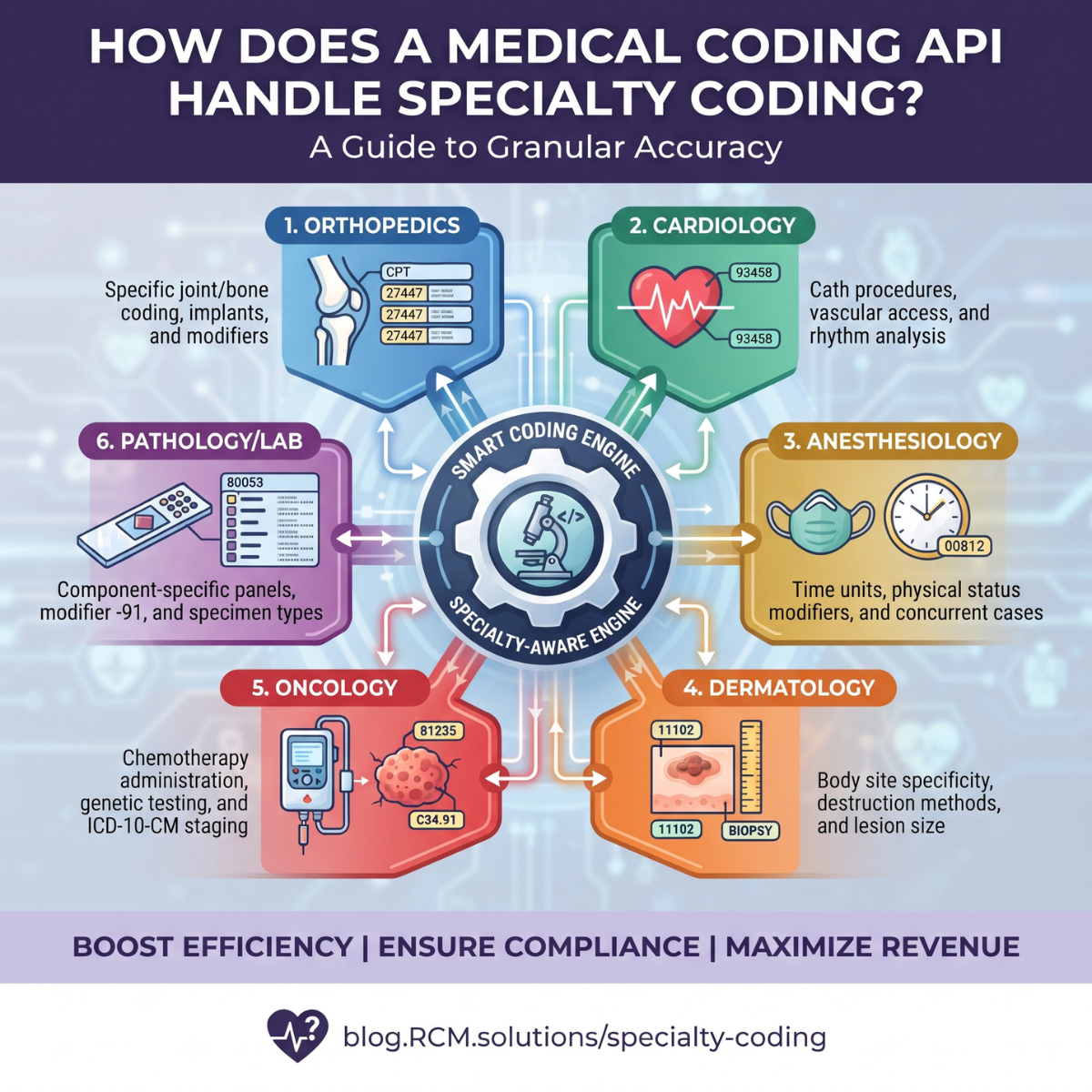
Medical coding is one of the most complex parts of healthcare revenue cycle management, particularly for medical practices that offer services across multiple specialties.
A dermatology clinic performs skin biopsies, lesion excisions, and destruction procedures. A cardiology practice provides diagnostic testing, evaluations, and cardiovascular procedures. An orthopedic clinic performs injections, surgical services, and fracture management. Behavioral health providers deliver psychotherapy, psychiatric evaluations, and medication management.
Although these specialties use standardized medical coding systems, they do not follow identical coding workflows.
Each specialty has unique documentation requirements, procedure descriptions, coding conventions, modifiers, and payer reimbursement considerations.
This creates a significant challenge for healthcare software providers and revenue cycle management teams.
How can a single medical coding API handle such different clinical and billing requirements?
The answer lies in combining standardized medical terminology with specialty-specific coding logic, structured clinical information, validation rules, and appropriate human oversight.
A well-designed medical coding API can support code selection, identify potential errors, validate code combinations, and help healthcare organizations prepare accurate claims.
However, an API does not automatically guarantee medical necessity, coding compliance, or insurance reimbursement.
Understanding how a medical coding API for specialty coding works is essential for developing reliable healthcare billing applications and improving revenue cycle performance.
What Is Specialty-Specific Medical Coding?
Specialty-specific medical coding is the process of translating clinical services into standardized medical codes while applying the documentation and reporting requirements relevant to a particular medical specialty.
Healthcare providers commonly use several coding systems.
ICD-10-CM identifies diagnoses and medical conditions.
CPT describes medical procedures and professional services.
HCPCS Level II identifies certain products, supplies, medications, and services.
ICD-10-PCS is used for procedure coding in applicable U.S. inpatient hospital settings.
While these coding systems are standardized, the clinical information needed to select the correct codes varies by specialty.
For example, dermatology procedure coding may require lesion measurements and anatomical location.
Behavioral health coding may depend on documented psychotherapy time.
Cardiology coding may require identifying whether a diagnostic service includes interpretation, technical performance, or both.
An orthopedic encounter may require laterality, fracture characteristics, treatment type, and applicable global surgical rules.
Specialty coding therefore involves more than selecting a code from a database.
It requires applying the correct coding instructions to the documented clinical circumstances.
Why General Medical Coding APIs Are Not Always Enough
A basic terminology API may answer questions such as:
Is this ICD-10-CM code valid?
What does this CPT code represent?
Is this HCPCS code active?
What version of the code set applies?
These functions are useful, but they do not necessarily establish that a code is appropriate for a particular encounter.
For example, a general coding API may confirm that a procedure code exists.
However, it may not determine whether the dermatologist documented the required lesion measurements or whether the procedure is separately reportable.
Similarly, a cardiology code may be valid but require additional review to determine whether the practice performed only the professional component or the complete diagnostic service.
A specialty-aware integration adds a clinical and billing rules layer.
This layer evaluates encounter details against the documentation and coding requirements relevant to the services being reported.
The result is a more useful coding workflow that can identify potential problems before claim submission.
1. How a Medical Coding API Identifies the Specialty
The first step is understanding the clinical context of the encounter.
A coding system may receive specialty information from the EHR, practice management system, provider profile, service department, or encounter record.
For example, the provider's registered specialty might identify the practice as dermatology, cardiology, orthopedics, or behavioral health.
However, specialty identification should not rely exclusively on the provider's classification.
A primary care provider may perform minor procedures.
A cardiologist may provide general E/M services.
A multi-specialty clinic may have several departments involved in one patient's care.
Therefore, the system should also evaluate the actual services performed, clinical documentation, procedure type, and encounter setting.
A well-designed integration uses specialty information to select relevant validation rules without assuming that every service follows the same coding pathway.
2. How Specialty Coding Rules Are Applied
A specialty-aware coding system combines general code validation with rules relevant to particular procedures and services.
For example, the rules engine may check whether a dermatology procedure requires lesion size documentation.
For cardiology, it may flag diagnostic services requiring professional and technical component review.
For behavioral health, it may identify services that require time documentation.
For orthopedics, it may flag missing laterality or possible global surgical period considerations.
These checks usually rely on structured information, terminology resources, coding references, and configurable validation logic.
An important distinction is that not every medical coding API contains a complete specialty rules engine.
Some vendors provide terminology lookup only.
Others offer computer-assisted coding, procedure editing, documentation validation, or payer-specific claim rules.
Healthcare organizations should verify which functions are actually included before selecting a vendor.
3. Dermatology Coding: Lesions, Biopsies, and Procedures
Dermatology is particularly dependent on accurate procedure documentation.
Common services include skin biopsies, lesion destruction, excisions, shave removals, injections, and surgical repairs.
A specialty-aware coding system may evaluate:
- Procedure performed
- Anatomical location
- Number of lesions
- Lesion measurements
- Treatment method
- Documented diagnosis
- Separate procedure sites
- Relevant modifiers
Consider a patient receiving a biopsy of one skin lesion and destruction of another lesion.
The application may identify that two procedures were documented and flag the claim for review under the applicable coding rules.
However, it should not automatically assume that both procedures are separately payable.
The coder must confirm whether the services were distinct, medically necessary, appropriately documented, and separately reportable.
For certain procedure combinations, a modifier may be appropriate when supported by current coding instructions.
The API's purpose is to identify coding requirements and potential conflicts, not automatically maximize the number of billed procedures.
4. Cardiology Coding: Diagnostic Services and Components
Cardiology coding involves a combination of office visits, diagnostic tests, interpretations, procedures, and monitoring services.
Certain diagnostic tests have professional and technical components.
The professional component generally relates to physician interpretation and reporting.
The technical component generally relates to the performance of the test, including applicable equipment and technical resources.
For eligible codes, Modifier 26 identifies the professional component, while Modifier TC identifies the technical component.
However, not every diagnostic code permits these modifiers.
Some codes separately describe interpretation or technical performance, while others have different reporting structures.
A specialty-aware coding API may flag these distinctions based on the selected code and documentation.
For example, if an external facility performs a diagnostic test and a cardiologist separately provides a qualifying interpretation, the billing workflow must determine which service was actually delivered and how it should be reported.
The API can assist with code selection and component validation.
It cannot assume that a practice performed both components merely because it reviewed the results.
5. Orthopedic Coding: Laterality and Surgical Rules
Orthopedic coding often requires precise information about anatomical structures, injuries, treatment methods, and surgical services.
Common coding considerations include:
- Right or left anatomical location
- Fracture characteristics
- Open or closed treatment
- Surgical procedure details
- Injection and medication administration
- Imaging services
- Global surgical periods
- Follow-up care
- Applicable modifiers
For example, an orthopedic provider may treat a fracture and schedule follow-up visits during the postoperative or global treatment period.
Not every follow-up encounter is separately reportable.
The coding system must evaluate the selected services against applicable global surgical and payer rules.
An API may also flag missing laterality or incomplete procedure descriptions.
However, it should not infer the correct anatomical side from unrelated data.
When documentation is unclear, the claim should be routed for clinical clarification.
This helps prevent unsupported coding and unnecessary payer denials.
6. Behavioral Health Coding: Time and Service Type
Behavioral health coding frequently involves time-based services, including psychotherapy.
Different services may require different documentation.
For example, psychiatric diagnostic evaluation, individual psychotherapy, group psychotherapy, and psychotherapy provided with an E/M service have distinct coding considerations.
A specialty-aware API can identify whether the selected service requires documented duration.
It may also flag situations where psychotherapy is billed alongside an E/M service and the work must be separately identifiable.
For example, when psychotherapy and E/M services are reported together under applicable rules, the psychotherapy time must be distinguished from the time used for E/M reporting.
The integration can check whether the required information is present.
However, it cannot establish the actual clinical service duration unless that information is accurately recorded.
Automated systems should never invent treatment time to support a higher-paying code.
The purpose of behavioral health coding automation is to improve documentation completeness and code accuracy.
7. Gastroenterology Coding: Multiple Procedures and Bundling
Gastroenterology includes diagnostic and therapeutic procedures such as endoscopy, colonoscopy, biopsy, and lesion removal.
These services may involve complicated procedure relationships.
For example, multiple techniques may be performed during one endoscopic encounter.
The billing system must determine whether the documented procedures are separately reportable under current coding conventions.
A specialty-aware API may identify relevant procedure-to-procedure edits.
It may also flag potentially bundled codes or modifier questions.
However, a modifier should not be added simply because the system detects a bundling edit.
The documentation must support any claimed distinction between procedures.
This is particularly important because the same encounter may include several clinical activities that are not all separately billable.
Accurate gastroenterology coding requires understanding the procedure performed and the specific reporting rules that apply.
8. Endocrinology Coding: Chronic Care and Monitoring
Endocrinology practices commonly manage diabetes, thyroid disorders, metabolic conditions, and other chronic diseases.
Their billing workflows may involve E/M services, medication management, diagnostic testing, diabetes education, and certain monitoring services.
For example, continuous glucose monitoring-related services have specific coding and documentation requirements.
The system must distinguish between applicable technical services, data interpretation, and other clinical management work.
An API can help validate selected codes and identify whether additional coding review is needed.
However, it should not automatically generate a separately billable monitoring charge whenever glucose data appears in the clinical record.
The service must meet the relevant code requirements and be supported by actual documented work.
For endocrinology, specialty coding automation is most valuable when it connects structured clinical information with appropriate service definitions and payer rules.
9. Radiology Coding: Professional and Technical Components
Radiology is another specialty where component-based billing is important.
Certain diagnostic services involve both technical performance and professional interpretation.
Depending on the service, billing arrangement, and payer requirements, the components may be reported together or separately.
A medical coding API can identify whether a selected code supports professional or technical component modifiers.
It can also flag inconsistencies between documented services and selected billing options.
For example, if one organization performs the technical portion of a diagnostic examination while another physician provides the interpretation, the claim must reflect the actual services performed.
A system should not automatically assign a global service simply because both components exist within the same coding family.
Accurate component reporting helps reduce inappropriate duplicate billing and reimbursement disputes.
10. Primary Care Coding: E/M and Same-Day Procedures
Primary care practices commonly deliver evaluation and management services alongside minor procedures, testing, and injections.
A major coding consideration is whether a separately billable E/M service is supported when another procedure occurs on the same date.
Modifier 25 may be appropriate when a significant, separately identifiable E/M service is performed in addition to a procedure.
However, the routine evaluation associated with performing a minor procedure generally does not automatically justify separate E/M billing.
A specialty-aware coding system may identify the combination and request review.
It can check whether the documentation contains information relevant to the separate E/M service.
The final decision must be based on the clinical record and applicable coding requirements.
Automatic use of Modifier 25 on every same-day E/M and procedure claim is not appropriate.
11. How APIs Handle CPT and ICD-10-CM Codes
A medical coding API generally relies on recognized terminology databases and coding resources.
For diagnosis coding, the application may validate an ICD-10-CM code against the appropriate release.
For procedure coding, it may retrieve CPT or HCPCS information from licensed or authorized sources.
However, code validity is only the first step.
For example, an ICD-10-CM code may be valid but insufficiently specific for the documented condition.
A CPT code may be active but describe a different procedure from the one performed.
A diagnosis and procedure may also require review under relevant coverage requirements.
The integration should therefore combine terminology validation with clinical context and coding instructions.
CPT licensing is particularly important.
Because CPT content is copyrighted by the American Medical Association, software vendors must obtain appropriate licensing for their intended use.
12. How APIs Handle Specialty-Specific Modifiers
Modifiers communicate additional information about how a procedure or service was performed.
Different specialties use different modifiers depending on the clinical circumstances.
Examples include:
Modifier 25: Significant, separately identifiable E/M service on the same date as another procedure or service.
Modifier 59: Distinct procedural service when applicable coding requirements are satisfied.
Modifier 26: Professional component of an eligible service.
Modifier TC: Technical component of an eligible service.
Other modifiers may address anatomical location, bilateral services, repeat procedures, surgical circumstances, or specific payer requirements.
A coding API can identify modifier compatibility and flag combinations requiring review.
However, it should not select modifiers based only on expected reimbursement.
Every modifier must be supported by the documented services and applicable coding instructions.
13. How National Correct Coding Initiative Edits Work
The National Correct Coding Initiative, or NCCI, provides Medicare coding edits intended to prevent certain improper payments.
Two important edit categories are:
Procedure-to-Procedure Edits (PTP): Identify code combinations that may not be separately reportable.
Medically Unlikely Edits (MUE): Address units of service reported under particular circumstances.
CMS updates NCCI edit files at least quarterly.
A coding platform may incorporate these edits into its validation workflow.
For example, when two procedure codes appear on the same claim, the system may identify whether an applicable edit exists.
The application should also examine whether the edit permits an appropriate modifier under the documented circumstances.
NCCI edits are not medical necessity determinations or prior authorization checks.
Commercial payers may also apply different editing policies.
This is why a medical coding API should not treat Medicare edits as a universal payment decision for every insurance plan.
14. How FHIR Supports Specialty Coding Integration
FHIR, or Fast Healthcare Interoperability Resources, is an HL7 standard used to exchange structured healthcare information.
FHIR terminology operations can support coding services.
For example:
CodeSystem $lookup retrieves information about a code.
CodeSystem $validate-code checks code validity.
ValueSet $expand retrieves concepts included in a value set.
ConceptMap $translate supports mappings between terminology systems.
A multi-specialty RCM platform may use these capabilities to connect EHR terminology with billing code references.
However, terminology mapping does not automatically establish a correct billing code.
A SNOMED CT clinical concept may not correspond directly to one billable ICD-10-CM diagnosis without additional context.
Similarly, an API's ability to validate a code does not establish that the clinical documentation supports it.
FHIR facilitates interoperability, while specialty coding rules provide additional clinical and billing context.
15. Why Code Versions and Service Dates Matter
Medical coding standards change regularly.
A code that is valid today may not have been valid for an earlier encounter.
Similarly, a code used in a previous year may have been revised or deleted.
For example, the FY 2027 ICD-10-CM release became effective October 1, 2026.
HCPCS Level II releases also receive periodic updates, and NCCI edits are updated at least quarterly.
A reliable coding API should validate codes using the appropriate service date and applicable code-set version.
This is particularly important for corrected claims and appeals involving older encounters.
Validating a historical claim exclusively against the latest code set can produce incorrect results.
Healthcare software providers should maintain version-aware validation and preserve relevant coding decisions for auditing.
16. How APIs Handle Payer-Specific Coding Rules
A code may be correctly selected and still fail a payer's reimbursement requirements.
Insurance plans may have different coverage policies, prior authorization requirements, frequency restrictions, modifier rules, and documentation standards.
For example, a diagnostic procedure may be covered by one payer but require additional authorization under another plan.
A specialty-aware RCM system should connect general code validation with payer-specific policy checks.
However, not every medical coding API includes payer policy functionality.
Some integrations require a separate claim editing or payer rules engine.
The system should distinguish between a valid code, a properly documented service, and a service that satisfies known payer coverage requirements.
Even after these checks, the payer makes the final adjudication determination.
A medical coding API can help prevent avoidable errors, but it cannot guarantee reimbursement.
17. How a Specialty-Aware Coding API Fits Into RCM
A specialty coding integration typically connects several stages of the revenue cycle.
The process begins when clinical documentation becomes available.
The EHR sends relevant encounter information to the coding workflow.
The integration identifies the relevant services and applicable specialty context.
The coding API retrieves terminology information, validates selected codes, or returns coding suggestions.
A specialty rules engine evaluates applicable code combinations, documentation requirements, and other relevant edits.
Complex or uncertain cases are routed to qualified coding professionals.
Approved codes are then transferred to claim preparation and claim scrubbing.
A typical workflow follows this sequence:
Clinical Documentation → Specialty Identification → Coding API → Specialty Rules Engine → Human Coding Review → Claim Scrubbing → Claim Submission.
The application should record the results of validation and the final coding decisions.
This creates a more transparent and auditable process.
18. Example: Dermatology Specialty Coding Workflow
Consider a patient who receives an office evaluation and a skin biopsy.
The EHR records the symptoms, examination findings, assessment, procedure information, and treatment plan.
The coding integration identifies the documented procedure and retrieves relevant coding references.
The specialty rules engine evaluates whether required details are present.
If an E/M code is also proposed, the system flags the encounter for review of the separately identifiable service requirements.
The coder then evaluates the clinical documentation.
If the record supports both services, appropriate codes and modifiers may be selected.
If the E/M work consists only of routine procedural evaluation, separate billing may not be supported.
The API assists by highlighting the relevant decision points.
The qualified coder determines what is actually reportable.
19. How Specialty Coding APIs Reduce Errors
Specialty-aware coding integrations can support more consistent billing by identifying potential problems earlier.
Examples include:
- Invalid or outdated codes
- Missing anatomical details
- Incomplete time documentation
- Potentially incompatible procedure codes
- Billing-unit inconsistencies
- Modifier combinations requiring review
- Possible documentation deficiencies
- Payer policy mismatches
These checks can reduce repetitive manual review for straightforward cases.
They may also help coding teams focus on encounters requiring specialized judgment.
However, automation should not be judged only by the number of suggested codes or alerts generated.
Excessive false alerts can create additional work.
A useful system identifies meaningful problems with sufficient context for employees to resolve them efficiently.
20. Why Human Coding Oversight Still Matters
Medical coding requires more than matching clinical phrases to code descriptions.
Coders must interpret documentation, apply official coding guidelines, and evaluate whether services are separately reportable.
Some situations involve unclear clinical information or complex procedure relationships.
For example, determining whether multiple procedures meet distinct-service requirements may require a detailed review of the medical record.
Similarly, behavioral health coding may require confirming the actual service duration and identifying time that cannot be counted twice.
An automated system should flag uncertainty rather than invent missing details.
Coding professionals should be able to approve, reject, or modify suggested codes based on documented evidence.
The system should retain an audit trail of decisions.
Human oversight is essential for maintaining clinical accuracy and billing compliance.
21. Protecting Patient Information During API Processing
Specialty coding APIs may process sensitive clinical information.
When an integration creates, receives, maintains, or transmits protected health information on behalf of a HIPAA-covered entity or business associate, applicable HIPAA obligations must be considered.
Developers should minimize unnecessary patient information transmitted to external coding services.
For example, validating whether a procedure code is active may not require identifying patient information.
More advanced documentation-based coding services may require protected clinical data.
Those integrations require appropriate risk assessment and vendor review.
Security controls should include authenticated API access, protected communication, appropriate permissions, audit logging, and secure credential management.
A Business Associate Agreement may be required depending on the vendor's role and data processing relationship.
Healthcare organizations should not assume that every coding API is automatically HIPAA compliant.
22. Measuring Specialty Coding API Performance
After implementation, healthcare organizations should measure the integration's impact.
Important performance indicators include:
Coding-Related Denial Rate: Tracks denials associated with coding issues.
Code Validation Accuracy: Measures whether the system correctly identifies coding validity and relevant errors.
Manual Review Rate: Tracks how frequently encounters require qualified coder intervention.
Coding Turnaround Time: Measures time between completed documentation and coding approval.
Coder Override Rate: Measures how frequently suggested results are changed by coding professionals.
Claim Correction Rate: Tracks claims requiring coding-related corrections.
Specialty-Specific Error Trends: Identifies coding problems by specialty, provider, or procedure category.
API Response Time and Availability: Measures technical performance and reliability.
Performance should be compared with pre-integration results.
For example, a practice may evaluate whether dermatology procedure denials decrease after implementing better lesion documentation checks.
A cardiology department may monitor whether professional and technical component errors decline.
These results help determine whether the API is improving actual revenue cycle performance.
23. Common Specialty Coding API Integration Mistakes
Several implementation mistakes can reduce the value of specialty coding automation.
Treating every specialty identically: Ignores different clinical documentation and coding requirements.
Relying only on code lookup: Valid codes do not automatically represent correctly reported services.
Ignoring procedure bundling: Creates potential claim editing problems.
Automatically adding modifiers: Risks unsupported billing and compliance exposure.
Using outdated code sets: Can produce incorrect validation results.
Assuming all payer rules are identical: Overlooks payer-specific reimbursement requirements.
Skipping coding reviews: Allows unsupported automated suggestions to enter claims.
Failing to preserve clinical context: Produces unreliable terminology mappings.
Ignoring data security: Exposes sensitive patient information.
Failing to analyze denial trends: Prevents organizations from identifying whether automation is producing measurable improvements.
A successful integration requires technical accuracy, clinical context, and revenue cycle oversight.
24. A 30-Day Implementation Plan
Healthcare organizations can begin with a focused specialty coding API pilot.
Week 1: Assess Specialty Requirements
Identify the specialties and services included in the pilot.
Review existing coding workflows, documentation requirements, claim denials, and manual review processes.
Determine which code sets, coding references, and validation functions are necessary.
Week 2: Configure the Integration
Connect the selected API to the EHR or RCM integration layer.
Configure specialty-specific validation rules and appropriate code versions.
Establish error handling, audit logging, and human review workflows.
Week 3: Test Specialty Scenarios
Use synthetic or appropriately protected test encounters.
Evaluate examples involving dermatology procedures, cardiology diagnostic components, orthopedic laterality, and behavioral health time documentation.
Have qualified coders review the results.
Week 4: Launch a Controlled Pilot
Begin with a limited set of providers or services.
Monitor coding errors, review time, alert quality, and technical performance.
Collect feedback from coding and billing teams.
Expand only after validation demonstrates that the integration is reliable.
This 30-day plan is an illustrative pilot approach, not a guaranteed implementation timeline.
Frequently Asked Questions
Can one medical coding API handle multiple specialties?
Yes, if the API and surrounding integration support the relevant code sets, clinical information, specialty-specific rules, and validation capabilities.
Does a medical coding API automatically select the correct CPT codes?
Some services offer automated suggestions, but the final coding decision must remain supported by clinical documentation and applicable coding instructions.
Can specialty coding APIs identify missing modifiers?
They may flag modifier requirements or inconsistencies. However, modifiers should only be applied when the documented circumstances and coding rules support them.
Does specialty-aware coding eliminate claim denials?
No. It may reduce preventable coding errors, but payer coverage decisions, authorization problems, documentation issues, and other factors can still produce denials.
What is the difference between a coding API and a specialty rules engine?
A coding API may provide terminology lookup, validation, mapping, or suggestions. A specialty rules engine applies additional clinical and billing logic to the relevant encounter.
Is a medical coding API suitable for multi-specialty practices?
Yes. Multi-specialty organizations can benefit from centralized coding infrastructure combined with configurable specialty workflows and consistent oversight.
Final Thoughts
A medical coding API handles specialty coding by connecting standardized medical code sets with clinical information and relevant coding rules.
However, specialty-specific billing requires more than checking whether a diagnosis or procedure code exists.
Dermatology may require lesion-specific documentation.
Cardiology may involve professional and technical billing components.
Orthopedics may require anatomical details and surgical coding considerations.
Behavioral health may depend on documented service time.
Other specialties introduce their own documentation, procedure, and payer requirements.
A reliable coding integration must support these differences while maintaining consistent validation, code version management, security, and professional oversight.
For healthcare organizations, the greatest value comes from connecting specialty coding with clinical documentation, charge capture, claim scrubbing, and denial analysis.
The objective is not to replace medical coders with an API. It is to help qualified professionals identify errors earlier, apply coding requirements consistently, and prepare more accurate claims.
When implemented correctly, specialty-aware medical coding technology can improve billing efficiency, reduce repetitive work, strengthen coding consistency, and support a more reliable revenue cycle.
The strongest medical coding systems do not treat every specialty the same.
They use standardized coding foundations while recognizing the clinical and billing requirements that make each specialty different.