
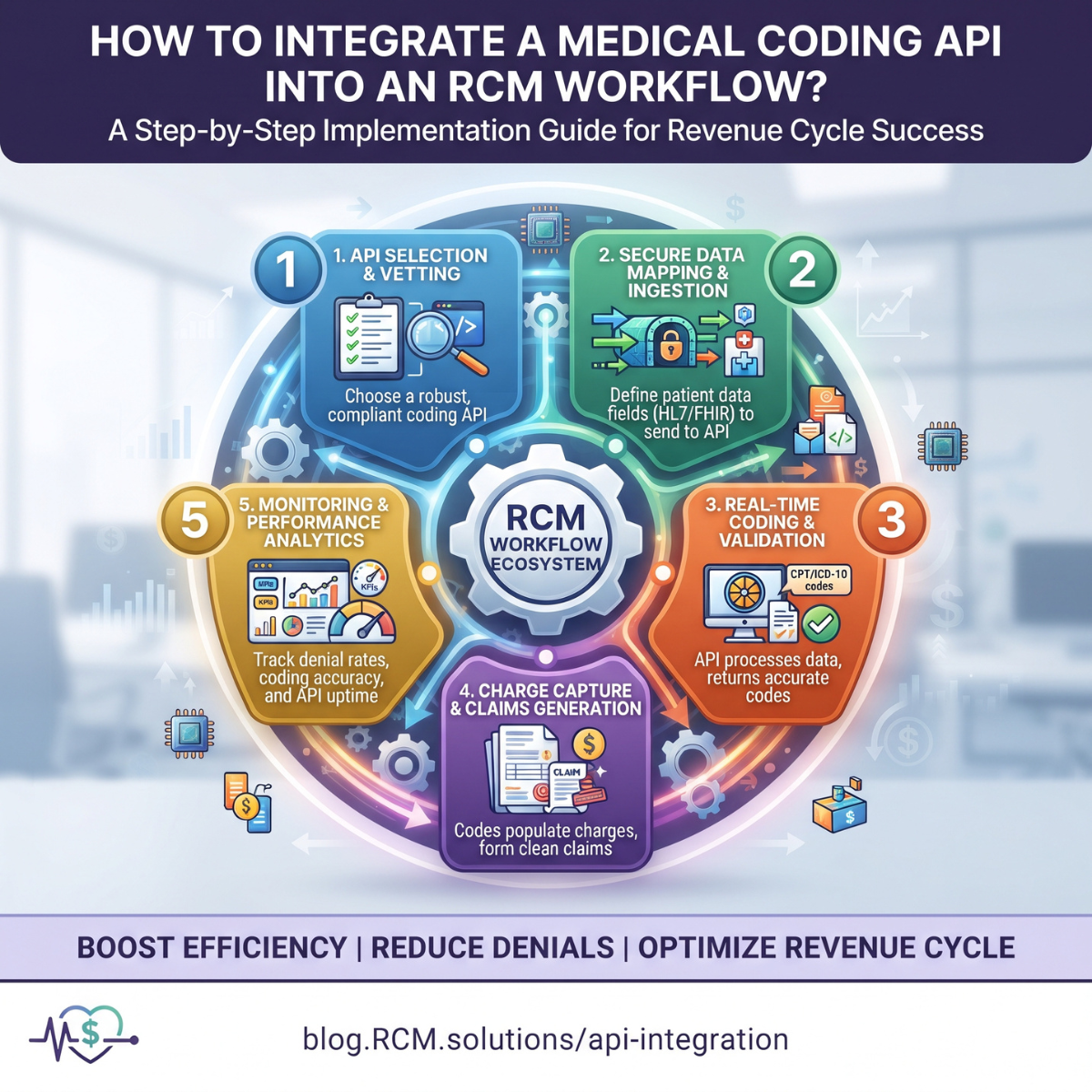
Healthcare revenue cycle management is becoming increasingly dependent on accurate data exchange, automated validation, and connected billing systems.
Medical practices, hospitals, and billing companies manage enormous amounts of clinical and financial information every day. From patient encounters and diagnoses to procedures, charge capture, coding, and insurance claims, every stage requires precise information.
A single coding error can delay payment, create a claim denial, or increase administrative workload.
For example, a provider may document a procedure correctly, but the billing system could contain an outdated CPT code, an unsupported diagnosis code, or an incorrect modifier. The claim may then require correction before reimbursement can be processed.
This is where medical coding API integration becomes valuable.
A medical coding API allows healthcare applications to connect with external coding databases, terminology services, and validation engines. Instead of relying entirely on manual searches or locally maintained code tables, revenue cycle management systems can retrieve coding information and apply validation rules directly within existing workflows.
However, connecting an API is only the beginning.
A successful integration must account for current code sets, clinical documentation, payer-specific requirements, data security, and human coding oversight.
This guide explains how to integrate a medical coding API into an RCM workflow, from selecting the appropriate service to testing, deployment, and ongoing optimization.
What Is a Medical Coding API?
A medical coding API is an application programming interface that allows healthcare software to access medical coding information or coding-related functionality.
Depending on the provider, a coding API may support diagnosis code searches, procedure code lookups, code validation, terminology mapping, coding suggestions, or claim editing.
Common coding systems include:
ICD-10-CM: Used to classify diagnoses and medical conditions for U.S. healthcare reporting and billing.
CPT: Used to describe medical procedures and professional services.
HCPCS Level II: Used for various products, supplies, equipment, and services not otherwise represented by CPT.
ICD-10-PCS: Used to report inpatient hospital procedures under applicable U.S. inpatient coding requirements.
Other terminologies, such as SNOMED CT and LOINC, may support clinical documentation and interoperability.
However, clinical terminology codes are not automatically interchangeable with billing codes.
For example, an EHR may use SNOMED CT to represent a clinical concept while the billing workflow requires an appropriate ICD-10-CM diagnosis code.
A coding API may help connect these systems, but coding decisions still require context and validation.
Why Medical Coding API Integration Matters for RCM
Medical coding sits between clinical documentation and claim submission.
After a patient receives care, the provider documents the encounter. The coding team identifies the applicable diagnoses and services. The billing department then uses this information to prepare the insurance claim.
When these systems are disconnected, employees may need to copy information between applications manually.
Manual workflows increase the risk of data entry errors, outdated codes, missed charges, and inconsistent billing information.
A coding API can make relevant coding information available directly within the RCM platform.
For example, the API may identify whether a diagnosis code is valid for the service date or whether a procedure code requires additional review.
This creates opportunities to detect problems before claims reach the payer.
The objective is not simply to automate code selection.
It is to improve billing accuracy, reduce avoidable rework, and support more consistent revenue cycle operations.
1. Identify Where the API Fits in Your RCM Workflow
Before selecting a medical coding API, determine which parts of the revenue cycle need improvement.
A typical RCM workflow includes:
Patient Scheduling → Insurance Verification → Clinical Documentation → Charge Capture → Medical Coding → Claim Scrubbing → Claim Submission → Payment Posting → Denial Management.
The medical coding API is most useful around clinical documentation, charge capture, coding review, and pre-submission claim validation.
For example, when a physician completes an encounter, the EHR may transfer diagnosis and procedure information to the coding module.
The coding API can then validate the relevant codes against the applicable code-set version.
If an issue is detected, the claim can be routed to a coder for review.
This is more effective than adding an API to the system without identifying a specific operational problem.
Start by evaluating coding delays, recurring denials, outdated code errors, and manual lookup requirements.
2. Define the Coding Functions Your Application Needs
Not every medical coding API offers the same capabilities.
Some APIs provide terminology search and validation.
Others support automated coding suggestions, clinical concept mapping, reimbursement edits, or payer-specific claim validation.
Before integration, identify which functions are necessary.
Common requirements include:
- Searching ICD-10-CM diagnosis codes
- Looking up CPT and HCPCS codes
- Validating code status and effective dates
- Identifying incomplete diagnosis codes
- Supporting code descriptions and references
- Reviewing procedure-to-procedure edits
- Checking billing units
- Supporting modifier review
- Mapping clinical terminology to billing terminology
- Identifying potential claim errors
A terminology lookup service is not the same as a full claim scrubbing engine.
Similarly, an AI-assisted coding service that proposes codes from clinical documentation does not automatically determine whether those services meet payer coverage requirements.
Define these functions separately before evaluating vendors.
3. Select a Reliable Medical Coding API Provider
Vendor selection should consider more than the size of the code database.
Healthcare organizations need accurate data, reliable availability, clear licensing rights, and appropriate security safeguards.
Evaluate whether the provider supports the coding systems relevant to your organization.
Confirm its update schedule and whether historical code versions remain accessible.
This matters because claims may be submitted or corrected long after the original date of service.
For CPT content, licensing deserves special attention.
The American Medical Association owns the copyrighted CPT code set and requires appropriate licensing for electronic products that use, reference, or display CPT content.
A vendor offering medical coding functionality should explain the scope of its licensing rights and whether those rights extend to your particular implementation.
Also review API documentation, response times, usage limits, technical support, pricing, and service-level commitments.
Avoid choosing a vendor based solely on claims of automated coding accuracy.
4. Understand FHIR Terminology APIs
FHIR, or Fast Healthcare Interoperability Resources, is a healthcare data exchange standard developed by HL7.
FHIR terminology services provide standardized mechanisms for working with code systems and value sets.
Common operations include:
CodeSystem $lookup: Retrieves information about a particular code.
CodeSystem $validate-code: Checks whether a code is valid within a specified code system.
ValueSet $expand: Retrieves concepts included in a value set.
ValueSet $validate-code: Checks whether a code belongs to a particular value set.
ConceptMap $translate: Supports mapping between code systems where suitable mappings exist.
These operations help applications exchange structured terminology information.
For example, an RCM system can use a terminology service to validate an ICD-10-CM code against the appropriate code version.
However, a valid code does not necessarily mean the diagnosis is supported by the patient's documentation.
Likewise, a terminology service does not automatically perform complete insurance claim validation.
FHIR provides a useful integration framework, but business rules and coding oversight remain essential.
5. Map Data Between the EHR and RCM System
A successful integration requires accurate data mapping.
The EHR may store clinical information in a different format from the billing application.
For example, a clinical diagnosis may be recorded using a structured clinical terminology, while the claim requires an ICD-10-CM code.
Similarly, a documented procedure may need to be translated into the appropriate claim-level procedure information.
The integration should identify which source fields correspond to each billing field.
Important information includes:
- Encounter identifier
- Date of service
- Encounter type
- Relevant diagnosis information
- Procedure details
- Rendering provider
- Service location
- Payer information
- Selected codes and modifiers
- Billing units
- Documentation references
Mapping should preserve clinical context.
A code should not be selected merely because its description resembles a phrase in the medical record.
When mapping is ambiguous, the system should flag the encounter for qualified review.
6. Design the API Integration Architecture
The architecture should allow coding services to communicate securely with the existing EHR and billing systems.
A practical workflow may follow this structure:
EHR → RCM Integration Layer → Medical Coding API → Validation Engine → Coder Review → Claim Scrubber → Clearinghouse.
The EHR supplies relevant encounter information.
The integration layer transforms the data into the format required by the coding service.
The API returns terminology information, validation results, or coding suggestions.
The validation engine combines those results with applicable coding and billing rules.
Claims requiring review are routed to a qualified employee.
Approved information then moves into claim preparation.
The integration layer should manage authentication, request validation, error handling, retries, and audit records.
Directly connecting every application to multiple external coding vendors can create unnecessary complexity.
A controlled integration layer generally offers better consistency and maintainability.
7. Connect Clinical Documentation to Coding Review
Clinical documentation provides the evidence supporting medical coding.
A medical coding API should not be used to generate final claim codes without considering the actual encounter.
For example, a dermatologist may document a lesion assessment and procedure.
The application may identify potential diagnosis and procedure codes based on structured information.
However, the coding team must confirm which services were performed, whether documentation supports them, and whether they are separately reportable.
When documentation is incomplete, the system should generate a clarification or review task.
Automated coding can assist with retrieving relevant information and identifying possible coding options.
It should not invent diagnoses, infer undocumented clinical decisions, or automatically change records to improve reimbursement.
Human oversight is especially important for complex procedures, E/M coding, and medical necessity issues.
8. Implement Date-Specific Code Validation
Medical code sets change over time.
An application that validates every claim against today's codes may incorrectly reject historical claims or overlook outdated codes.
For example, the ICD-10-CM fiscal year 2027 release became effective October 1, 2026, for the applicable reporting period.
CMS also publishes HCPCS Level II updates throughout the year.
The National Correct Coding Initiative updates relevant procedure-to-procedure and unit edits at least quarterly.
A reliable coding API integration should therefore support version-aware validation.
For each code, the system should consider the service date, code system, applicable version, effective date, and deletion or expiration status.
Historical claims should be validated using the rules appropriate to their service dates.
This is particularly important for corrected claims, appeals, and accounts receivable follow-up.
Code version management should be part of the integration design from the beginning.
9. Add Procedure Bundling and Unit Validation
Code validity is only one part of correct medical billing.
Two individually valid procedure codes may not be separately payable when reported together.
Similarly, a valid HCPCS code may be submitted with incorrect units.
CMS maintains the National Correct Coding Initiative to address certain improper coding combinations and unit-of-service problems.
NCCI includes procedure-to-procedure edits and Medically Unlikely Edits.
A medical coding integration may incorporate applicable edit data or connect with a licensed coding rules engine.
For example, a claim containing two potentially bundled procedures may be flagged for review.
However, the system should not automatically add Modifier 59 or another modifier simply to override the edit.
The coding team must determine whether a distinct procedural service is supported by documentation and applicable rules.
The goal is compliant billing, not automatic edit avoidance.
10. Integrate Coding Validation With Charge Capture
Charge capture is the process of recording legitimate billable services provided during a patient encounter.
An API can improve this workflow by supporting validation of recorded diagnoses, procedures, and billing units.
For example, a medical practice may administer a medication during an office visit.
The EHR records the administered dose and service information.
The billing system then prepares the corresponding charges.
A coding or validation engine can help identify whether the selected code is active and whether the billing units require review.
However, the system must distinguish an ordered service from a completed service.
A procedure should not automatically generate a claim charge simply because it was scheduled.
Likewise, a coding API cannot determine from terminology alone whether a supply or service is separately reimbursable.
Charge capture integration should confirm performance, documentation, coding rules, and payer requirements.
11. Connect the API to Claim Scrubbing
Claim scrubbing evaluates claims before electronic submission.
This is one of the most valuable points for coding API integration.
After coding review, the RCM system can run validation checks against the prepared claim.
These may identify invalid diagnosis codes, inactive procedure codes, inconsistent modifiers, incorrect billing units, and other applicable errors.
A comprehensive claim scrubber should also evaluate administrative information such as patient identifiers, provider details, payer selection, and authorization requirements.
However, coding APIs alone do not perform all these functions.
The integration should combine terminology validation with claim editing and payer-specific rules.
Claims that pass the required checks can proceed to submission.
Claims with unresolved issues should enter a review queue.
This helps prevent avoidable errors without allowing software to make unsupported clinical coding decisions.
12. Understand Payer-Specific Coding Requirements
One of the biggest integration mistakes is treating code validity as proof of reimbursement eligibility.
A CPT code may be valid, but the patient's insurance plan may not cover that service.
A procedure may require prior authorization.
A diagnosis may not satisfy a particular payer's medical necessity policy.
A payer may also apply specific modifier, frequency, provider, or place-of-service requirements.
These rules go beyond basic terminology validation.
Therefore, the RCM workflow may require a separate payer rules engine or claim editing service.
The system should distinguish between:
Code validity: Is the code recognized and active for the relevant date?
Coding compliance: Is the code supported by documentation and applicable coding instructions?
Payer policy validation: Does the claim satisfy known payer-specific requirements?
Reimbursement determination: What does the payer ultimately decide during adjudication?
An API can support the first three areas, depending on its functionality.
It cannot guarantee the fourth.
13. Secure the Integration Under HIPAA
Medical coding integrations may process electronic protected health information.
If the integration operates for a HIPAA-covered entity or business associate, applicable HIPAA requirements must be addressed.
Security should begin with minimizing the information transmitted to external services.
A terminology lookup may need only a code, code-system identifier, and version.
It may not require the patient's name or entire medical record.
Clinical coding services that process encounter narratives may require additional sensitive information.
In those cases, organizations should perform an appropriate risk analysis and evaluate vendor business associate obligations.
Important safeguards include authenticated API access, protected communications, appropriate authorization controls, audit logging, and secure credential management.
Access tokens and API keys should not be embedded in client-side application code.
Sensitive request and response data should not be unnecessarily stored in application logs.
When required, an appropriate Business Associate Agreement must be established with vendors processing PHI.
14. Build Reliable Error Handling and Monitoring
External APIs can experience timeouts, network failures, invalid responses, or service interruptions.
The RCM workflow must account for these conditions.
A failed API request should not automatically be interpreted as an invalid medical code.
For example, if the terminology service becomes unavailable, the system should identify the validation status as pending or unavailable.
It should not incorrectly label the code as deleted.
Implement retry controls, reasonable timeouts, and appropriate fallback procedures.
Requests should be traceable through internal identifiers so that failures can be investigated.
Organizations should also avoid duplicate processing when requests are retried.
For high-risk validation failures, the application may need to stop the claim from progressing until the issue is resolved.
For lower-risk technical interruptions, an established manual review workflow may be appropriate.
The application should display clear error messages without exposing PHI or sensitive technical details.
15. Maintain Human Coding Oversight
Automated coding tools can improve efficiency, but they do not eliminate the need for professional coding judgment.
Medical coding requires interpreting documentation, selecting appropriate code specificity, evaluating procedure relationships, and applying official guidance.
Some coding decisions also depend on information that automated systems cannot reliably establish from structured fields alone.
For example, determining whether a separately identifiable E/M service is supported alongside a procedure requires documentation review.
Similarly, a terminology mapping may produce several plausible diagnosis codes.
The correct selection depends on the clinical record.
Coding API integration should therefore include a review process for uncertain, conflicting, or higher-risk results.
The system should allow authorized coders to approve, reject, or revise suggestions.
It should also record the final decision and the relevant supporting rationale.
Automation should assist professional judgment rather than conceal or replace it.
16. Connect Coding Results to Claim Submission
Once codes have been reviewed and approved, the results must be transferred accurately into the claim generation process.
For standard U.S. electronic professional and institutional claims, the adopted HIPAA electronic claim transaction standard includes the ASC X12 837.
FHIR terminology services and X12 claims serve different purposes.
FHIR may support clinical information exchange and terminology operations.
The 837 transaction carries standardized claim information to the payer or clearinghouse.
Therefore, an RCM system may need a transformation layer that maps approved coding information into the appropriate claim format.
Before submission, verify that diagnosis pointers, procedure codes, modifiers, units, service dates, provider identifiers, and other relevant fields are correctly populated.
The clearinghouse should then validate the transaction according to applicable submission requirements.
Claim acceptance must still be monitored after transmission.
17. Use Denial Data to Improve Coding Rules
The integration should not stop after claim submission.
Payer denials provide information about coding and workflow problems that may have escaped earlier validation.
For example, repeated denials involving a specific code combination may indicate a missing edit or outdated payer rule.
Recurring medical necessity denials may reveal documentation gaps or differences in payer coverage requirements.
The RCM system should capture relevant denial information and connect it to the original claim validation history.
This allows teams to investigate whether the issue originated in clinical documentation, code selection, charge capture, claim formatting, or payer processing.
Validated findings can then guide updates to coding rules and staff training.
However, payer denials should not automatically become new coding rules.
A payer may have made an incorrect determination.
Human review is necessary before modifying the validation engine.
18. Track Medical Coding API Performance
After deployment, organizations should measure whether the integration improves revenue cycle operations.
Important metrics include:
Coding Turnaround Time: Measures how long it takes to move from completed documentation to approved coding.
Invalid Code Error Rate: Tracks codes found invalid for the applicable service date.
Coding-Related Denial Rate: Measures denied claims associated with coding problems under a consistent definition.
Manual Review Rate: Tracks how frequently API results require human review.
API Availability: Measures whether the coding service remains accessible during required operating periods.
Validation Response Time: Tracks how quickly the API returns results.
Coder Override Rate: Measures how often qualified coders revise or reject suggested coding results.
Claim Rework Rate: Tracks claims requiring correction because of coding or validation issues.
Practices should compare results with a pre-integration baseline.
A lower API response time is useful, but it does not establish financial improvement by itself.
The real objective is better coding accuracy, fewer preventable claim problems, and more efficient billing operations.
19. Test the API Before Production Deployment
A medical coding integration should be thoroughly tested before processing live claims.
Testing should include valid codes, invalid codes, historical codes, inactive codes, missing fields, unexpected responses, and network interruptions.
It should also examine complex clinical and billing situations.
Examples include code combinations subject to bundling review, claims requiring modifiers, multiple diagnosis codes, and procedures with special billing-unit requirements.
Test data should be synthetic or appropriately de-identified unless there is a justified and compliant reason to use real patient information.
The test environment should also verify user permissions, logging, vendor authentication, and error handling.
A strong testing process includes review by both technical staff and qualified medical coding professionals.
Successful API connectivity is not enough.
The system must produce reliable results within actual revenue cycle workflows.
20. Create a 30-Day Integration Roadmap
Medical practices and healthcare software providers can begin with a phased integration plan.
Week 1: Assess Requirements
Identify the coding problems the organization wants to solve.
Review the current EHR, billing software, coding workflow, and claim scrubbing process.
Determine required code sets, historical version support, security requirements, and vendor licensing.
Establish baseline performance measurements.
Week 2: Build the Integration
Configure secure access to the selected coding API.
Implement data mapping and request validation.
Connect terminology lookup and code validation functions to a controlled RCM integration layer.
Establish error handling, logging, and review queues.
Week 3: Validate With Test Claims
Use synthetic or appropriately protected test encounters.
Test valid and invalid codes, historical service dates, code combinations, and technical failure scenarios.
Have coding professionals review results.
Resolve data mapping and validation problems before production.
Week 4: Pilot and Monitor
Deploy the integration to a limited workflow or specialty.
Monitor validation accuracy, coder review requirements, system availability, and claim processing outcomes.
Compare early performance with the original baseline.
Expand deployment only after the integration performs reliably.
Thirty days is an illustrative pilot roadmap, not a guaranteed implementation timeframe. Complex enterprise integrations may require more extensive development, certification, and security review.
Common Medical Coding API Integration Mistakes
Several mistakes can undermine an otherwise promising integration.
Using outdated code sets: Validates claims against obsolete coding information.
Ignoring CPT licensing: Creates intellectual property and contractual risks.
Sending unnecessary PHI: Increases privacy and security exposure.
Treating API suggestions as final codes: Removes necessary clinical and coding oversight.
Ignoring payer rules: Confuses code validity with reimbursement eligibility.
Skipping historical validation: Creates problems for corrected claims and appeals.
Weak error handling: Allows technical failures to disrupt billing.
Failing to monitor denials: Prevents the organization from learning whether coding validation is effective.
Overautomating modifiers: Risks unsupported coding and improper payment.
Measuring only API response speed: Overlooks the actual impact on billing accuracy and collections.
Successful integration requires attention to technical performance, coding quality, and revenue cycle outcomes.
Frequently Asked Questions
Can a medical coding API automatically assign CPT and ICD-10-CM codes?
Some commercial services provide automated code suggestions or computer-assisted coding features. However, capabilities vary, and final code selection must remain supported by documentation and applicable coding rules.
Is a medical coding API the same as a claim scrubbing API?
No. A terminology API may support code lookup or validation, while a claim scrubber evaluates additional billing rules, claim fields, and payer requirements. Some vendors combine these capabilities.
Can a coding API reduce medical claim denials?
It can help reduce preventable coding-related errors when implemented correctly. It cannot eliminate denials caused by eligibility, authorization, medical necessity, or other payer issues.
Does every coding API require a HIPAA Business Associate Agreement?
Not necessarily. Whether a BAA is required depends on the relationship and whether the vendor creates, receives, maintains, or transmits PHI as a business associate. A service receiving only non-PHI terminology requests may present a different situation.
Can a medical coding API connect with an existing EHR?
Often, yes, if the EHR and API provide compatible integration mechanisms. The exact implementation depends on available interfaces, data formats, permissions, and vendor restrictions.
How often should medical coding data be updated?
The integration should follow the applicable publication and effective-date schedules for each code set and related editing rules. For example, ICD-10-CM generally follows annual fiscal-year releases, while HCPCS Level II and NCCI edits also receive updates during the year.
Final Thoughts
Medical coding API integration can improve how healthcare organizations connect clinical documentation, code validation, charge capture, claim preparation, and billing workflows.
However, successful integration is not simply a matter of connecting an API endpoint to an existing application.
It requires accurate data mapping, appropriate terminology services, current code sets, payer-specific validation, secure information handling, and professional coding oversight.
Healthcare organizations should begin by identifying the problems they want the integration to solve.
They should then select a suitable provider, establish secure architecture, validate codes against the appropriate service dates, connect coding information to claim scrubbing, and measure performance after deployment.
The most important distinction is that an API can validate coding information without guaranteeing that the claim is medically supported, covered, or payable.
That is why medical coding automation must operate within a broader revenue cycle management framework.
When implemented correctly, a medical coding API can reduce repetitive manual work, improve coding consistency, identify potential errors earlier, and help billing teams prepare more accurate claims.
The objective is not to eliminate human coding expertise.
It is to give coding and revenue cycle professionals better tools for producing accurate, compliant, and efficient reimbursement workflows.