
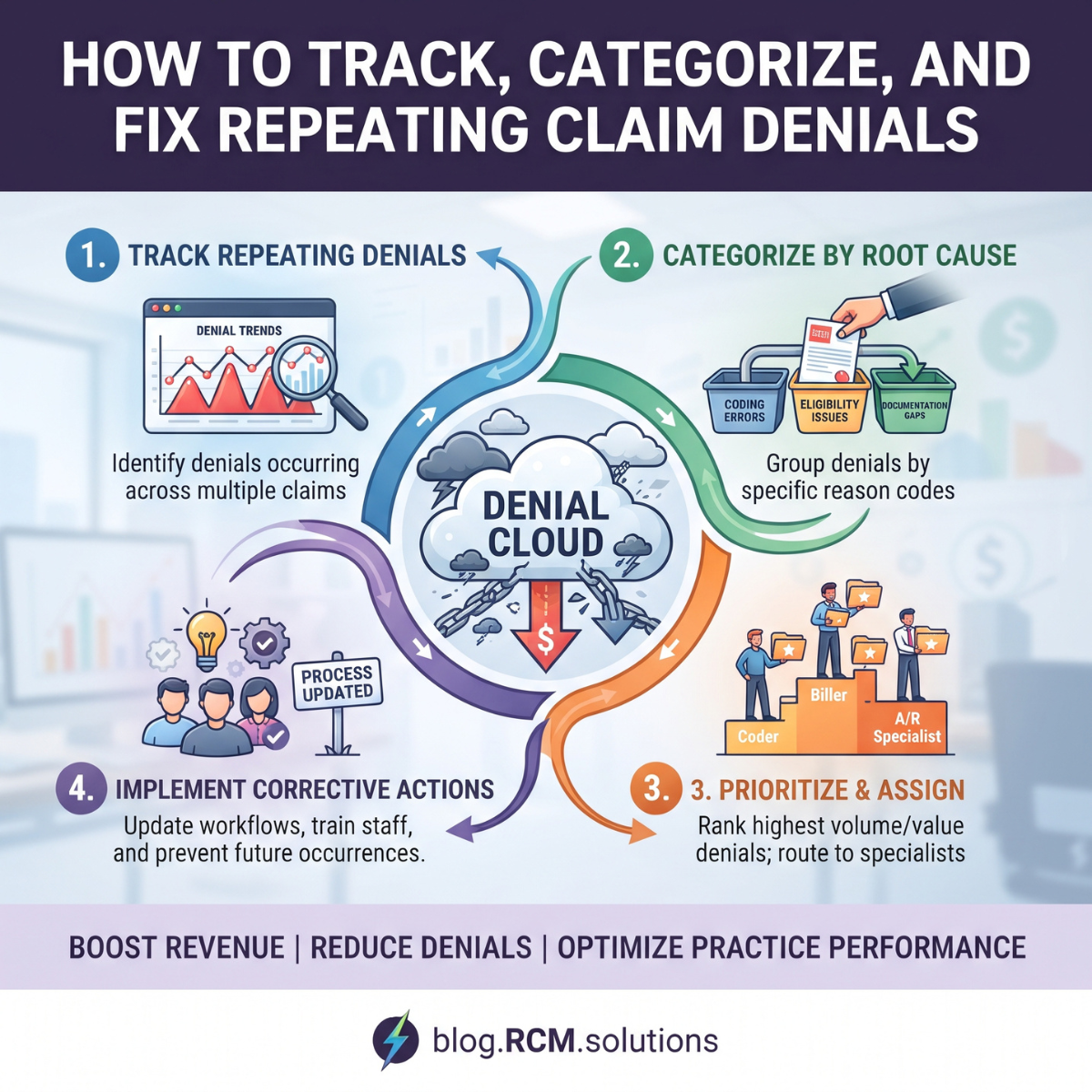
How to Track, Categorize, and Fix Repeating Claim Denials
Medical claim denials are a persistent challenge for healthcare practices, but repeated denials create an even bigger problem.
A claim gets denied because of missing authorization. The billing team corrects the issue and moves on. A few days later, another claim receives the same denial. The following month, the problem appears again across multiple providers.
The team continues correcting individual claims, but the underlying problem remains.
This is how repeating claim denials create unnecessary administrative work, delay reimbursement, and contribute to healthcare revenue leakage.
The real issue is not always that billing employees are failing to resolve denied claims. It is that the organization lacks a structured system for identifying patterns and preventing the same problems from recurring.
Effective claim denial management requires more than correcting unpaid claims. It requires tracking denial trends, categorizing errors, investigating root causes, assigning corrective actions, and measuring improvement.
According to the Healthcare Financial Management Association (HFMA), standardized denial metrics help healthcare organizations identify operational problems, improve claim resolution, and evaluate revenue cycle performance.
For growing medical practices, recurring denials should be treated as indicators of broader workflow problems rather than isolated billing incidents.
This guide explains how to track, categorize, and fix repeating claim denials through practical denial management strategies, payer-specific analysis, and continuous process improvement.
What Are Repeating Claim Denials?
Repeating claim denials occur when similar denial reasons continue appearing across multiple claims, patients, providers, or reporting periods.
For example, a dermatology practice may repeatedly receive denials for missing procedure modifiers.
A cardiology clinic may encounter recurring prior authorization denials for diagnostic services.
A primary care practice may experience frequent eligibility denials because insurance information is not being verified consistently.
These denials may involve different patients and claim numbers, but they share a common underlying problem.
It is also important to distinguish recurring denial patterns from repeat denials on the same claim.
A recurring denial pattern occurs when the same issue affects multiple claims.
A repeat denial on one claim occurs when a previously denied claim is corrected, reconsidered, or appealed and receives another unfavorable determination.
Both require attention, but they should be tracked separately.
The first indicates a potentially widespread process failure. The second may indicate an unresolved claim-specific problem.
Why Repeating Claim Denials Are Expensive
Every denied claim requires additional administrative work.
Billing staff must review the payer's response, investigate the reason, check documentation, contact the payer, submit corrections or appeals, and track the claim until resolution.
When the same denial occurs repeatedly, these activities consume time that could otherwise support clean claim submission and accounts receivable management.
The financial consequences include delayed cash flow, increased administrative costs, longer claim resolution times, potential appeal deadline failures, and permanent reimbursement losses.
For example, consider a practice receiving 30 authorization-related denials every month.
If each denial requires an average of 20 minutes of investigation and follow-up, the organization spends approximately 10 staff hours monthly on that category alone.
This is an illustrative calculation rather than an industry benchmark.
It also excludes additional appeals, provider communication, and payer follow-up.
The more important question is why those authorization-related denials continue happening.
If the underlying process is corrected, the organization may prevent future denials instead of repeatedly paying employees to resolve them.
Step 1: Create a Centralized Denial Tracking System
The first step in controlling repeating claim denials is establishing a reliable tracking system.
Practices cannot identify denial patterns when information is scattered across payer portals, emails, spreadsheets, and individual employee notes.
A centralized denial tracking system should capture every adjudicated denial in a consistent format.
Important data fields include:
- Claim and encounter identification
- Payer and insurance plan
- Provider and specialty
- Date of service
- Initial denial date
- Denied claim or service line
- CPT or HCPCS code
- Diagnosis code
- Claim adjustment reason code
- Remittance advice remark code
- Denial category
- Suspected root cause
- Expected collectible reimbursement
- Assigned employee
- Appeal or correction deadline
- Current resolution status
- Final outcome
Each record should have a unique identifier so the organization can monitor the claim throughout its lifecycle.
If the same claim receives multiple payer responses, the system should preserve that history without incorrectly counting every response as a new initial denial.
This distinction is essential for accurate reporting.
Step 2: Understand CARC and RARC Codes
Insurance payer remittance information is a primary source for denial analysis.
After adjudication, payers provide payment and adjustment details through electronic remittance advice or equivalent reporting.
These records use standardized code sets.
Claim Adjustment Reason Codes (CARCs) explain why a claim or service line was adjusted.
Remittance Advice Remark Codes (RARCs) provide additional information or clarification about payment processing.
Claim Adjustment Group Codes identify categories of financial responsibility, such as contractual obligations or patient responsibility.
The Centers for Medicare & Medicaid Services (CMS) explains that these codes work together to communicate payment adjustments.
Billing teams should review the complete combination rather than analyzing one code in isolation.
For example, a CARC may indicate that additional information is required, while a RARC provides more specific instructions.
However, not every financial adjustment is a denial. Contractual adjustments and other ordinary payment differences should not automatically be counted as denied claims.
The billing team must interpret remittance information in context.
Step 3: Categorize Denials Into Meaningful Groups
Denial codes are useful, but individual codes alone do not always reveal the operational problem.
Medical practices should organize denied claims into standardized categories.
Common categories include:
Eligibility Denials
These involve inactive coverage, incorrect insurance information, or other patient eligibility problems.
Prior Authorization Denials
These occur when required approval is missing, expired, invalid, or inconsistent with the service performed.
Medical Necessity Denials
These involve payer determinations about clinical coverage criteria or the adequacy of supporting documentation.
Coding and Modifier Denials
These involve procedure codes, diagnosis codes, modifiers, billing units, or coding-related payment policies.
Documentation Denials
These arise when records are missing, incomplete, or insufficient to support the claim.
Duplicate Claim Denials
These occur when the payer identifies repeated or overlapping billing that does not support additional reimbursement.
Coordination-of-Benefits Denials
These involve incorrect payer order or unresolved primary and secondary insurance information.
Timely Filing Denials
These arise when claims fail to meet applicable submission deadlines.
Provider Enrollment Denials
These relate to provider identifiers, enrollment status, service locations, or billing arrangements.
Practices should use consistent definitions for each category.
Without standardization, the same issue may be recorded as a coding denial by one employee and a documentation denial by another.
That inconsistency makes trend analysis unreliable.
Step 4: Distinguish Denial Reasons From Root Causes
One of the biggest denial management mistakes is assuming that the payer's denial reason identifies the underlying cause.
It often does not.
For example, a payer may deny a claim because prior authorization is missing.
However, several operational failures could have produced that result.
The scheduling team may not have recognized that authorization was required.
An authorization specialist may have obtained approval for the wrong procedure.
The provider may have changed the planned service without triggering another authorization review.
The billing system may have failed to transmit an existing authorization number.
All these situations can produce similar payer responses, but they require different solutions.
Therefore, denial tracking should include two separate fields:
Denial reason: What the payer reported.
Root cause: What actually went wrong in the practice or payer process.
This distinction turns denial reports into actionable information.
It also prevents organizations from repeatedly correcting claim symptoms while ignoring workflow failures.
Step 5: Analyze Denials by Payer, Specialty, and Provider
Once denial information is collected and categorized, the practice should look for patterns.
A useful analysis should answer questions such as:
Which payer generates the most recurring denials?
Which specialty experiences the highest authorization denial rate?
Are coding denials concentrated around particular CPT codes?
Are eligibility problems associated with one location?
Do certain procedures receive repeated medical necessity denials?
Are denials increasing after a payer policy change?
Analyzing total denial counts alone can be misleading.
A payer processing 5,000 claims may naturally generate more denials than a payer processing 200 claims.
The practice should compare denial rates using appropriate denominators.
For example, if Payer A denies 100 of 2,000 claims while Payer B denies 40 of 400 claims, their simplified claim-count denial rates are 5% and 10%, respectively.
Payer B has fewer total denials but a higher denial rate.
This difference helps management prioritize investigations based on actual performance rather than volume alone.
Step 6: Build a Denial Tracking Dashboard
A denial dashboard gives healthcare leaders a clearer view of recurring reimbursement problems.
It should show both overall financial performance and specific denial patterns.
Useful dashboard sections include denial volume, denial rates, denied dollars, denial categories, payer comparisons, provider trends, appeal performance, and unresolved denied balances.
A monthly trend chart can show whether authorization denials are increasing.
A payer comparison can identify insurance plans with unusually high denial rates.
A service-line analysis can reveal specific procedures affected by repeated coding or coverage problems.
The dashboard should also distinguish initial denials from subsequent appeals or repeated payer decisions on the same claim.
Otherwise, multiple denial events may inflate the reported initial denial rate.
The purpose of the dashboard is not simply to display attractive graphs.
It should help managers identify where investigation and corrective action are needed.
Step 7: Prioritize Recurring Denial Patterns
Not every recurring denial pattern carries the same financial or operational impact.
Medical practices should prioritize problems based on several factors.
These include denial frequency, expected recoverable reimbursement, appeal deadlines, administrative effort, and the likelihood that the issue can be prevented.
For example, a recurring denial affecting 60 low-value claims may deserve attention because of the volume of administrative work it creates.
A separate issue affecting five high-value surgical claims may require immediate attention because of the reimbursement at risk.
Priority should therefore consider both frequency and financial exposure.
Practices should also distinguish billed charges from expected collectible reimbursement.
A denied claim with $5,000 in billed charges does not necessarily represent $5,000 in recoverable revenue.
Contracted rates, payment rules, and applicable adjustments determine the amount that may legitimately be collected.
Step 8: Conduct Root Cause Analysis
Root cause analysis identifies why recurring errors continue happening.
Rather than accepting a denial category as the final explanation, the revenue cycle team investigates the workflow responsible for the problem.
One practical approach is the Five Whys method.
Consider a recurring authorization denial:
Why was the claim denied?
The payer did not have a valid authorization.
Why was authorization missing?
The required authorization was not requested.
Why was it not requested?
The scheduling team classified the appointment incorrectly.
Why was the appointment classified incorrectly?
The appointment categories did not distinguish services requiring authorization.
Why was that distinction missing?
The practice had no standardized authorization screening rules connected to scheduling.
The root cause is not simply missing authorization.
It is a scheduling workflow that fails to identify authorization requirements.
The corrective action should focus on the scheduling process, staff training, and authorization controls.
Root cause analysis prevents organizations from relying on temporary fixes that do not address the original problem.
Step 9: Fix Repeating Eligibility Denials
Recurring eligibility denials often indicate weaknesses in patient registration or insurance verification.
Common causes include outdated insurance information, incorrect subscriber details, inactive coverage, and incorrect payer selection.
The solution is to improve verification before the patient receives services.
Practices should establish a standard process for checking coverage and relevant benefits.
Registration employees should verify key patient details rather than automatically carrying forward information from previous visits.
Eligibility exceptions should be assigned to responsible staff before the appointment whenever possible.
The billing department should also share denial findings with patient access teams.
For example, if one location generates repeated eligibility denials, management should investigate its registration practices and system configuration.
Correcting the front-end issue can reduce future claims affected by the same problem.
Step 10: Fix Repeating Prior Authorization Denials
Prior authorization denials frequently occur when the practice lacks reliable tracking procedures.
Authorization requirements may vary by payer, specialty, procedure, and insurance product.
A successful prevention strategy begins with identifying which services require approval.
Practices should verify authorization details, including procedure codes, approved units, rendering provider, service location, and effective dates.
Authorization information should also be connected to the relevant encounter and claim.
In 2026, certain payers covered by the CMS Interoperability and Prior Authorization Final Rule are subject to additional decision timeframe and denial-reason requirements for applicable medical items and services.
These requirements are not universal, and the rule's particular provisions exclude drug authorizations.
Practices should use current payer policies when designing authorization workflows.
Repeated authorization denials should trigger a review of the original approval process rather than relying only on retrospective appeals.
Step 11: Fix Repeating Coding and Modifier Denials
Recurring coding denials may indicate outdated code references, documentation deficiencies, incorrect modifier usage, or payer-specific billing rules.
For example, a dermatology practice may receive repeated denials when Modifier 25 is used without sufficient documentation supporting a significant, separately identifiable E/M service.
A different practice may experience procedure bundling denials because modifier rules are being applied incorrectly.
Coding teams should review the specific CPT or HCPCS codes associated with recurring denials.
They should compare documentation against current coding guidance and payer requirements.
Corrective actions may include coder education, provider documentation training, updated claim editing rules, or targeted internal audits.
Automated billing software can identify potential errors, but qualified coding review remains necessary.
The objective is accurate, compliant reimbursement—not simply finding coding combinations that produce payment.
Step 12: Fix Repeating Medical Necessity and Documentation Denials
Medical necessity denials can be complex because they involve clinical coverage requirements.
Recurring denials may indicate that the practice is using unsupported diagnosis codes, failing to document necessary clinical findings, or misunderstanding payer coverage policies.
However, repeated medical necessity denials do not automatically mean the services were inappropriate.
The payer may have applied an incorrect policy or failed to consider relevant records.
The practice should investigate both possibilities.
Clinical and coding teams should review the documented indication for treatment, applicable coverage policies, and the information submitted with the claim.
When documentation supports the service, an appropriate appeal may be warranted.
When documentation is consistently incomplete, provider education and improved templates may be necessary.
Corrective actions must preserve clinical accuracy and avoid modifying records merely to satisfy reimbursement criteria.
Step 13: Assign Corrective Actions to the Right Department
A denial management team cannot prevent every recurring problem independently.
Many root causes originate outside the billing department.
Eligibility errors may require registration improvements.
Authorization denials may require changes in scheduling and authorization workflows.
Coding errors may require coder education or updated rules.
Documentation deficiencies may require provider training.
Payment disputes may require payer contract review.
Each recurring denial pattern should have a designated process owner.
A corrective action record should identify the problem, root cause, proposed solution, responsible department, implementation date, and expected outcome.
This creates accountability.
Without clear ownership, denial reports may repeatedly identify the same problems without producing meaningful operational changes.
Step 14: Create a Structured Denial Resolution Workflow
Preventing future denials is important, but practices must also resolve existing denied claims.
Each denial should move through an established workflow.
A practical process includes:
- Identify the denied claim.
- Review the payer's reason and supporting codes.
- Confirm whether the denial is valid.
- Investigate documentation and claim information.
- Determine the correct response.
- Submit a correction, reopening request, reconsideration, or appeal when appropriate.
- Track payer acknowledgment and response.
- Verify payment and adjustments.
- Record the final outcome.
- Update root-cause reporting.
Claims should not be resubmitted repeatedly without understanding the original denial.
Some payment disputes require corrected claims, while others require formal appeals.
For Original Medicare, eligible first-level redetermination requests generally must be filed within 120 days after receipt of the initial claim determination.
Other payer deadlines and procedures vary.
Each claim should have a defined next action and a responsible employee until final resolution.
Step 15: Measure Whether Corrective Actions Work
Implementing a new process does not automatically mean the original problem has been solved.
The organization must verify whether recurring denials decrease after the corrective action.
Suppose a clinic changes its authorization workflow after identifying repeated authorization denials.
Before the change, the practice experienced 24 authorization denials among 600 comparable claims, a rate of 4%.
After implementing the new workflow, it records 9 authorization denials among 600 comparable claims, a rate of 1.5%.
This represents a reduction of 2.5 percentage points, or a 62.5% relative decline.
These figures are illustrative.
Management should evaluate whether the improvement is sustained and whether changes in payer mix, services, or claim volume may explain part of the difference.
The goal is to demonstrate measurable improvement rather than assuming success because an employee completed the assigned task.
Step 16: Track Essential Denial Management KPIs
Medical practices need consistent performance indicators to evaluate recurring denial problems.
Important metrics include:
Initial Denial Rate
Measures claims receiving an initial denial relative to a defined claim population.
Denial Rate by Category
Measures denials involving eligibility, authorization, coding, medical necessity, and other categories.
Denial Rate by Payer
Helps identify differences in claims processing and reimbursement outcomes between insurance plans.
Recurring Denial Frequency
Tracks repeated occurrences of a defined denial pattern across claims or reporting periods.
Denied Dollars
Measures the financial value of denials using a consistent methodology.
Denial Overturn Rate
Measures the proportion of eligible denials successfully reversed through review or appeals.
Time to Denial Resolution
Tracks how long claims remain unresolved after the initial denial.
Denial Write-Off Rate
Measures reimbursement permanently written off because of denied claims.
Corrective Action Effectiveness
Compares denial performance before and after workflow changes.
HFMA has published standardized claim integrity metrics covering initial denials, denial write-offs, appeal timeliness, resolution time, and overturned denials.
Practices should apply consistent definitions when calculating and comparing performance.
Step 17: Use Automation to Identify Recurring Patterns
Revenue cycle management technology can help medical practices detect denial trends that may be difficult to identify manually.
An integrated denial management system may collect electronic remittance information, categorize claims, identify repeated denial combinations, assign follow-up tasks, and track payer responses.
Advanced reporting may highlight recurring problems by CPT code, payer, provider, specialty, or service location.
For example, the system may identify that the same authorization-related denial has occurred repeatedly for a specific imaging procedure.
That information can trigger a review of authorization requirements before additional claims are submitted.
Automation can also support appeal deadline alerts, work queue prioritization, and corrective action monitoring.
However, automatically grouping claims by reason code does not establish their root cause.
Human review remains essential for interpreting clinical documentation, payer policies, and underlying workflow problems.
Step 18: Establish Weekly and Monthly Denial Reviews
Recurring denials should be reviewed regularly rather than only when cash flow declines.
Weekly operational meetings can focus on high-priority denied claims, approaching appeal deadlines, unresolved payer responses, and immediate process problems.
Monthly management reviews should focus on broader patterns.
These may include:
- Changes in denial rates
- Highest-volume denial categories
- Payer-specific trends
- Recurring procedure denials
- Appeal outcomes
- Denial write-offs
- Root-cause findings
- Corrective action progress
Each recurring problem should have a documented owner and measurable follow-up.
Review meetings should produce decisions rather than simply repeat information from the dashboard.
The most important question is not how many denials occurred.
It is what the practice is changing to prevent the same problem from occurring again.
Step 19: Build a 30-Day Recurring Denial Reduction Plan
A medical practice can begin improving recurring denial management through a focused 30-day plan.
Week 1: Collect and Organize Denial Data
Gather recent remittance information, payer responses, and denial reports.
Separate rejected claims from adjudicated denials.
Standardize categories and identify the most common recurring patterns.
Establish baseline denial rates and financial exposure.
Week 2: Investigate Root Causes
Select the highest-priority recurring denial categories.
Review affected claims, clinical documentation, payer requirements, and administrative workflows.
Identify contributing factors and assign process owners.
Week 3: Implement Corrective Actions
Introduce targeted improvements.
These may include better insurance verification, authorization screening, coding education, documentation updates, or claim editing changes.
Train affected employees and document implementation dates.
Week 4: Monitor and Refine
Review new denial activity and corrective action progress.
Confirm that existing denied claims remain under active follow-up.
Evaluate early performance indicators and adjust procedures as necessary.
Some improvements will require longer observation periods before their effectiveness can be established.
The purpose of the first month is to create a repeatable improvement process.
Common Mistakes That Allow Claim Denials to Repeat
Medical practices often struggle with recurring denials because they focus on individual claim resolution without investigating broader trends.
Common mistakes include:
- Tracking denials without categorizing them
- Treating all adjustment codes as actual denials
- Counting repeated payer responses as new initial denials
- Ignoring payer-specific patterns
- Failing to distinguish symptoms from root causes
- Correcting claims without assigning preventive actions
- Using outdated payer policies
- Failing to monitor appeal deadlines
- Measuring denied charges instead of expected recoverable revenue
- Implementing changes without checking results
These mistakes create the appearance of active denial management without necessarily reducing future errors.
A high-performing revenue cycle requires reliable data, clear ownership, and measurable process improvement.
Frequently Asked Questions
What causes repeating claim denials?
Recurring denials may result from repeated eligibility errors, missing authorizations, unsupported coding, documentation deficiencies, payer policy misunderstandings, or unresolved workflow problems.
How should medical practices categorize denials?
Use standardized categories such as eligibility, authorization, coding, documentation, medical necessity, timely filing, and coordination of benefits. Track the operational root cause separately.
Which denial management metric is most important?
No single metric tells the complete story. Initial denial rate, recurring denial frequency, denied dollars, appeal outcomes, resolution time, and denial write-offs should be evaluated together.
Can denial management software automatically fix recurring denials?
Software can identify patterns, support validation, and route tasks, but clinical judgment, payer policy interpretation, and operational oversight remain necessary.
How often should practices review denial trends?
Daily operational monitoring, weekly work queue reviews, and monthly trend analysis are practical starting points. Review frequency should reflect claim volume and risk.