
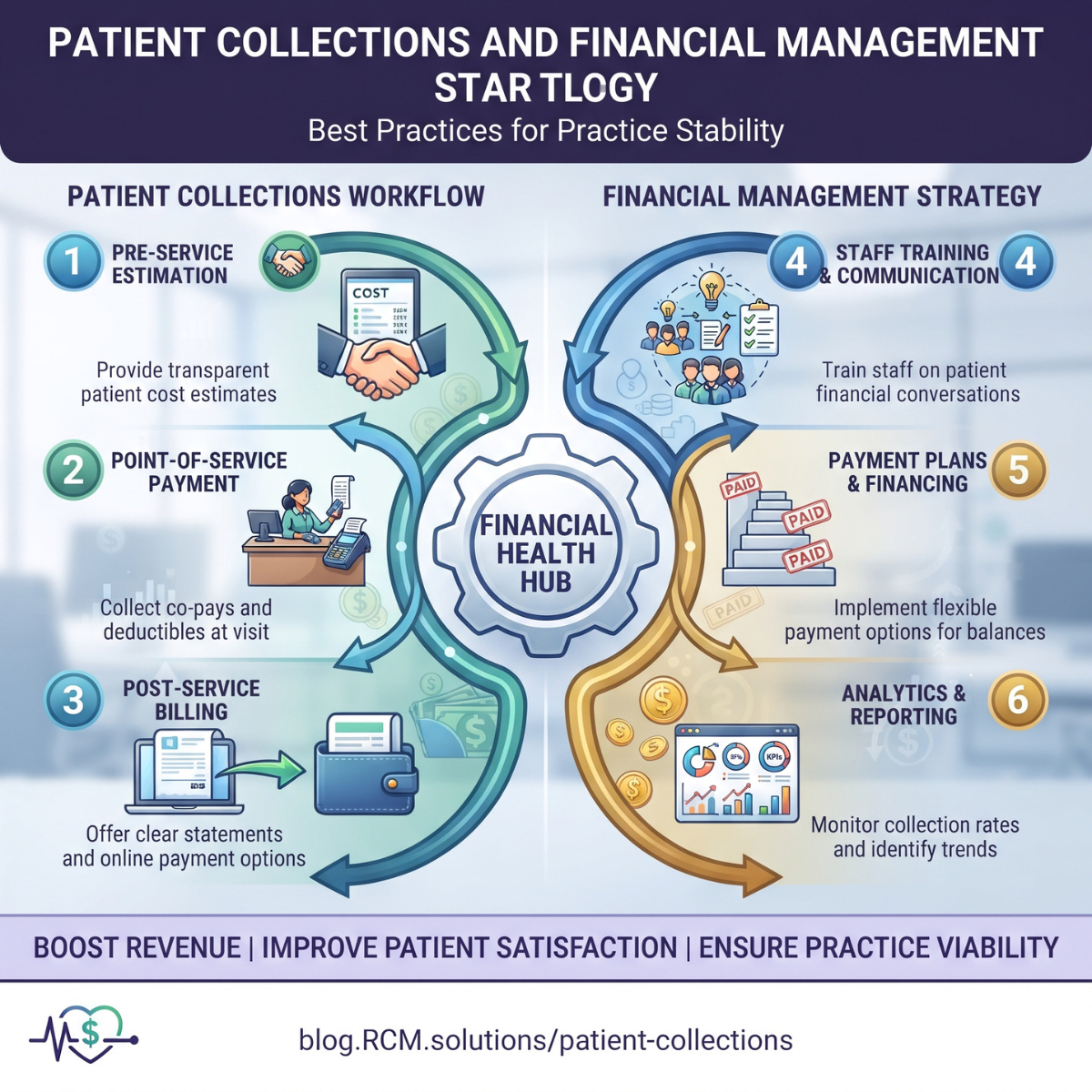
Patient collections and financial management are essential to maintaining a financially stable healthcare practice. Medical providers may deliver excellent care, submit insurance claims accurately, and receive timely payer reimbursement while still experiencing cash flow problems because patient balances remain unpaid.
As healthcare costs shift between insurers and patients through deductibles, copayments, and coinsurance, practices must manage patient financial responsibility with greater accuracy and transparency.
However, collecting patient payments is not simply about sending statements or requesting outstanding balances.
It requires a coordinated process that begins before an appointment and continues through insurance verification, patient financial counseling, billing, payment posting, and account resolution.
Poorly managed patient collections can lead to billing disputes, administrative expenses, aging accounts receivable, and lost reimbursement.
According to the Healthcare Financial Management Association (HFMA), effective patient financial communication should be clear, concise, accurate, and patient-friendly.
For healthcare organizations, successful patient collections and financial management require balancing appropriate revenue recovery with transparent communication and responsible patient billing practices.
This guide explains how to improve patient collections, manage financial operations, reduce avoidable payment delays, and strengthen revenue cycle performance.
What Are Patient Collections in Medical Billing?
Patient collections refer to the process of obtaining payments that patients are legally and contractually responsible for after considering insurance coverage, applicable adjustments, and other financial protections.
Patient responsibility may include:
- Copayments
- Deductibles
- Coinsurance
- Eligible non-covered services
- Self-pay charges
- Outstanding balances from previous encounters
For example, a patient may receive a covered service with a contracted allowed amount of $200.
If the insurance plan pays $160 and assigns $40 in coinsurance to the patient, the practice may bill the patient for the remaining $40, subject to applicable rules and other coverage.
The amount charged by the provider is not necessarily the amount collectible.
Insurance contracts, patient protections, and payer adjudication determine what the practice can appropriately collect.
Effective patient collections ensure that valid balances are accurately identified, communicated, and resolved.
Why Patient Collections Matter for Healthcare Financial Management
Patient collections directly influence a practice's cash flow, accounts receivable, and operating expenses.
Healthcare organizations depend on revenue to pay employees, maintain facilities, purchase supplies, invest in technology, and support ongoing patient services.
When patient balances remain unpaid, the practice may experience additional financial pressure even if insurance payments arrive regularly.
The problem becomes more complicated as patient volume increases.
A growing clinic may have hundreds of small outstanding balances spread across multiple payers, providers, and locations.
Individually, these balances may appear manageable.
Collectively, they can require substantial administrative effort.
Strong financial management connects patient collections with budgeting, revenue forecasting, payment reconciliation, cost control, and accurate financial reporting.
The goal is not simply to increase the number of payment requests.
It is to collect appropriate amounts efficiently while minimizing errors, protecting patient rights, and maintaining a positive financial experience.
1. Start Patient Financial Management Before the Visit
One of the biggest mistakes medical practices make is beginning the collections process after a patient receives treatment.
By that point, patients may have little understanding of their expected financial responsibility.
A better approach begins during scheduling and preregistration.
The practice should collect accurate patient information, verify insurance coverage, identify applicable benefits, and determine whether financial counseling may be helpful.
For planned services, staff can explain expected copayments, deductibles, and other relevant payment considerations.
This allows patients to prepare financially before receiving care.
Early communication can also identify insurance issues, missing referrals, and authorization requirements that might otherwise lead to reimbursement problems.
Financial preparation must remain consistent with applicable emergency care obligations and patient protections.
The objective is informed financial planning, not creating inappropriate barriers to medically necessary treatment.
2. Verify Insurance Eligibility and Benefits
Insurance eligibility verification is a fundamental part of patient financial management.
A patient may present a valid-looking insurance card even though coverage has changed or terminated.
Additionally, active coverage does not guarantee that every medical service will be covered.
Practices should verify eligibility and review service-specific benefits when appropriate.
Important information includes:
- Active coverage status
- Copayment requirements
- Deductible information
- Coinsurance obligations
- Referral requirements
- Prior authorization requirements
- Relevant benefit limitations
- Primary and secondary insurance
For example, a patient may have active insurance coverage but a deductible that has not yet been satisfied.
The patient may therefore be responsible for a larger portion of the allowed charges than anticipated.
Accurate verification helps staff communicate potential costs and reduces avoidable billing surprises.
However, benefit verification is not a guarantee of final payment or patient responsibility.
3. Understand Deductibles, Copayments, and Coinsurance
Patient financial responsibility depends on the insurance plan and how the payer processes the service.
A copayment is a fixed amount a patient may owe for a covered service.
A deductible is the amount a patient generally must pay toward certain covered healthcare expenses before the plan begins paying under the applicable benefit structure.
Coinsurance is the patient's percentage share of an allowed charge.
These amounts can interact.
For example, a patient may have a $1,000 deductible and 20% coinsurance after the deductible is met.
The amount owed for a particular encounter depends on the applicable benefits, remaining deductible, contracted rates, and claim adjudication.
Billing staff should avoid assuming that a patient's financial responsibility equals the provider's full charge.
The final collectible amount must follow the payer's determination and applicable legal requirements.
4. Provide Accurate Patient Cost Estimates
Financial uncertainty is a common cause of patient frustration.
A patient may agree to a medical procedure without understanding how much it could cost.
When an unexpected bill arrives weeks later, the patient may dispute the charge or delay payment.
Cost estimates can help reduce these problems.
An estimate should identify the expected service, relevant insurance benefits, applicable contracted rates where available, and potential patient responsibility.
However, practices should clearly distinguish estimates from final bills.
Insurance claims may be processed differently from initial projections because of deductible changes, additional services, or coverage determinations.
For uninsured and eligible self-pay patients, the federal No Surprises Act includes specific good faith estimate requirements.
In most applicable non-emergency situations, providers must supply a good faith estimate when qualifying care is scheduled at least three business days in advance or when the individual requests one.
Practices should maintain workflows that comply with these requirements.
5. Improve Point-of-Service Collections
Point-of-service collections refer to payments collected before or during a healthcare encounter, or within the period defined by the organization's reporting method.
These may include copayments, agreed deposits, and other appropriate payments.
Collecting a known patient responsibility at the appropriate time can reduce later billing work.
For example, if a patient's insurance plan requires a verified $25 office visit copayment, staff may collect that amount at check-in when permitted.
However, uncertain deductible or coinsurance estimates require more care.
Practices should explain that estimated amounts may change after claim adjudication.
Any excess payment must be reconciled and refunded or handled according to applicable rules.
Point-of-service collection policies should be clearly communicated, consistently applied, and sensitive to patients facing financial hardship.
HFMA includes point-of-service cash collections among its revenue cycle performance metrics.
6. Create Clear and Understandable Patient Statements
A confusing medical bill can delay payment even when the balance is correct.
Patients may not understand medical billing terminology, insurance adjustments, or the difference between provider charges and their actual responsibility.
A patient-friendly statement should clearly show:
- Provider or practice name
- Date of service
- Description of services
- Original charges
- Insurance payments
- Contractual adjustments
- Patient payments already received
- Remaining patient balance
- Payment methods
- Billing support contact information
The statement should make it easy to understand why the patient owes the amount shown.
Medical practices should avoid unnecessary technical terminology and confusing account descriptions.
HFMA's Patient Friendly Billing initiative emphasizes financial communications that are clear, concise, correct, and patient-friendly.
Better communication supports both patient understanding and more efficient account resolution.
7. Distinguish the Explanation of Benefits From a Patient Bill
One common source of confusion is the Explanation of Benefits, commonly called an EOB.
An EOB is a document issued by an insurance plan explaining how a healthcare claim was processed.
It typically shows billed charges, allowed amounts, insurance payments, adjustments, and possible patient responsibility.
However, an EOB is not a provider bill.
CMS explicitly explains that the EOB helps patients understand insurance processing and what they may owe when they receive a bill.
Before sending a patient statement, practices should review payer adjudication details and confirm that the balance is actually collectible.
The billing system should not automatically transfer every unpaid charge to patient responsibility.
For example, a contractual adjustment or payer processing error may require correction rather than patient collection.
Accurate balance validation helps prevent disputes and inappropriate billing.
8. Offer Flexible and Accessible Payment Options
Patients may be willing to resolve legitimate balances but struggle with inconvenient payment methods or financial constraints.
Medical practices can improve the payment experience by providing accessible options.
These may include:
- Secure online payment portals
- Credit or debit card payments
- Bank-based payment methods
- Approved payment arrangements
- In-person payments
- Telephone payment assistance
- Electronic statements with secure payment links
Payment processes should be straightforward and transparent.
Patients should receive clear receipts and confirmation of posted transactions.
If recurring payments are offered, the practice should explain the authorization, amount, frequency, and cancellation terms.
Payment information must also be protected through appropriate security controls.
Convenient payment technology can reduce administrative friction, but it should not pressure patients into unaffordable arrangements or inappropriate financing products.
9. Establish Responsible Patient Payment Plans
Large medical bills can be difficult for patients to pay in one transaction.
Payment plans allow eligible patients to resolve balances through scheduled installments.
For example, a patient owing $600 may agree to pay $100 per month for six months.
This can make the balance more manageable while providing the practice with a predictable payment schedule.
Payment plans should be based on the patient's circumstances and the organization's policies.
Important considerations include:
- Total approved balance
- Installment amount
- Payment frequency
- Plan duration
- Fees or interest, if any
- Missed payment procedures
- Financial assistance eligibility
Terms should be documented and clearly explained.
Practices should also distinguish internal payment plans from third-party financing, which may involve additional consumer credit requirements and costs.
The objective is sustainable balance resolution rather than maximizing short-term collections.
10. Implement Patient Financial Counseling
Financial counseling can help patients understand insurance benefits, estimated costs, available assistance, and payment options.
This is especially valuable for patients facing major procedures, recurring treatments, or substantial out-of-pocket expenses.
A financial counselor can explain the difference between insurance coverage and patient responsibility.
They can also help identify payment resources, financial assistance programs, and appropriate account arrangements.
For example, a patient receiving a series of treatments may benefit from understanding expected expenses before beginning the course of care.
Financial counseling should be factual, respectful, and consistent with applicable requirements.
Staff should avoid making promises about final insurance reimbursement.
A well-designed counseling process reduces uncertainty and gives patients clearer information for financial planning.
11. Establish Appropriate Financial Assistance Policies
Financial assistance is an important component of responsible healthcare financial management.
Some patients cannot afford their medical bills even when the charges are accurate.
Healthcare organizations may offer discounted care, charity care, or other assistance under applicable policies.
For tax-exempt hospital facilities subject to Internal Revenue Code Section 501(r), specific federal financial assistance requirements apply.
These facilities must maintain and publicize qualifying financial assistance policies and meet other applicable billing and collections requirements.
Section 501(r) also requires reasonable efforts to determine eligibility for assistance before certain extraordinary collection actions.
These requirements should not be inaccurately presented as applying identically to every independent physician practice.
Nevertheless, medical practices can establish their own assistance policies where appropriate.
Eligibility criteria, application procedures, available discounts, and approval responsibilities should be clearly documented.
Financial assistance should be identified before accounts are unnecessarily escalated to collections.
12. Manage Self-Pay Patient Accounts Accurately
Self-pay billing requires particular attention because there may be no insurance payer adjudicating the claim before the patient receives a bill.
A patient may be uninsured or may choose not to use available insurance.
Practices should identify the patient's status before the service and determine the relevant pricing and disclosure requirements.
For eligible uninsured or self-pay patients, good faith estimates are required in applicable circumstances under the No Surprises Act.
Patients may also have access to the federal patient-provider dispute resolution process if a bill from a provider or facility is at least $400 above that provider's or facility's estimate.
The final bill should accurately reflect the services performed and applicable pricing arrangements.
Clear self-pay pricing, documented estimates, and financial counseling can help reduce misunderstandings.
Practices should retain appropriate estimate and billing records for compliance and dispute resolution.
13. Build a Structured Patient Collections Workflow
Patient collections should follow a defined process rather than depend on individual employees remembering to contact patients.
A practical workflow begins when a valid patient balance is established.
Step 1: Confirm the balance.
Verify insurance adjudication, adjustments, prior payments, and applicable patient protections.
Step 2: Generate a clear statement.
Explain the amount due and available payment options.
Step 3: Provide accessible billing support.
Allow patients to ask questions or dispute incorrect charges.
Step 4: Offer appropriate assistance.
Review payment arrangements and financial assistance options where available.
Step 5: Follow up consistently.
Use approved communication methods and documented follow-up schedules.
Step 6: Resolve and reconcile the account.
Record payments, adjustments, refunds, disputes, or approved write-offs accurately.
This process improves consistency while protecting patients from inappropriate collection activity.
14. Monitor Patient Accounts Receivable
Patient accounts receivable represents outstanding balances assigned to patients.
As balances age, collection efforts may become more complicated.
Practices should monitor patient A/R using defined aging categories, such as:
- 0–30 days
- 31–60 days
- 61–90 days
- 91–120 days
- More than 120 days
However, aging alone does not determine whether a balance is valid or collectible.
Accounts may be subject to insurance corrections, financial assistance review, payment plans, disputes, or legal protections.
A/R reports should distinguish ordinary unpaid balances from these special circumstances.
For example, a balance awaiting insurance reprocessing should not automatically receive the same collection treatment as a verified self-pay balance.
Regular aging reviews help managers identify billing delays, unresolved disputes, and process weaknesses before accounts remain outstanding for extended periods.
15. Prevent Incorrect Patient Balance Transfers
A serious patient billing error occurs when balances are transferred to patients before insurance processing is complete or after the payer has assigned responsibility elsewhere.
For example, a claim may be denied because of incorrect provider coding.
That does not automatically mean the patient is responsible for the denied charge.
The practice may need to correct the claim, appeal the payer's decision, or apply a contractual adjustment.
Patient liability depends on the benefit plan, provider contract, coverage rules, and applicable law.
Practices should also recognize specific protections for Qualified Medicare Beneficiary (QMB) program enrollees.
Federal law generally prohibits Medicare providers and suppliers from billing QMB individuals for Medicare Part A and Part B cost-sharing amounts on Medicare-covered services.
Billing systems should identify these protections and prevent prohibited patient statements.
Validating patient responsibility before collection is a fundamental revenue integrity control.
16. Address Medical Debt Collection Responsibly
Medical debt collection is a sensitive area because patients may be dealing with illness, financial hardship, or disputed insurance claims.
Practices should establish clear policies for handling overdue accounts.
Before escalating an account, verify that the balance is accurate, the patient is legally responsible, insurance issues have been resolved as required, and available assistance options have been considered.
When third-party debt collectors are involved, the Fair Debt Collection Practices Act may apply to their activities.
The Consumer Financial Protection Bureau explains that debt collectors cannot use false or misleading representations about amounts owed.
Additional federal and state requirements may also affect collection practices and medical debt reporting.
For certain qualifying patient-provider disputes under the No Surprises Act, collection activity must be paused while the formal dispute process is pending.
Responsible collection practices protect patient rights while supporting appropriate account recovery.
17. Improve Payment Posting and Financial Reconciliation
Collecting a payment is only one part of patient financial management.
The payment must also be posted accurately to the correct account.
Posting errors can lead to duplicate statements, incorrect patient balances, missed refunds, and unreliable financial reporting.
For example, a patient may pay $150 through an online portal, but the payment may remain unapplied because of an account-matching error.
The patient could then receive another statement requesting the same amount.
A reliable process should reconcile patient payments against bank deposits, payment processor records, and patient accounting transactions.
Practices should regularly review:
- Unapplied payments
- Duplicate transactions
- Credit balances
- Refund requests
- Payment plan transactions
- Reversed payments
- Posting exceptions
Accurate reconciliation helps protect financial data and reduces avoidable patient disputes.
18. Track Financial Management and Collection KPIs
Healthcare organizations need measurable performance indicators to assess patient collections and financial management.
Important metrics include:
Patient Collection Rate
Measures payments received against appropriately defined collectible patient responsibility.
Point-of-Service Cash Collections
Tracks qualifying patient payments collected around the time of service.
Patient A/R Aging
Shows the distribution of outstanding patient balances by age.
Payment Plan Performance
Measures whether enrolled patients complete scheduled payments and resolve balances.
Bad Debt
Tracks amounts considered uncollectible under the organization's accounting methodology.
Cost to Collect
Measures the resources spent on revenue cycle operations relative to cash collections.
Financial Assistance Activity
Tracks assistance applications, approvals, and qualifying adjustments.
Refund and Credit Balance Aging
Measures unresolved overpayments and refund obligations.
HFMA's MAP Keys provide standardized revenue cycle performance definitions, including point-of-service collections, aged A/R, bad debt, charity care, net A/R days, and cost to collect.
Practices should use consistent definitions rather than comparing incompatible collection metrics.
19. Connect Patient Collections With Practice Financial Planning
Patient collections should be incorporated into broader financial management decisions.
A practice may report substantial patient revenue but still face cash flow challenges if collections are delayed.
Financial planning should distinguish billed charges, expected reimbursement, actual collections, adjustments, and outstanding receivables.
Management should monitor how collection timing affects operating cash.
For example, payroll, rent, equipment costs, and technology subscriptions may need to be paid before all patient balances are collected.
Cash flow forecasts should reflect realistic collection patterns rather than assuming every billed dollar will be received immediately.
Practices should also budget for payment processing fees, billing staff, technology, refunds, financial assistance, and collection expenses.
Accurate financial planning helps leadership evaluate staffing, expansion, and operational investment decisions.
Revenue cycle reporting should support those decisions with reliable data.
20. Use Technology to Improve Patient Collections
Disconnected billing systems can make patient collections more difficult.
Scheduling software, eligibility tools, EHR platforms, insurance billing, patient statements, and payment processing may operate independently.
This creates opportunities for errors and delayed information sharing.
A unified RCM platform can connect patient financial information across the care journey.
Useful capabilities include:
- Electronic eligibility verification
- Patient cost estimation
- Financial clearance workflows
- Automated statement generation
- Secure patient payment portals
- Payment plan management
- Patient A/R tracking
- Electronic payment posting
- Credit balance monitoring
- Financial assistance workflows
- Collection performance dashboards
Automation can reduce repetitive work and improve account visibility.
However, automated collection reminders should not be sent when balances are disputed, subject to applicable collection restrictions, or awaiting required review.
Technology should improve accuracy and communication rather than simply increase collection pressure.
21. Protect Patient Information and Payment Data
Patient collections involve sensitive financial and healthcare information.
Billing applications may process personal identifiers, insurance information, account balances, and payment credentials.
Organizations subject to HIPAA must apply appropriate safeguards to protected health information.
Payment systems must also address applicable payment card security requirements.
For example, practices should avoid storing full payment card details in unprotected systems or placing sensitive account information in unsecured messages.
Secure payment links, appropriate access controls, authenticated patient portals, and audit records help reduce exposure.
Billing employees should access only the information necessary for their assigned responsibilities, subject to applicable legal requirements and exceptions.
Third-party payment processors and billing vendors should be reviewed for relevant security and contractual obligations.
A reliable collections process must protect financial transactions as well as the patient information connected to them.
22. Train Staff on Patient Financial Communication
Patient collections require more than knowledge of billing software.
Employees must be able to explain financial responsibility clearly and handle questions professionally.
Staff should understand basic insurance terminology, payer adjudication, copayments, deductibles, coinsurance, payment arrangements, and financial assistance procedures.
They should also know when to refer complicated disputes to billing specialists or managers.
For example, a patient who believes insurance processed a claim incorrectly may need a claims review rather than another payment reminder.
Employees should avoid pressuring patients to pay amounts that have not been properly verified.
Training should include respectful communication, privacy requirements, dispute handling, and escalation procedures.
A well-trained financial services team can improve resolution efficiency while protecting the patient relationship.
23. Create a 30-Day Patient Collections Improvement Plan
Healthcare practices can begin strengthening financial operations through a focused improvement plan.
Week 1: Assess Current Performance
Review patient A/R aging, collection rates, billing disputes, payment posting accuracy, and outstanding payment plans.
Identify recurring causes of delayed collections.
Establish baseline performance measures.
Week 2: Improve Front-End Financial Processes
Review insurance verification, patient estimates, copayment collection, and financial communication procedures.
Update statements and payment instructions where needed.
Train staff on patient responsibility verification.
Week 3: Strengthen Collections and Reconciliation
Introduce standardized account follow-up workflows.
Review financial assistance procedures.
Improve payment posting controls and establish clear ownership of unresolved accounts.
Week 4: Measure and Refine
Evaluate payment posting accuracy, collection activity, patient disputes, and outstanding balances.
Compare initial findings against current performance.
Identify improvements requiring additional automation or staff education.
The first month should establish a repeatable management process rather than promise immediate recovery of every outstanding balance.
Common Patient Collections Mistakes to Avoid
Medical practices frequently experience collection problems because of preventable operational weaknesses.
Common mistakes include:
- Sending bills before verifying patient responsibility
- Failing to explain expected costs
- Using confusing statements
- Ignoring payment posting errors
- Offering no accessible payment options
- Overlooking financial assistance
- Treating every overdue balance identically
- Transferring payer errors to patients
- Failing to track payment plan performance
- Automating reminders without dispute controls
- Focusing on gross charges instead of collectible revenue
- Measuring collection success without considering patient rights
These mistakes create unnecessary administrative costs and can damage patient trust.
A successful collections strategy should prioritize billing accuracy, financial transparency, and appropriate account resolution.
Frequently Asked Questions
What are patient collections in healthcare?
Patient collections involve receiving payments for amounts patients are appropriately responsible for, including applicable copayments, deductibles, coinsurance, and self-pay charges.
How can medical practices improve patient collections?
Practices can improve verification, provide accurate estimates, communicate clearly, offer convenient payment options, establish appropriate payment plans, and monitor outstanding balances.
What is point-of-service collection?
It refers to qualifying patient payments collected around the time healthcare services are delivered, according to the organization's reporting methodology.
Does an insurance denial automatically become patient responsibility?
No. Patient responsibility depends on insurance rules, provider contracts, legal protections, and the specific reason for the denial.
Should every unpaid patient balance go to a collection agency?
No. Practices should first verify the balance, review applicable financial assistance and dispute requirements, and follow relevant collection laws and organizational policies.
How does financial management support medical practice growth?
Accurate collections, cash flow forecasts, budgeting, account reconciliation, and performance reporting help organizations plan expenses and support sustainable operations.
Final Thoughts
Patient collections and financial management are essential parts of a successful healthcare revenue cycle.
Medical practices cannot rely exclusively on timely insurance reimbursement while ignoring the financial experience of patients.
Unclear statements, inaccurate patient balances, limited payment options, weak reconciliation, and inconsistent account follow-up can increase administrative expenses and delay revenue.
A stronger process begins with accurate insurance verification and transparent financial communication.
It continues through appropriate cost estimates, responsible point-of-service collections, flexible payment options, financial counseling, accurate statements, and consistent accounts receivable management.
Financial assistance, patient protections, and compliance requirements must remain integrated into the collections workflow.
Technology and automation can improve efficiency, but they must support accurate billing and responsible communication.
The goal of patient collections is not to collect the maximum possible amount from every patient. It is to collect the correct amount, through an appropriate process, while maintaining financial transparency and patient trust.
Healthcare organizations that follow this approach can improve collection efficiency, strengthen cash flow visibility, reduce avoidable billing disputes, and build more sustainable financial operations.
Effective patient financial management benefits both the medical practice and the people it serves.