
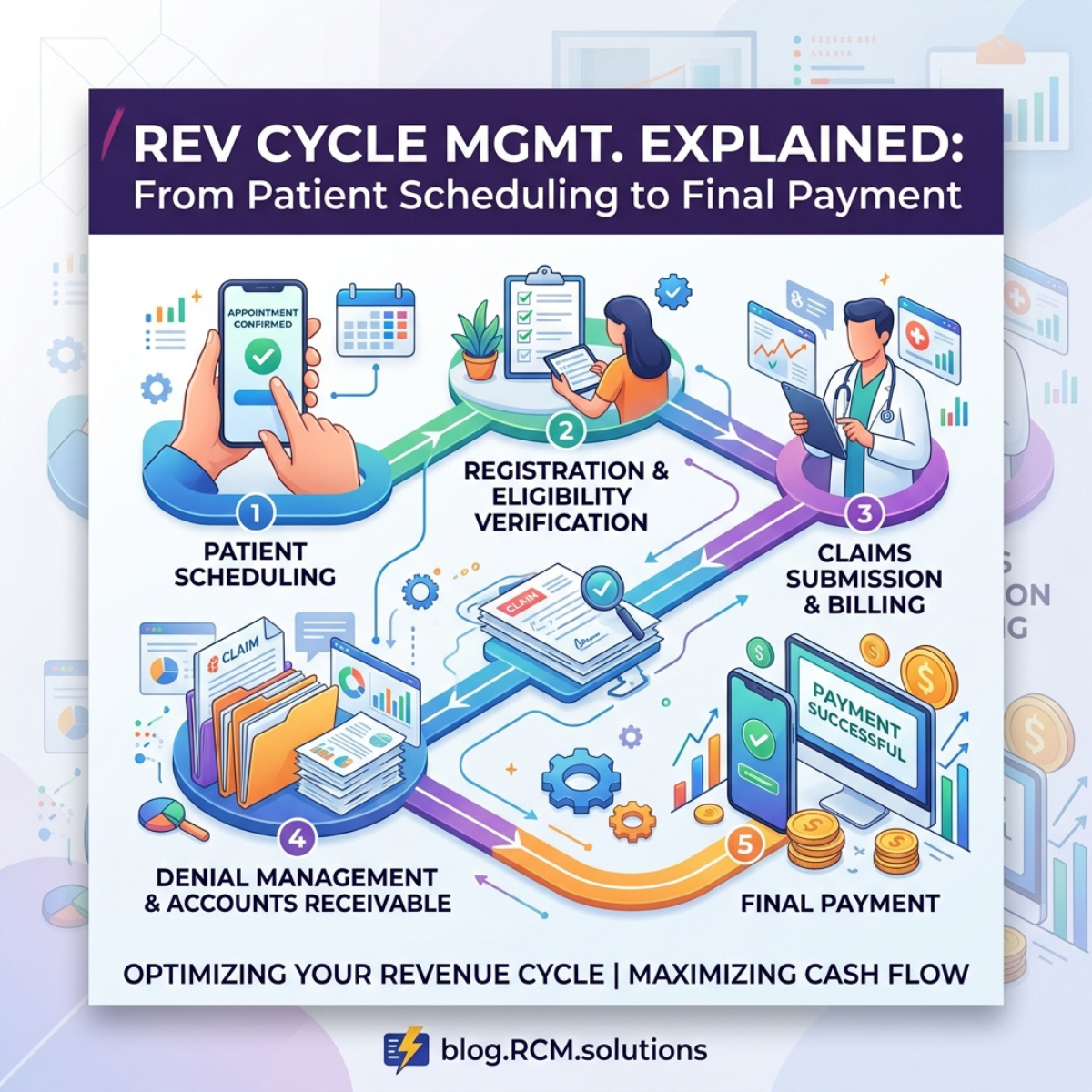
Revenue Cycle Management Explained: From Patient Scheduling to Final Payment
Revenue cycle management, often called RCM, is the financial engine of a healthcare practice. It covers every step that turns a patient encounter into accurate reimbursement. The process begins before the patient walks into the clinic and continues until the insurance company and patient balances are fully resolved.
A healthcare organization can deliver excellent care and still struggle financially if its revenue cycle is weak. Missed eligibility checks, incorrect patient information, poor documentation, coding errors, delayed claims, underpayments, and unresolved denials all create revenue leakage. The result is slower cash flow, higher administrative workload, and avoidable financial pressure.
Healthcare revenue cycle management includes the activities that lead to payment for services, including patient registration, benefit verification, care delivery, claim submission, and reimbursement. HFMA emphasizes that data accuracy and completeness are critical from scheduling through claim filing.
In simple terms, RCM is the full journey of healthcare payment: schedule the patient, verify coverage, document care, code correctly, submit the claim, manage denials, post payments, collect patient responsibility, and close the account.
Why Revenue Cycle Management Matters
RCM matters because healthcare payment is complex. A provider does not simply perform a service and receive payment immediately. Every encounter must pass through clinical, administrative, coding, payer, and patient payment checkpoints.
Each checkpoint creates risk.
If scheduling captures the wrong insurance plan, the claim may deny. If eligibility is not verified, the patient may receive care without active coverage. If prior authorization is missed, the payer may reject the service. If documentation is weak, coding becomes inaccurate. If coding is wrong, the claim may deny or underpay. If denials are not worked quickly, payment may be lost. If patient responsibility is not communicated clearly, collections become harder.
A strong revenue cycle protects the practice from these problems.
The goal of RCM is not just to submit claims. The goal is to create a controlled process where services are authorized, documented, coded, billed, paid, and reconciled correctly.
Step 1: Patient Scheduling
The revenue cycle starts at scheduling.
This is the first point where the practice collects essential information. The scheduling team captures the patient’s name, date of birth, contact details, insurance information, reason for visit, provider preference, appointment type, and referral requirements.
This step looks basic, but it is financially important. Bad front-end data causes back-end billing problems.
For example, if the patient is scheduled under the wrong insurance plan, the claim may deny. If the visit type is selected incorrectly, the practice may fail to identify authorization requirements. If the patient’s demographic information is incomplete, the claim may reject before it reaches adjudication.
Scheduling should also identify whether the visit is new or established, in-person or telehealth, preventive or problem-oriented, routine or urgent, and whether the service may require a referral or prior authorization.
The best billing teams do not wait until after the visit to find problems. They prevent problems at the scheduling stage.
Step 2: Patient Registration and Demographic Accuracy
Patient registration confirms the information needed to bill correctly. This includes patient demographics, insurance details, guarantor information, contact details, policyholder relationship, address, phone number, email, and consent forms.
Small errors matter.
A wrong date of birth, misspelled name, outdated insurance ID, incorrect payer selection, or missing subscriber information can delay payment. These errors often result in claim rejections, eligibility failures, or patient billing disputes.
Registration should also include consent to treat, assignment of benefits, financial responsibility acknowledgment, privacy notices, and communication preferences.
This stage creates the administrative foundation for the entire claim. If registration is weak, every downstream department pays the price.
Step 3: Insurance Eligibility Verification
Eligibility verification confirms whether the patient’s insurance coverage is active on the date of service. It also checks benefit details such as copay, deductible, coinsurance, coverage limitations, plan type, payer rules, and patient responsibility.
Eligibility should not be treated as optional.
A patient may present an insurance card, but that card does not prove active coverage. Plans change. Employers change. Deductibles reset. Benefits vary. Some services may be covered while others are excluded.
A strong eligibility process helps the practice understand what the payer may cover and what the patient may owe.
This step also improves the patient experience. Patients are frustrated when they receive unexpected bills. Accurate eligibility verification helps the practice communicate financial responsibility earlier and more clearly.
Step 4: Prior Authorization and Referral Management
Prior authorization is one of the most important front-end revenue cycle controls. It confirms whether the payer requires approval before a service is provided.
Not every service requires authorization, but many high-cost, specialty, diagnostic, therapy, surgical, imaging, medication, and procedure-related services do. Some insurance plans also require referrals before the patient can see a specialist.
CMS describes prior authorization and pre-claim review initiatives as tools used to help ensure compliance with Medicare rules and reduce improper billing and payments, while noting that these processes do not change medical necessity or documentation requirements.
That point is important. Authorization does not replace medical necessity. It only confirms that the payer has reviewed the request under its rules.
If authorization is missed, the claim may deny even when the service was clinically appropriate. This is why practices need a clear authorization workflow before the patient receives care.
The authorization process should track payer requirements, requested services, approval numbers, effective dates, service limits, provider details, and expiration dates.
Step 5: Patient Check-In and Financial Clearance
Patient check-in is where the practice confirms the patient’s information again before care is delivered. This includes verifying identity, insurance, forms, referrals, authorizations, and financial responsibility.
Financial clearance means the practice has checked whether the visit is ready for billing. The patient’s coverage is active. Required authorization is obtained. Demographics are correct. Copay information is available. Consent forms are signed. Referral requirements are addressed.
This is also the right time to collect copays and outstanding balances when appropriate.
A weak check-in process creates billing delays. A strong check-in process reduces rework and improves cash flow.
Step 6: Clinical Documentation
Clinical documentation is the bridge between patient care and medical billing.
The provider must document what happened during the encounter, why it was medically necessary, what diagnosis was assessed, what services were performed, what treatment was provided, and what follow-up was recommended.
Billing cannot safely rely on memory or assumptions. Coders and billers need documentation that supports the codes submitted.
Poor documentation causes several problems. It can lead to undercoding, overcoding, medical necessity denials, payer audits, delayed claims, and compliance exposure.
For E/M services, documentation should support the level of service selected. For procedures, documentation should support the procedure performed, location, laterality, size where relevant, technique, findings, and medical necessity. For telehealth, documentation should also include modality and patient location when required by payer policy.
If it is not documented, it is difficult to defend.
Step 7: Charge Capture
Charge capture is the process of identifying all billable services provided during the encounter.
This includes office visits, procedures, injections, diagnostic tests, supplies, medications, ancillary services, and other reimbursable items. The goal is to make sure that every service performed is accurately captured and transferred into the billing workflow.
Missed charges directly reduce revenue. Incorrect charges increase denial risk.
Charge capture must be accurate, timely, and connected to documentation. A procedure should not be billed unless the documentation supports it. At the same time, practices should not lose legitimate revenue because services were performed but never entered.
This is especially important in multi-specialty clinics, urgent care, dermatology, cardiology, orthopedics, and other procedure-heavy specialties.
Step 8: Medical Coding
Medical coding converts clinical documentation into standardized billing codes.
This usually includes ICD-10-CM diagnosis codes, CPT procedure codes, HCPCS codes, modifiers, units, place of service codes, and other claim details. Coding tells the payer what condition was treated, what service was performed, where it happened, and whether special billing rules apply.
Accurate coding is one of the most important parts of RCM.
Wrong diagnosis codes can fail medical necessity edits. Wrong CPT codes can cause denials or underpayments. Missing modifiers can lead to bundling issues. Incorrect units can cause overbilling or underbilling. Incorrect place of service can affect reimbursement.
Coding should be based on documentation, payer rules, and current coding guidelines. It should not be based on habit.
Step 9: Claim Scrubbing and Clean Claim Review
Before a claim is submitted, it should go through claim scrubbing.
Claim scrubbing checks for errors that may cause rejection or denial. This includes missing patient information, invalid codes, payer-specific rule conflicts, modifier issues, diagnosis-code mismatches, authorization gaps, duplicate claims, and formatting problems.
The goal is clean claim submission.
A clean claim is a claim that has the required information for the payer to process it without avoidable delay. Clean claims improve cash flow because they reduce rework and shorten the time between service and payment.
Claim scrubbing does not guarantee payment, but it reduces preventable mistakes.
Step 10: Claim Submission
Claim submission is the process of sending the claim to the payer for reimbursement.
Most claims are submitted electronically through billing software or a clearinghouse. CMS explains that electronic billing information is intended for providers, clearinghouses, and billing services that submit transactions to or receive transactions from Medicare fee-for-service contractors.
The claim includes patient information, provider information, payer details, diagnosis codes, procedure codes, modifiers, charges, place of service, date of service, and other required data.
The claim may be submitted as a professional claim or institutional claim depending on provider type and service setting.
After submission, the claim may be accepted by the clearinghouse, rejected for correction, accepted by the payer, denied, paid, or partially paid.
A rejection is not the same as a denial. A rejection usually means the claim did not enter payer adjudication because of missing or invalid data. A denial means the payer processed the claim but refused payment for one or more reasons.
Both must be managed quickly.
Step 11: Payer Adjudication
Payer adjudication is the payer’s review of the claim.
During adjudication, the payer determines whether the patient was eligible, whether the service is covered, whether authorization was required, whether the coding is valid, whether medical necessity is supported, whether the provider is in network, and how much should be paid under the contract.
The payer may pay the claim, deny the claim, request more information, apply contractual adjustments, apply deductible or coinsurance, or bundle services based on its rules.
This stage is where many revenue cycle problems become visible. A claim that looked complete inside the practice may fail against payer-specific rules.
That is why payer policy knowledge is essential.
Step 12: Payment Posting
Payment posting records payer payments, adjustments, denials, and patient responsibility into the billing system.
When the payer processes a claim, it sends payment information through an explanation of benefits or electronic remittance advice. CMS defines an electronic remittance advice as an explanation from a health plan to a provider about claim payment.
CMS also explains that ERA data can be automatically posted to accounting or billing applications, reducing the time and cost of manual posting from paper remittance.
Payment posting must be accurate because it affects accounts receivable, patient balances, denial workflows, secondary billing, refunds, and financial reporting.
If payments are posted incorrectly, the practice may pursue the wrong patient balance, miss an underpayment, overlook a denial, or misstate revenue.
Step 13: Denial Management
Denial management is the process of identifying, correcting, appealing, and preventing denied claims.
Common denial reasons include eligibility issues, missing authorization, coding errors, lack of medical necessity, duplicate claims, timely filing issues, missing documentation, invalid modifiers, coordination of benefits problems, and payer-specific rule failures.
CMS notes that all payers, including Medicare, are required under HIPAA to use approved claim adjustment reason codes and remittance advice remark codes to explain claim payment adjustments.
A strong denial process does not simply “work denials.” It studies denial patterns.
The billing team should track denial rate by payer, provider, specialty, location, service type, CPT code, denial reason, and preventability. This helps the organization fix root causes.
For example, repeated authorization denials may indicate a front-end workflow problem. Repeated medical necessity denials may point to documentation or diagnosis coding issues. Repeated modifier denials may suggest coding rule gaps.
The goal is not only to recover denied revenue. The goal is to stop preventable denials from happening again.
Step 14: Accounts Receivable Follow-Up
Accounts receivable, often called A/R, represents money owed to the practice.
A/R follow-up focuses on unpaid claims, delayed payments, underpayments, denied claims, pending payer responses, and patient balances.
Strong A/R management requires prioritization. High-dollar claims, aging claims, denied claims, and payer delays should be worked before they become unrecoverable.
A/R teams should monitor aging buckets such as 0–30 days, 31–60 days, 61–90 days, 91–120 days, and over 120 days. The older a claim becomes, the harder it is to collect.
Delayed follow-up is expensive. Payers have timely filing limits, appeal deadlines, and documentation response windows. Missing those deadlines can turn a recoverable claim into lost revenue.
Step 15: Patient Billing and Collections
After insurance processes the claim, the remaining balance may become the patient’s responsibility. This can include deductibles, copays, coinsurance, non-covered services, and self-pay balances.
Patient billing must be clear, accurate, and timely.
A confusing patient statement creates calls, disputes, complaints, and delayed payment. Patients need to understand what was billed, what insurance paid, what adjustments were applied, and why they owe a balance.
Patient collections should begin with transparency before the visit. If patients know their estimated responsibility earlier, they are more likely to pay and less likely to be surprised.
A good patient payment process includes clear statements, online payment options, payment plans, financial counseling, and consistent follow-up.
The goal is not aggressive collection. The goal is clear communication and responsible balance resolution.
Step 16: Final Payment and Account Closure
The revenue cycle ends when the account is fully resolved.
This may happen through payer payment, secondary insurance payment, patient payment, adjustment, write-off, refund, or transfer to collections according to policy.
Final account closure should confirm that all payments are posted, all denials are addressed, all patient balances are resolved or assigned to the correct workflow, and all contractual adjustments are accurate.
This final step matters because unresolved accounts distort financial reporting. They also create unnecessary workload for billing teams.
A closed account should be clean, reconciled, and documented.
Common Revenue Cycle Management Problems
Most RCM problems are not caused by one major failure. They are caused by repeated small failures across the workflow.
Common issues include inaccurate patient registration, skipped eligibility checks, missing authorizations, weak documentation, delayed charge entry, coding errors, incorrect modifiers, claim rejections, payer denials, underpayments, slow A/R follow-up, poor patient billing communication, and disconnected systems.
The most dangerous problem is lack of visibility.
If leadership cannot see where claims are getting delayed, denied, or underpaid, the practice cannot fix the revenue cycle. Reporting must show performance across scheduling, eligibility, coding, claims, denials, A/R, payment posting, and patient collections.
Key RCM Metrics Every Practice Should Track
A strong RCM process should be measured with clear metrics.
Important metrics include clean claim rate, denial rate, days in A/R, net collection rate, first-pass resolution rate, claim rejection rate, patient collection rate, charge lag, payment lag, denial overturn rate, and aging A/R by payer.
HFMA’s MAP Keys are recognized revenue cycle KPIs and include performance areas such as patient access, pre-billing, claims, account resolution, and financial management.
Metrics prevent guesswork. They show whether the revenue cycle is improving or deteriorating.
For example, a high denial rate means the practice has upstream problems. A high A/R over 90 days means follow-up is too slow or payer problems are unresolved. A low clean claim rate means errors are entering the claim before submission. A high patient balance aging rate means patient collections need improvement.
Data should guide action.
Why Technology Matters in RCM
Manual RCM is inefficient. Spreadsheets, disconnected systems, and payer portals create delays and errors.
A strong RCM platform connects scheduling, eligibility, authorization, documentation, coding, claim submission, denial management, payment posting, and reporting. This gives the practice one workflow instead of multiple isolated processes.
Technology can help automate eligibility checks, flag missing information, validate codes, scrub claims, track denials, post payments, identify underpayments, and produce reporting.
But technology alone is not enough. It must be paired with trained staff, payer knowledge, clear workflows, and consistent auditing.
The best revenue cycle is not just automated. It is controlled.