
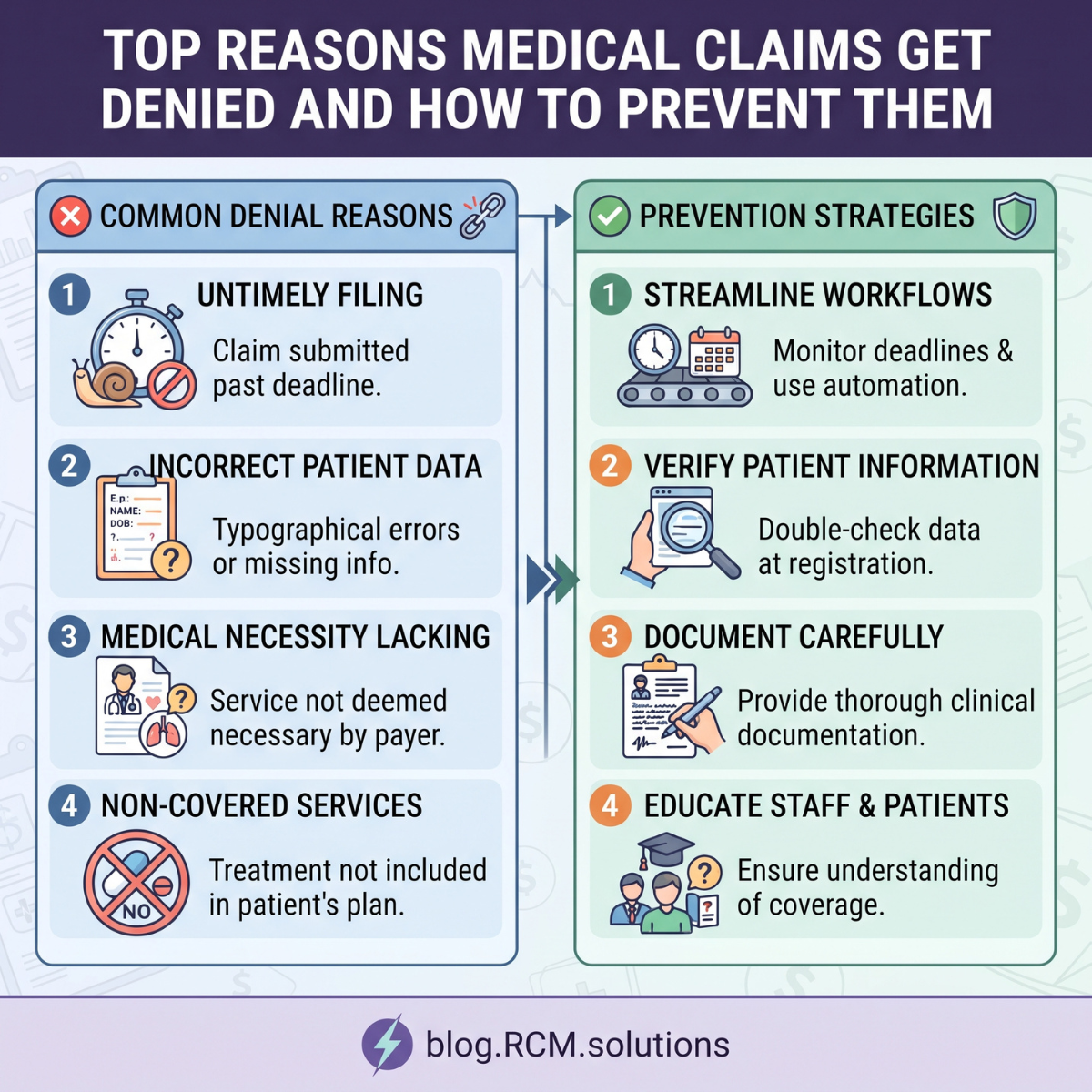
Medical claim denials are one of the most persistent financial challenges facing healthcare practices. Even when providers deliver medically necessary services, maintain accurate patient records, and submit claims within filing deadlines, insurance payers may still deny reimbursement.
For medical practices, every denied claim creates additional work. Billing staff must investigate the denial, review payer policies, gather supporting documentation, submit corrections or appeals, and monitor the claim until it is resolved.
This process delays cash flow, increases administrative expenses, and can result in lost reimbursement.
According to the Healthcare Financial Management Association (HFMA), 11.65% of healthcare claims were denied on first pass in 2025, highlighting the importance of effective denial management and prevention strategies.
However, claim denials are not always caused by billing department mistakes.
Many originate much earlier in the revenue cycle, including patient scheduling, registration, insurance eligibility verification, prior authorization, clinical documentation, and medical coding.
A missed authorization can result in a denial weeks after treatment. Incorrect diagnosis coding can cause a medical necessity problem. Outdated insurance information can send a claim to the wrong payer.
Understanding the reasons medical claims get denied is the first step toward preventing these problems.
This guide explains common medical claim denial causes, how to address them, and practical strategies healthcare organizations can use to reduce avoidable denials and protect practice revenue.
What Is a Medical Claim Denial?
A medical claim denial occurs when an insurance payer processes a claim but determines that payment should not be made for one or more billed services.
The payer may deny the claim because the service is not covered, documentation does not support medical necessity, authorization requirements were not satisfied, or the submitted information conflicts with applicable payment rules.
Denials can affect an entire claim or individual claim lines.
A denial should not be confused with a claim rejection.
A claim rejection generally occurs when the claim fails initial validation before entering payer adjudication.
A denied claim has undergone payer processing and received an unfavorable payment determination.
The distinction matters because rejected claims usually require correction and resubmission, while denied claims may require reconsideration, claim correction, or formal appeals.
Why Medical Claim Denials Hurt Practice Revenue
Claim denials create costs beyond the immediate unpaid balance.
When a payer denies a claim, billing employees spend additional time investigating the reason and determining the appropriate response.
This may involve reviewing medical records, contacting providers, checking authorizations, researching payer policies, and submitting appeals.
Meanwhile, the account remains outstanding.
Repeated denials can increase accounts receivable, delay cash collections, and reduce billing department productivity.
Some claims eventually receive payment after correction or appeal. Others become unrecoverable because of missed deadlines, insufficient documentation, or legitimate coverage restrictions.
The financial impact becomes more significant as a practice grows.
A clinic processing hundreds of claims may manage occasional denials relatively easily. A multi-specialty organization processing thousands of claims can face substantial administrative pressure when denial rates increase.
The objective of denial management should be to prevent avoidable errors while recovering reimbursement that is legitimately owed.
1. Incorrect Patient Demographic Information
Patient registration mistakes are a frequent source of medical billing problems.
Incorrect names, dates of birth, insurance identification numbers, addresses, or subscriber relationships may prevent claims from being processed correctly.
For example, a patient's date of birth entered incorrectly during registration may cause the payer to question whether the submitted claim belongs to the correct member.
Depending on the payer's processing system, this may result in an initial rejection or a later eligibility-related denial.
These errors often originate at the front desk rather than in the billing department.
How to Prevent It
Standardize patient registration and demographic verification.
Confirm essential information during scheduling, preregistration, and check-in.
Use electronic validation where appropriate, and train staff to identify discrepancies between insurance records and practice management information.
2. Inactive Insurance or Eligibility Problems
Insurance eligibility is another major contributor to claim denials.
A patient may present an insurance card without realizing the coverage is inactive, terminated, or associated with a different plan.
Coverage may change because of employment, enrollment periods, or other circumstances.
If the practice bills an inactive policy, the payer may refuse reimbursement.
Additionally, active insurance does not necessarily mean that every service is covered.
Eligibility and benefits must be evaluated separately.
How to Prevent It
Verify coverage before the date of service whenever possible.
Confirm effective dates, termination dates, payer information, and relevant benefit restrictions.
CMS provides a HIPAA Eligibility Transaction System that supports real-time Medicare eligibility inquiries through 270/271 transactions.
Regular verification helps identify coverage problems before they become unpaid claims.
3. Missing or Incorrect Prior Authorization
Certain medical procedures, treatments, imaging services, and specialty medications require prior authorization.
When authorization is required but not obtained, the resulting claim may be denied.
Authorization errors can also occur when approval is obtained for the wrong service, provider, location, or treatment date.
An authorization may expire or cover fewer service units than those actually delivered.
For example, a patient may receive a procedure that requires prior approval, but the practice submits the claim without a valid authorization.
Even when the service was clinically appropriate, reimbursement may be denied under the payer's rules.
How to Prevent It
Maintain an authorization tracking workflow.
Confirm approval numbers, authorized services, dates, providers, locations, and service limits before treatment.
Review payer-specific requirements regularly.
Prior authorization does not guarantee payment, but properly managing it reduces avoidable administrative denials.
4. Lack of Medical Necessity
Medical necessity denials occur when a payer determines that the submitted service does not meet applicable clinical coverage criteria.
This may involve diagnosis information, clinical findings, treatment history, or supporting documentation.
For example, a diagnostic test may be appropriate for some clinical conditions but not covered for every diagnosis.
If the documentation does not establish why the test was necessary, the payer may deny reimbursement.
Medical necessity decisions can also be disputed.
A payer's denial does not automatically mean the treatment was inappropriate.
How to Prevent It
Verify relevant coverage policies before planned services when practical.
Ensure clinical documentation supports the medical necessity of the service.
Review applicable Medicare National Coverage Determinations, Local Coverage Determinations, and commercial payer medical policies.
When an appropriate service is denied, evaluate whether a medically supported appeal is justified.
5. Incorrect Diagnosis Coding
ICD-10-CM diagnosis codes communicate the conditions, symptoms, and diagnoses addressed during an encounter.
Incorrect diagnosis coding can create medical necessity problems or other claim processing errors.
Common issues include outdated codes, insufficient specificity, unsupported diagnoses, and incorrect relationships between diagnoses and procedures.
For example, a service may require documentation supporting a particular condition, but the claim contains a diagnosis code that does not accurately represent the patient's documented clinical situation.
The payer may deny the service under its coverage rules.
How to Prevent It
Use current ICD-10-CM code sets and official coding guidelines.
Select codes supported by clinical documentation.
Review diagnosis-to-procedure relationships when payer policies require them.
Avoid selecting diagnoses solely because they are more likely to generate payment.
Coding must accurately represent the medical record.
6. Incorrect CPT or HCPCS Codes
Procedure coding errors can cause denials when the submitted code does not accurately describe the service performed.
Examples include reporting an incorrect procedure, using a deleted code, selecting inappropriate billing units, or misrepresenting the service setting.
Procedure coding can be especially challenging in dermatology, cardiology, orthopedics, pain management, radiology, and other procedure-intensive specialties.
Coding requirements may change annually, while certain coding edits are updated more frequently.
How to Prevent It
Maintain current CPT and HCPCS code references.
Train coding teams on specialty-specific rules.
Perform targeted coding audits and establish a clinical documentation clarification process.
Claims should be reviewed for consistency between procedure documentation, diagnosis information, codes, and payer requirements.
7. Missing or Incorrect Modifiers
Modifiers provide additional information about the circumstances of a billed service.
Incorrect modifier selection can result in bundling denials, reduced reimbursement, or compliance concerns.
For example, Modifier 25 may apply when a significant, separately identifiable E/M service is performed on the same day as another procedure.
Modifier 59 may be appropriate for distinct procedural services when applicable coding rules permit it.
However, neither modifier should be added automatically to bypass a payer edit.
CMS's National Correct Coding Initiative includes procedure-to-procedure edits that help prevent inappropriate payment for certain code combinations.
How to Prevent It
Verify modifier requirements against the clinical documentation and applicable coding rules.
Review payer-specific policies.
Use automated editing tools to identify potential modifier problems, while retaining qualified coding oversight.
Modifiers should clarify legitimate billing circumstances, not manufacture separate reimbursement.
8. Missing or Insufficient Clinical Documentation
Clinical documentation supports the medical services reported on insurance claims.
Incomplete records may prevent payers from determining whether a service meets coverage or medical necessity requirements.
Common deficiencies include unclear diagnoses, missing procedure descriptions, inadequate treatment history, and insufficient documentation of medical decision-making.
For time-based services, incomplete time documentation can also create billing problems.
How to Prevent It
Train providers on documentation expectations relevant to their specialties.
Use structured EHR templates where appropriate without encouraging unnecessary or duplicated documentation.
Review recurring documentation-related denials with clinical and coding teams.
When additional records are requested, ensure the response is complete and submitted within the required timeframe.
9. Duplicate Claim Submission
Duplicate billing occurs when the same or overlapping service is reported more than once under circumstances that do not support separate payment.
Duplicate claims may be generated by accidental resubmission, disconnected billing systems, or incorrect replacement claim procedures.
For example, staff may submit another original claim after a payment delay without checking whether the payer has already accepted the first submission.
The payer may deny the later claim as a duplicate.
How to Prevent It
Check claim status before retransmitting previously submitted claims.
Use appropriate corrected or replacement claim procedures.
Implement duplicate detection rules that consider patient, provider, procedure, service date, and other relevant billing details.
Verify whether repeated services are legitimately separately reportable before adding modifiers or additional claim lines.
10. Timely Filing Violations
Insurance payers establish deadlines for receiving claims.
A claim submitted after the applicable filing period may be denied, even when the service was covered and medically necessary.
For Original Medicare, claims generally must be filed within 12 months of the date of service unless a specific exception applies.
Commercial insurance and Medicaid filing requirements vary.
Claims may also be delayed by incomplete provider documentation, administrative backlogs, or unresolved rejection errors.
How to Prevent It
Maintain a payer-specific timely filing reference.
Monitor unbilled encounters, charge lag, and pending claims.
Confirm that electronic submissions are accepted rather than assuming successful transmission means payer acceptance.
Prioritize claims approaching filing deadlines.
11. Coordination-of-Benefits Errors
Coordination of benefits determines the order in which insurance plans process claims when a patient has multiple coverage sources.
If the billing team submits a claim to the wrong primary payer, payment may be denied or delayed.
Problems may occur when patients have Medicare and employer-sponsored insurance, coverage through multiple family members, or other overlapping benefits.
How to Prevent It
Collect information about all active insurance policies.
Verify the correct primary and secondary payer sequence according to applicable coordination rules.
Maintain current coverage information and ensure that secondary claims contain the required primary adjudication details.
12. Non-Covered Services and Benefit Limitations
A patient may have active insurance coverage but receive a service that is excluded from the policy.
Insurance plans may also impose frequency limitations, benefit maximums, or service-specific restrictions.
For example, a therapy plan may limit the number of covered visits or require additional authorization after a certain threshold.
If the practice overlooks these restrictions, claims may be denied.
How to Prevent It
Verify benefits for the planned service.
Review applicable frequency limitations and coverage exclusions.
Explain potential patient financial responsibility before non-emergency services when appropriate.
Do not automatically transfer denied charges to patients; patient liability depends on payer rules, contract provisions, and applicable law.
13. Provider Enrollment and Network Problems
Provider enrollment problems can affect claim reimbursement.
A physician may be properly licensed and qualified but not correctly enrolled with a particular payer or insurance product.
Claims may also be affected by incorrect rendering provider information, billing identifiers, taxonomy details, or service locations.
These issues become more common when practices add providers or expand into new locations.
How to Prevent It
Verify payer enrollment before scheduling reimbursable services under new billing arrangements.
Maintain accurate provider and location records.
Coordinate credentialing, scheduling, and billing departments so changes are reflected across systems.
14. Incorrect Place of Service and Telehealth Information
The place-of-service code identifies the setting associated with a healthcare service.
Incorrect place-of-service reporting can affect reimbursement or produce payer denials.
Telehealth services require additional attention because billing rules may depend on the patient's location and communication modality.
For example, POS 02 identifies telehealth provided to a patient somewhere other than home, while POS 10 identifies telehealth received in the patient's home.
Modifier requirements can also vary between payers.
How to Prevent It
Capture accurate service location information.
Verify whether the encounter was performed in person, through synchronous audio-video, or through another covered modality.
Use the appropriate POS code and modifiers under the payer's current requirements.
Do not assume that all insurance plans process virtual encounters identically.
15. Payer Processing Errors and Disputed Determinations
Not every denial originates from a healthcare provider's mistake.
Insurance payers may process claims incorrectly, apply outdated information, misinterpret contract provisions, or make disputed coverage determinations.
A practice may receive a denial even when the submitted claim appears to satisfy applicable billing requirements.
These situations require careful investigation rather than automatic changes to the original coding.
How to Prevent and Address It
Maintain accurate payer contract information and coverage references.
Compare denial decisions against clinical documentation and applicable policies.
Escalate questionable determinations through the payer's reconsideration or appeal process.
Track recurring payer processing problems and preserve documentation supporting each dispute.
The Role of Claim Scrubbing in Denial Prevention
Claim scrubbing helps identify potential billing errors before electronic submission.
An effective claim editing process may check:
- Required patient information
- Provider identifiers
- Current diagnosis and procedure codes
- Modifier compatibility
- Billing units
- Duplicate charges
- Authorization information
- Relevant payer-specific requirements
Automated claim edits can reduce preventable mistakes, particularly those involving missing information or inconsistent coding.
However, claim scrubbing cannot guarantee payment.
A technically valid claim may still be denied for medical necessity, coverage exclusions, authorization deficiencies, or payer policy disputes.
Claim scrubbing works best as one component of a broader revenue cycle quality program.
How to Build a Proactive Claim Denial Prevention Workflow
Denial prevention should begin before the patient receives care.
Step 1: Strengthen Patient Registration
Collect accurate demographics, insurance information, and provider details.
Verify key information during check-in.
Step 2: Verify Coverage and Benefits
Confirm active eligibility and service-specific benefit requirements.
Step 3: Check Authorizations and Referrals
Identify required approvals and confirm that they match the planned services.
Step 4: Improve Clinical Documentation
Ensure records support the diagnoses, services, and medical necessity represented on the claim.
Step 5: Validate Coding
Review diagnosis codes, procedure codes, units, modifiers, and service settings.
Step 6: Scrub Claims Before Submission
Identify preventable errors using coding edits and payer-specific validation.
Step 7: Monitor Electronic Acknowledgments
Confirm that the payer accepts submitted claims for processing.
Step 8: Review Denials by Root Cause
Categorize denials and direct corrective actions to the department responsible for the underlying issue.
This workflow helps practices transition from reactive denial correction to proactive prevention.
What to Do When a Medical Claim Is Denied
Even well-managed practices experience denials.
When a denial occurs, the billing team should follow a structured resolution process.
First, review the payer's electronic remittance advice or explanation of benefits.
Identify the relevant Claim Adjustment Reason Code (CARC), Remittance Advice Remark Code (RARC), and adjustment group code.
CMS explains that these codes communicate why payments were adjusted and help identify financial responsibility.
Next, verify whether the denial is valid.
Compare the claim against medical records, payer requirements, authorization details, and applicable coverage policies.
Determine whether the appropriate next step is a corrected claim, reopening, reconsideration, or formal appeal.
For Original Medicare, eligible first-level redetermination requests generally must be submitted within 120 days after receipt of the initial claim determination.
Other payer deadlines vary.
Finally, record the result and identify whether changes are needed to prevent similar denials.
The most effective denial teams do not stop after recovering an individual claim.
They address the underlying process weakness.
Key Denial Management KPIs Every Practice Should Track
Medical practices need clear performance measurements to understand whether denial prevention strategies are working.
Initial Denial Rate
Measures the percentage of claims receiving an initial denial under a consistently defined methodology.
Denied Dollars
Tracks the financial value of claims or claim lines denied.
Denial Overturn Rate
Measures the percentage of appealed denials successfully reversed.
Time to Denial Resolution
Tracks how long denied claims remain unresolved.
Denial Write-Off Rate
Measures revenue written off because claims could not be recovered.
Clean Claim Rate
Measures claims passing a defined set of validation checks without requiring corrections.
Days in Accounts Receivable
Shows how long outstanding reimbursement remains uncollected relative to average daily net revenue.
HFMA recommends standardized denial metrics to support reliable comparisons, root-cause identification, and process improvement.
Practices should monitor these indicators by payer, provider, specialty, location, and denial category.
How RCM Automation Helps Reduce Medical Claim Denials
Revenue cycle management technology can support denial prevention by connecting administrative, clinical, and billing workflows.
For example, an integrated billing platform may identify missing insurance information during registration, flag authorization requirements, validate coding, and route denied claims into appropriate work queues.
Useful capabilities include automated eligibility verification, authorization tracking, coding alerts, claim scrubbing, electronic remittance processing, and denial analytics.
Predictive analytics may also help organizations identify claims with elevated denial risk based on historical patterns.
However, automated recommendations require appropriate validation and human oversight.
An automated system should not change documented diagnoses, add unsupported modifiers, or submit appeals containing unverified clinical information.
For growing medical practices, technology is most effective when combined with standardized workflows, trained employees, and payer-specific policy review.
A Practical 30-Day Denial Reduction Plan
Week 1: Analyze Current Denials
Collect recent denial data.
Identify the most frequent reasons, highest-value denied services, and payers generating the greatest workload.
Separate true adjudicated denials from initial claim rejections.
Week 2: Correct Front-End Problems
Review registration, insurance eligibility, benefits verification, and authorization workflows.
Introduce validation checks for recurring administrative errors.
Week 3: Improve Coding and Documentation
Audit selected denied claims for coding and documentation deficiencies.
Train providers and billing staff on recurring problems.
Update claim editing rules when appropriate.
Week 4: Measure and Refine
Compare new denial patterns against baseline performance.
Review appeal outcomes and unresolved denied balances.
Assign responsibility for remaining process gaps.
Establish recurring monthly denial reviews.
The objective is continuous improvement rather than a temporary reduction in the denial backlog.
Frequently Asked Questions
What is the most common reason medical claims get denied?
Common causes include eligibility problems, missing prior authorization, insufficient documentation, medical necessity disputes, coding issues, and non-covered services. The leading cause varies by payer, specialty, and organization.
Can a denied medical claim be corrected?
Sometimes. Depending on the denial, the appropriate response may involve a corrected claim, reopening, reconsideration, or appeal.
Does prior authorization guarantee reimbursement?
No. Authorization does not eliminate other coverage, coding, documentation, and payment requirements.
How can small medical practices reduce claim denials?
Start with accurate registration, eligibility verification, authorization tracking, coding review, timely filing, and consistent denial follow-up.
Can automation eliminate claim denials?
No. Automation can identify preventable errors, but payer coverage decisions, medical necessity disputes, and other factors still require review.
Final Thoughts
Medical claim denials are not simply a billing department problem.
They can originate anywhere in the revenue cycle, from inaccurate patient registration and incomplete eligibility verification to coding mistakes, missing authorizations, clinical documentation gaps, and payer processing errors.
Practices that focus exclusively on appealing denied claims remain reactive.
A more effective approach is to identify the root causes of denials and prevent avoidable problems before claims reach the payer.
This requires coordination between patient access, providers, coders, billing staff, authorization specialists, and revenue cycle managers.
Accurate information, compliant coding, payer-specific workflows, effective claim validation, and consistent monitoring all contribute to stronger reimbursement performance.
The goal is not to eliminate every possible denial. It is to prevent avoidable denials, resolve legitimate payment disputes efficiently, and protect reimbursement for appropriately documented and covered services.
Medical practices that make denial prevention a continuous revenue cycle priority can reduce administrative rework, improve cash flow visibility, and build more financially sustainable operations.