
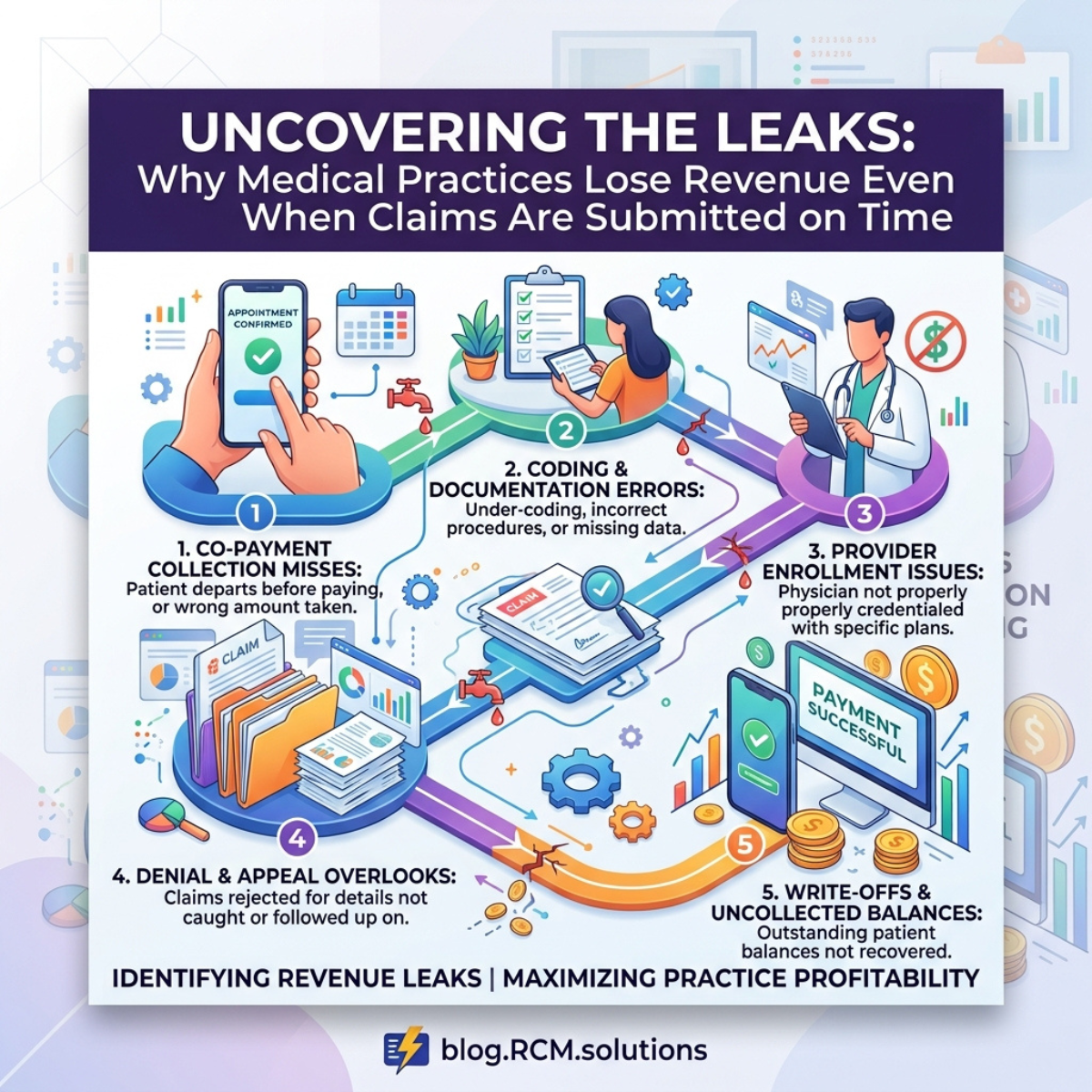
Many medical practices assume that revenue is protected as long as claims are submitted on time.
That assumption is wrong.
Timely claim submission matters, but it does not guarantee payment. A claim can be submitted before the payer deadline and still be rejected, denied, underpaid, delayed, appealed too late, posted incorrectly, or left unpaid in accounts receivable. In medical billing, submitting the claim is not the finish line. It is only one step in the revenue cycle.
This is where many practices quietly lose money.
A practice may have busy providers, full schedules, steady patient volume, and claims going out every day. On paper, everything looks active. But activity is not the same as revenue control. If claims are not clean, documented, coded, scrubbed, tracked, appealed, posted, and collected properly, revenue still leaks out of the system.
Healthcare revenue cycle management includes every activity that leads to payment, from patient registration and benefit verification to care delivery, claim submission, and reimbursement. HFMA notes that unless claims are filed on time, include necessary processing information, and are sent to the correct place, they can still be denied.
That point is critical: timely filing is only one requirement. It is not the only requirement.
A claim submitted on time can still fail if the information inside it is wrong.
Timely Submission Is Not the Same as Clean Submission
A timely claim is submitted within the payer’s filing deadline.
A clean claim is accurate, complete, properly coded, medically supported, payer-compliant, and ready for adjudication.
Those are not the same thing.
A claim can be submitted on time with the wrong insurance information. It can be submitted on time without authorization. It can be submitted on time with a missing modifier. It can be submitted on time with unsupported diagnosis coding. It can be submitted on time with a procedure that does not match payer medical necessity rules.
The payer does not pay a claim simply because it arrived before the deadline. The payer pays when the claim meets coverage, coding, documentation, medical necessity, and contract requirements.
This is why practices that only measure claim submission speed miss the bigger problem.
Fast billing is useful only when the claim is accurate.
Fast errors are still errors.
1. Incorrect Patient and Insurance Information
One of the most common reasons practices lose revenue is inaccurate front-end data.
The revenue cycle starts before the patient sees the provider. If the front desk captures the wrong insurance plan, incorrect member ID, outdated demographic information, wrong date of birth, incorrect subscriber relationship, or incomplete address, the claim can reject or deny later.
These mistakes look small, but they create real revenue loss.
A claim may be submitted on time, but if the payer cannot match the patient to active coverage, the claim fails. Staff then have to correct the information, resubmit the claim, call the payer, contact the patient, or transfer the balance. That delay increases administrative cost and pushes payment further out.
In some cases, the practice misses the corrected filing window because the original claim was wrong.
That means the practice did the work, submitted something on time, and still lost payment.
The fix is basic but often ignored: registration quality must be treated as a billing function, not just an administrative task.
Every practice should verify patient demographics, insurance details, subscriber information, payer selection, and plan status before the appointment.
2. Eligibility Was Not Verified Correctly
Insurance eligibility verification confirms whether the patient has active coverage on the date of service. It also identifies copays, deductibles, coinsurance, plan limitations, coverage exclusions, and payer-specific billing requirements.
Skipping eligibility verification is lazy revenue cycle management.
A patient may present an insurance card, but that card does not prove active coverage. Insurance can change, terminate, shift to another plan, or become secondary. Patients may not know their own benefit details. Some plans require referrals. Some services are excluded. Some require prior authorization.
If eligibility is not checked properly, the practice may submit the claim on time but still face denial or patient balance disputes later.
This creates two problems.
First, payment is delayed or lost.
Second, patient collections become harder because the patient was not informed of responsibility upfront.
A strong eligibility process should happen before the visit, not after denial. It should confirm active coverage, benefit details, payer rules, and patient responsibility.
3. Prior Authorization Was Missed or Invalid
Prior authorization is one of the biggest causes of avoidable revenue loss.
A claim can be perfectly coded and submitted on time, but if the payer required prior authorization and the practice did not obtain it, the claim may deny.
This is especially common in specialties such as cardiology, orthopedics, dermatology, radiology, physical therapy, behavioral health, pain management, and surgery.
The AMA has repeatedly identified prior authorization as a major administrative burden for physicians, with survey findings showing high concern around delays, workload, and treatment disruption.
For billing purposes, the issue is simple: authorization is a front-end requirement with back-end financial consequences.
Practices lose revenue when:
Authorization was not requested.
Authorization was requested for the wrong CPT code.
Authorization expired before the service date.
Authorization was approved for a different provider or location.
Authorized units were exceeded.
The service performed did not match the approved service.
Documentation does not support the authorized service.
The claim was submitted on time but did not match the authorization record.
Authorization must be tracked with precision. Approval number, CPT codes, diagnosis codes, date range, unit limits, provider, facility, payer, and expiration date should all be verified before care is delivered.
If this process is manual or inconsistent, revenue loss is predictable.
4. Weak Clinical Documentation
Medical billing depends on clinical documentation.
If the documentation does not support the service billed, the claim is vulnerable even when it is submitted on time.
Providers often document from a clinical perspective, while payers review from a billing and medical necessity perspective. That gap creates revenue leakage.
Weak documentation can lead to:
Downcoding
Medical necessity denials
Procedure denials
Modifier denials
Audit risk
Delayed payment
Requests for additional records
Appeals that cannot be defended
For example, a provider may perform a medically appropriate service, but if the note does not clearly support the diagnosis, decision-making, procedure details, time, or medical necessity, the billing team cannot safely defend the claim.
In procedure-heavy specialties, documentation must include details such as site, laterality, size, technique, findings, number of lesions, medication dosage, route, units, and reason for the procedure.
For E/M services, documentation must support the selected level of service.
For telehealth, documentation may need to include patient location, modality, consent, and payer-specific requirements.
The rule is blunt: if the documentation is weak, the revenue is weak.
5. Coding Errors and Modifier Mistakes
Coding errors are another major reason practices lose revenue after timely claim submission.
A claim may be sent within the deadline, but if the codes are wrong, payment is at risk.
Common coding problems include:
Incorrect CPT codes
Unsupported diagnosis codes
Missing modifiers
Incorrect modifiers
Wrong units
Wrong place of service
Bundling errors
Unbundling errors
Incorrect laterality
Incorrect procedure sequencing
Diagnosis and procedure mismatch
Modifiers are especially dangerous because they can directly affect reimbursement.
For example, Modifier 25 may be needed when a significant, separately identifiable E/M service is performed on the same day as a procedure. Modifier 59 may be needed when distinct procedural services are separately supported. Telehealth modifiers may be required by payer policy. Surgical modifiers, anatomical modifiers, and professional/technical component modifiers may also affect payment.
If a modifier is missing, the claim may deny or underpay.
If a modifier is used incorrectly, the claim may create audit exposure.
Coding must match the documentation and payer rules. It should not be based on habit, provider preference, or “what usually gets paid.”
6. Charge Capture Gaps
Charge capture is the process of making sure all billable services are recorded and billed.
Practices often lose revenue because services were provided but never captured.
This happens frequently in busy clinics where providers perform add-on procedures, injections, point-of-care tests, supplies, vaccines, imaging, wound care, or additional services during the same visit.
If those services are not entered into the billing workflow, no claim is submitted for them.
That revenue is not denied. It is invisible.
Charge capture gaps are dangerous because they do not always show up in denial reports. The payer cannot deny a service that was never billed. Leadership may think revenue is stable while legitimate services are quietly missing from claims.
Common charge capture failures include:
Procedures documented but not billed
Supplies used but not captured
Injections billed without medication units
Medication billed without administration code
Lab tests performed but not charged
Ancillary services omitted
Follow-up services not entered
Provider notes closed after billing cutoff
Charge capture should be reconciled against schedules, documentation, procedure logs, inventory, superbills, and EHR records.
If charge capture is not monitored, practices will keep losing money without realizing it.
7. Claims Are Submitted but Not Tracked
Submitting a claim is not enough. The claim must be tracked until it is paid, denied, adjusted, appealed, transferred, or closed.
Many practices lose revenue because they treat submission as completion.
That is poor revenue cycle control.
After submission, claims can be rejected by the clearinghouse, accepted by the payer, denied, pended, requested for records, partially paid, underpaid, bundled, or shifted to patient responsibility.
If staff do not monitor claim status, unpaid claims age silently.
By the time someone checks, appeal deadlines may be close or already missed.
Claim follow-up should be systematic. Practices should track claim status by payer, date of service, submission date, charge amount, claim age, denial reason, and responsible team member.
Unworked claims become old claims.
Old claims become lost revenue.
8. Rejections Are Not Fixed Quickly
A claim rejection happens before the claim is fully processed by the payer. It usually means the claim has missing, invalid, or mismatched information.
Common rejection reasons include invalid member ID, missing date of birth, incorrect payer ID, invalid diagnosis code, invalid CPT code, missing NPI, incorrect format, or missing required fields.
Some practices mistakenly treat rejections like minor technical issues.
They are not minor.
A rejected claim has not successfully entered payer adjudication. If it is not corrected quickly, the practice can lose days or weeks. In the worst case, the corrected claim may miss timely filing.
This is one of the most frustrating forms of revenue loss because the practice may believe the claim was submitted on time, but the payer never accepted it as a valid claim.
Rejection work queues should be reviewed daily.
No claim should sit in rejection status without ownership.
9. Denials Are Worked Too Slowly
Denial management is where many practices lose revenue.
A denied claim is not automatically lost, but it becomes lost if no one works it properly.
HFMA explains that denial management involves determining the cause of the denial, deciding how to respond so it can be overturned, and preventing similar denials in the future.
That last part matters.
A weak denial team only reacts. A strong denial team identifies patterns and fixes root causes.
Common denial categories include:
Eligibility denials
Authorization denials
Medical necessity denials
Coding denials
Modifier denials
Duplicate claim denials
Coordination of benefits denials
Timely filing denials
Provider enrollment denials
Referral denials
Non-covered service denials
The problem is not only the denial itself. The problem is delay.
Every payer has appeal deadlines. If the billing team waits too long, the practice may lose appeal rights. Even when appeal is still possible, old claims are harder to resolve because documentation, payer records, and staff memory become less accessible.
Denial management should be measured by denial rate, denial reason, payer, provider, specialty, dollar value, appeal success rate, and preventability.
If the same denial happens every month, the practice does not have a denial problem.
It has a process problem.
10. Underpayments Are Missed
Not every revenue loss appears as a denial.
Sometimes the payer pays, but pays less than it should.
This is underpayment.
Underpayments are easy to miss because the claim appears “paid.” Staff may post the payment and move on without comparing it against the contracted rate.
That is a serious mistake.
A payer may underpay because of contract loading errors, incorrect fee schedules, bundling mistakes, modifier issues, wrong place of service, payer processing errors, incorrect provider status, or policy misapplication.
If the billing team does not compare expected reimbursement against actual payment, the practice may lose money on paid claims.
This is silent revenue leakage.
Payment posting should not be mechanical. It should include variance review. Any difference between expected allowed amount and actual allowed amount should be investigated.
Practices should track underpayments by payer, CPT code, provider, location, and contract.
A paid claim is not always a correctly paid claim.
11. Payment Posting Errors
Payment posting records payer payments, adjustments, denials, and patient responsibility into the billing system.
If payment posting is wrong, the entire revenue cycle becomes distorted.
CMS explains that electronic remittance advice provides claim payment details and that ERA data can be automatically posted to billing systems, reducing manual posting time and cost.
Automation helps, but it does not eliminate the need for review.
Payment posting errors can cause:
Incorrect patient balances
Missed denials
Incorrect contractual adjustments
Hidden underpayments
Duplicate write-offs
Refund errors
Secondary billing delays
Bad A/R reporting
Incorrect provider productivity reports
CMS also notes that payers must use standardized claim adjustment reason codes and remittance advice remark codes to explain payment adjustments.
Those codes should be reviewed, not ignored.
If denial codes and adjustment codes are posted incorrectly, the practice loses visibility into why revenue is being reduced.
Bad posting creates bad reporting.
Bad reporting creates bad decisions.
12. Patient Responsibility Is Not Collected Effectively
Insurance reimbursement is only one part of payment. Patient responsibility is another.
Practices lose revenue when deductibles, copays, coinsurance, and self-pay balances are not collected effectively.
This problem has grown as high-deductible health plans have become more common. Patients often owe more out of pocket, and practices must communicate financial responsibility clearly.
Revenue is lost when:
Copays are not collected at check-in.
Deductibles are not estimated.
Patients are not informed of balances.
Statements are confusing.
Payment options are limited.
Balances are sent too late.
Staff avoid financial conversations.
Old balances are not followed up.
Patient collections should begin before the visit whenever possible. That does not mean aggressive collection. It means transparency.
Patients should know what they may owe, why they owe it, and how they can pay.
If the practice waits months to send a confusing statement, collection becomes harder.
13. Secondary Claims Are Delayed or Missed
When a patient has more than one insurance plan, coordination of benefits becomes critical.
The primary payer processes the claim first. Then the remaining balance may need to go to the secondary payer.
Revenue is lost when secondary claims are delayed, submitted incorrectly, or never submitted.
This often happens because payment posting is incomplete, COB information is missing, secondary insurance was not collected, or the system does not trigger secondary billing automatically.
Secondary billing requires accurate primary payment details, adjustment codes, patient responsibility amounts, and payer coordination rules.
If the secondary claim is not filed correctly and on time, the practice may lose reimbursement that should have been collected.
14. A/R Follow-Up Is Weak
Accounts receivable follow-up is the discipline of working unpaid claims until they are resolved.
Weak A/R follow-up is one of the clearest signs of poor revenue cycle management.
A claim submitted on time can still sit unpaid for 30, 60, 90, or 120 days. The older the claim becomes, the harder it is to collect.
A/R teams should monitor aging buckets, payer delays, denial trends, high-dollar claims, unresolved rejections, underpayments, and patient balances.
The goal is not simply to “check claims.”
The goal is to move every account toward resolution.
A strong A/R workflow prioritizes:
High-dollar claims
Aging claims
Denied claims
No-response claims
Appeal deadline claims
Underpaid claims
Claims requiring medical records
Claims stuck with payer errors
If A/R is not worked consistently, revenue remains trapped.
15. Payer Rules Change but Workflows Do Not
Payer rules change frequently. Coverage policies, modifier rules, prior authorization requirements, telehealth rules, medical necessity edits, payer portals, and documentation requirements may shift throughout the year.
Practices lose revenue when billing workflows do not keep up.
A code that was paid last year may deny this year. A modifier that was optional may become required. A payer may change authorization rules. A telehealth service may require a different POS code or modifier. A payer may update medical necessity requirements.
If the practice relies on outdated billing habits, denials increase.
Billing teams need a payer policy review process. They should track payer bulletins, clearinghouse alerts, denial trends, contract updates, and specialty-specific reimbursement changes.
Revenue cycle management is not static.
A static billing process fails in a changing payer environment.
16. Disconnected Systems Create Revenue Leakage
Many practices lose revenue because their systems do not communicate properly.
Scheduling, eligibility, EHR documentation, coding, billing, clearinghouse submission, payer portals, payment posting, denial management, and patient collections may all operate separately.
That creates gaps.
A front-desk update may not reach billing. A provider note may not trigger a charge. An authorization may not connect to the claim. A denial may not route to the right person. A payer response may sit in one system while A/R staff work from another.
Disconnected workflows create duplicate work, missed information, and delayed resolution.
A unified billing platform can reduce these problems by connecting the revenue cycle from patient scheduling to final payment.
The system should help staff identify missing information, verify eligibility, track authorizations, capture charges, scrub claims, apply payer rules, monitor denials, post payments, identify underpayments, and report revenue cycle performance.
Technology will not fix bad processes by itself.
But disconnected systems almost guarantee preventable leakage.
17. Leadership Tracks the Wrong Metrics
Some practices measure productivity by how many claims were submitted.
That metric is incomplete.
A high number of submitted claims does not mean the practice is collecting well.
Better revenue cycle metrics include:
Clean claim rate
Claim rejection rate
Initial denial rate
Net collection rate
Gross collection rate
Days in A/R
A/R over 90 days
Charge lag
Payment lag
Denial overturn rate
Underpayment recovery
Patient collection rate
Prior authorization denial rate
Claim follow-up time
If leadership only asks, “Were claims submitted?” they will miss the real problem.
The better questions are:
Were the claims clean?
Were they accepted?
Were they paid correctly?
Were denials appealed?
Were underpayments identified?
Were patient balances collected?
Were old claims resolved?
Were root causes fixed?
Revenue is protected by visibility, not assumptions.
How Medical Practices Can Stop Losing Revenue
The solution is not simply “submit claims faster.”
The solution is to control the full revenue cycle.
Medical practices should take these steps:
Verify eligibility before every visit.
Confirm authorization requirements before service.
Improve front-end registration accuracy.
Train providers on documentation requirements.
Audit coding and modifier usage.
Reconcile charge capture against documentation.
Scrub claims before submission.
Work rejections daily.
Track denials by root cause.
Appeal denials before deadlines.
Compare payments against contracts.
Review ERA and adjustment codes carefully.
Collect patient responsibility earlier.
Monitor A/R aging weekly.
Maintain payer-specific billing rules.
Use reporting to identify leakage points.
Revenue protection requires discipline at every stage.
One weak step can damage the entire claim.
Final Thoughts
Medical practices do not lose revenue only because claims are submitted late.
They lose revenue because claims are incomplete, inaccurate, unsupported, undercoded, overcoded, denied, underpaid, poorly posted, weakly followed up, or never fully collected.
Timely filing matters, but it is not enough.
A claim submitted on time can still lose money if eligibility was wrong, authorization was missing, documentation was weak, coding was inaccurate, modifiers were incorrect, payment was underpaid, or A/R follow-up was delayed.
The real goal is not timely submission.
The real goal is clean submission, accurate reimbursement, fast denial resolution, correct payment posting, and complete account closure.
Medical practices need to stop measuring billing success by whether claims went out.
That is too low of a standard.
The better standard is whether the practice got paid correctly, completely, and efficiently.
That is the difference between claim submission and true revenue cycle management.