
Medical practices submit thousands of insurance claims to receive reimbursement for services provided to patients. However, not every submitted claim moves smoothly through the payment process.
Some claims are rejected before they enter payer adjudication. Others pass initial validation but are denied after the insurance company evaluates coverage, coding, medical necessity, or other payment requirements.
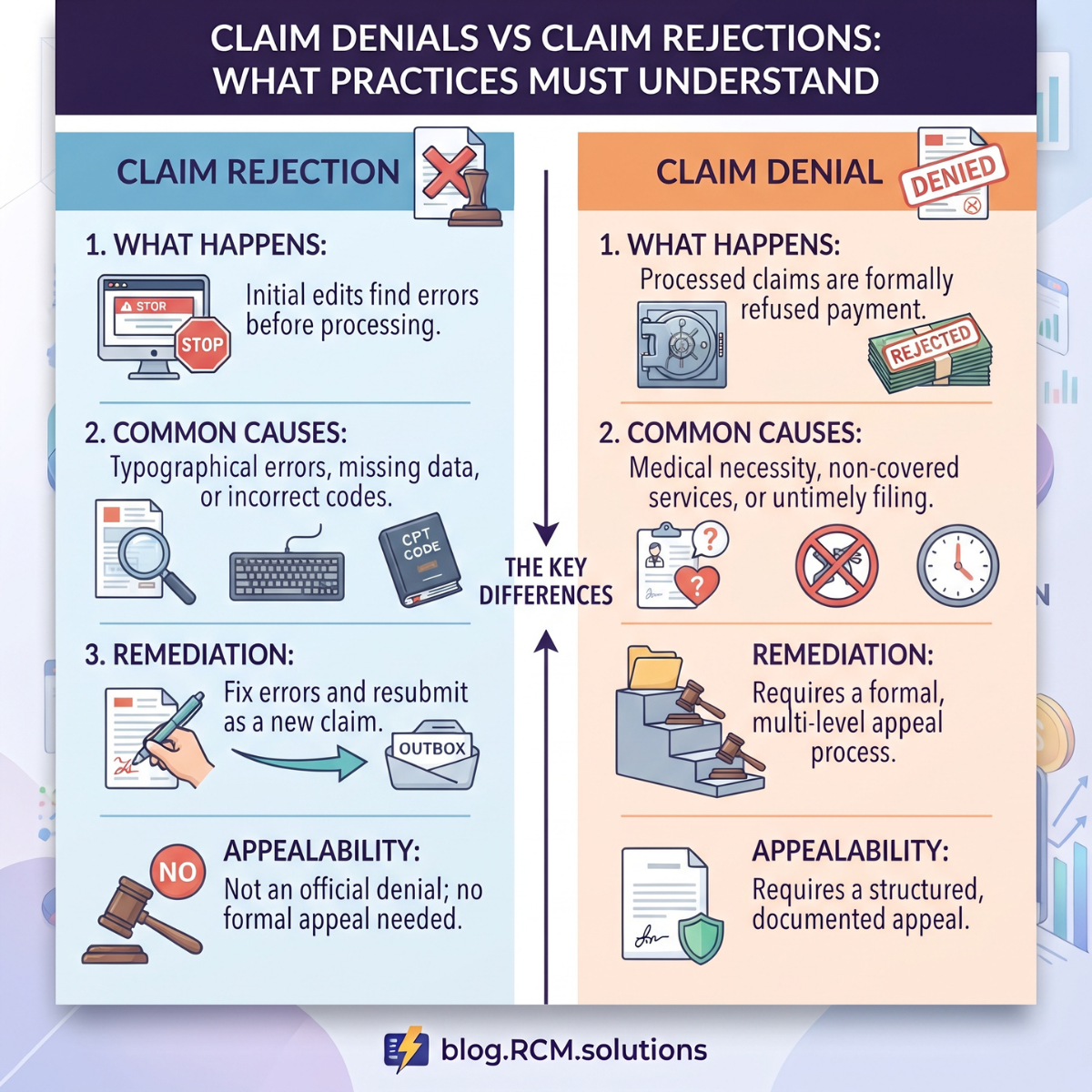
Although these outcomes may appear similar, claim denials and claim rejections represent different problems in medical billing.
Confusing the two can lead to incorrect claim corrections, unnecessary appeals, missed filing deadlines, delayed reimbursement, and increased administrative expenses.
For example, a claim rejected because of an invalid patient insurance identification number generally needs correction and resubmission. A claim denied because the payer determined that a procedure was not medically necessary may require additional documentation, reconsideration, or a formal appeal.
The resolution processes are not interchangeable.
Understanding claim denials vs claim rejections helps medical practices identify where billing errors occur, assign appropriate corrective actions, and prevent avoidable revenue leakage.
This guide explains how rejected and denied claims differ, why they happen, how to resolve them, and how healthcare organizations can improve overall revenue cycle performance.
What Is a Claim Rejection in Medical Billing?
A claim rejection generally occurs when an insurance claim fails validation before being accepted into the payer's adjudication process.
The rejection may originate from a clearinghouse, payer electronic data interchange system, or another claim-processing validation stage.
Claims are commonly rejected because required information is missing, incorrectly formatted, invalid, or inconsistent.
Examples include incorrect patient demographics, invalid insurance identification numbers, missing provider identifiers, or electronic claim formatting errors.
A rejected claim ordinarily has not received a payment determination.
Instead, the submitting organization receives an acknowledgment or error report identifying the issue.
The billing team must investigate the rejection, correct the appropriate information, and retransmit the claim.
For example, suppose a practice submits an office visit claim with an invalid subscriber identification number.
The payer cannot match the submitted information to an eligible member record, and the claim fails initial validation.
The practice must verify the patient's insurance information and submit the corrected claim.
The essential point is that a rejected claim has not successfully completed the intake process required for payment adjudication.
However, organizations should recognize that Medicare and commercial payer systems may use the word "rejection" at different processing stages. Always verify the actual claim status rather than relying exclusively on the terminology displayed in software.
What Is a Claim Denial in Medical Billing?
A claim denial occurs when an insurance payer processes a claim but makes an unfavorable payment determination for one or more services.
Unlike a typical front-end rejection, a denied claim has undergone payer adjudication.
The payer may determine that the service is not covered, the documentation does not support medical necessity, an authorization requirement was not satisfied, or the coding does not meet applicable payment rules.
Denials may affect an entire claim or individual claim lines.
For example, a practice submits a claim for an orthopedic procedure.
The claim passes electronic validation, but the payer determines that a required prior authorization was missing.
The payer processes the claim and denies payment.
The billing team must evaluate the denial, determine whether the decision is correct, and identify an appropriate resolution.
Some denied claims can be corrected or reconsidered. Others require formal appeals, and certain denials may not be recoverable.
A denial is a payment decision, not simply an unsuccessful electronic submission.
Claim Denials vs Claim Rejections: Key Differences
| FactorClaim RejectionClaim Denial | ||
| Processing stage | Usually before adjudication | After payer adjudication |
| Primary issue | Validation or submission error | Coverage, coding, authorization, or payment decision |
| Typical source | Clearinghouse or payer intake system | Insurance payer |
| Common notification | Acknowledgment or rejection report | Remittance advice or denial notice |
| Typical response | Correct and resubmit | Review, correct, reconsider, or appeal |
| Payment determination | Generally not made | Made for affected services |
| Main risk | Claim never enters processing | Claim is processed but payment is refused |
| Deadline concern | Timely filing and resubmission | Correction, reconsideration, and appeal deadlines |
The most important distinction is whether the claim was accepted for adjudication and whether a payment determination was made.
That status determines the next appropriate billing action.
How Insurance Claims Move Through the Billing Process
Understanding the claims process makes it easier to identify where rejections and denials originate.
Stage 1: Claim Preparation
The medical billing team prepares the claim using patient information, provider details, diagnosis codes, CPT or HCPCS codes, modifiers, units, and other required information.
Stage 2: Clearinghouse Validation
Many practices send electronic claims through a clearinghouse.
The clearinghouse checks formatting, required fields, and other validation requirements.
Claims that fail its edits may be rejected before reaching the insurance payer.
Stage 3: Payer Intake
Claims reaching the payer undergo additional electronic validation.
The payer may reject claims that fail its intake requirements.
Stage 4: Payer Adjudication
Accepted claims enter processing for coverage, coding, medical necessity, authorization, benefit, and payment evaluation.
This stage may produce payment, partial payment, or denial.
Stage 5: Remittance and Payment Posting
The payer communicates adjudication results through electronic or paper remittance information.
The billing team records payments, adjustments, denials, and applicable patient responsibility.
CMS explains that Medicare electronic claims undergo multiple levels of edits before coverage and payment policy processing.
This shows why a successful electronic transmission does not automatically mean a claim has been accepted for adjudication or approved for payment.
Common Causes of Claim Rejections
Claim rejections frequently arise from preventable administrative or electronic submission errors.
1. Incorrect Patient Demographics
A misspelled name, incorrect birth date, or inconsistent subscriber information may prevent the payer from identifying the patient.
2. Invalid Insurance Identification
Claims may fail validation when the subscriber ID, group number, or insurance information does not match payer requirements.
3. Missing Provider Identifiers
Incorrect or missing National Provider Identifier information, taxonomy codes, or other required provider data can trigger rejection.
4. Invalid Diagnosis or Procedure Codes
An expired, invalid, or improperly formatted diagnosis or procedure code may fail validation.
5. Missing Required Claim Fields
Claims may be rejected when important information such as dates of service, required identifiers, or other mandatory data is omitted.
6. Electronic Formatting Problems
Electronic claims must comply with applicable transaction standards and implementation requirements.
Invalid segments, data formats, or electronic file structures can cause submission failures.
7. Incorrect Payer Selection
Submitting a claim to the wrong payer destination may produce a routing or validation rejection.
These problems should be addressed through accurate registration, reliable claim validation, and daily rejection monitoring.
Common Causes of Claim Denials
Claim denials generally involve payer decisions after claims enter adjudication.
1. Lack of Medical Necessity
The payer determines that the submitted diagnosis or clinical documentation does not support coverage for the service.
2. Missing Prior Authorization
A service requiring advance authorization was performed without satisfying the applicable requirements.
3. Non-Covered Services
The patient's benefit plan excludes the service or does not cover it under the circumstances billed.
4. Coding and Modifier Issues
The payer identifies a problem involving procedure coding, diagnosis relationships, modifiers, units, or other payment rules.
5. Duplicate Billing
The payer determines that the same or overlapping service has already been processed.
6. Coordination-of-Benefits Problems
The claim may require processing by another insurer before the payer can determine its responsibility.
7. Provider or Network Issues
Payment may be affected by provider enrollment, participation, billing arrangements, or network restrictions.
8. Untimely Filing
The claim was not received within the applicable payer filing period.
Not every denial means the provider made an error.
Some denials result from payer processing mistakes, disputed interpretations of coverage policy, or information the payer has not considered.
The billing team must investigate the actual reason before deciding whether to correct, appeal, or close the claim.
How to Identify Whether a Claim Was Rejected or Denied
The first step in resolving an unpaid claim is determining its actual processing status.
For rejected claims, review clearinghouse responses, payer acknowledgment reports, and applicable electronic submission messages.
Healthcare electronic transactions may include:
- 999 acknowledgment: Communicates results of electronic transaction implementation validation.
- 277CA acknowledgment: Communicates claim-level acceptance or rejection information.
- 276/277 claim status transactions: Support claim status inquiries and responses.
These transactions have different purposes. A 277CA acknowledgment should not be confused with a 277 claim status response.
For denied claims, review the payer's electronic remittance advice, explanation of benefits, or formal denial notification.
An 835 electronic remittance advice can report adjudication results and adjustments.
Claim Adjustment Reason Codes, Remittance Advice Remark Codes, and adjustment group codes help explain payment decisions and financial responsibility.
The billing team should identify the status, payer message, affected claim lines, and applicable deadline before taking corrective action.
How to Correct a Rejected Medical Claim
Rejected claims should move through a controlled correction process.
Step 1: Identify the rejection source.
Determine whether the rejection came from the clearinghouse, electronic transaction validation, or payer intake system.
Step 2: Read the rejection details.
Review the rejection message and identify the affected information.
Step 3: Verify the original data.
Compare submitted information with patient registration records, insurance information, provider records, and clinical documentation.
Step 4: Correct the underlying error.
Update the appropriate source record and the claim.
Avoid changing information merely to force acceptance.
Step 5: Resubmit the claim.
Transmit the corrected claim using the appropriate submission method.
Step 6: Confirm acceptance.
Review the new acknowledgment to verify that the claim passed applicable validation and reached the intended processing stage.
A corrected transmission is not successful simply because the billing software marks the claim as sent.
The billing team should confirm its accepted status.
How to Resolve a Denied Medical Claim
Denied claims require a different workflow because the payer has already made a payment decision.
Step 1: Review the denial reason.
Examine remittance details, adjustment codes, payer correspondence, and the applicable policy.
Step 2: Verify the claim.
Determine whether the original claim contained an error or whether the payer may have processed it incorrectly.
Step 3: Review supporting documentation.
Check medical records, authorizations, referrals, coding, coverage information, and relevant contracts.
Step 4: Select the appropriate action.
Depending on the payer and denial, this may involve a corrected claim, administrative reopening, reconsideration, peer-to-peer review, or formal appeal.
Step 5: Meet the applicable deadline.
Do not assume that all payers use the same correction or appeal period.
Step 6: Track the outcome.
Record the payer's response, payment determination, follow-up requirements, and final account disposition.
A successful denial management process also identifies the original cause so that similar problems can be prevented.
Claim Resubmission vs Corrected Claim vs Appeal
These terms should not be used interchangeably.
Claim resubmission commonly refers to sending a rejected claim again after correcting the validation problem.
A corrected or replacement claim changes information on a previously accepted or processed claim, using the payer's required replacement procedures.
An appeal challenges a payer's claim determination and requests review of the decision.
For example, an invalid insurance member number may require a corrected resubmission after rejection.
A previously processed claim containing an incorrect procedure detail may require a corrected claim, depending on the payer's rules.
A medical necessity denial supported by appropriate clinical documentation may require an appeal.
Some payers offer reconsideration or reopening processes for specific issues.
Medicare distinguishes minor errors and omissions that may be handled through reopening from determinations requiring the formal appeals process.
The correct workflow depends on the claim's status and the payer's requirements.
Why Filing and Appeal Deadlines Matter
Deadline management is one of the most important differences between rejection and denial workflows.
A rejected claim may not establish that a valid claim was timely received by the payer.
Therefore, submitting an electronic file before the deadline does not necessarily protect the practice if the claim fails required intake validation.
Billing teams must confirm acceptance and retain appropriate submission records.
For Medicare fee-for-service, claims generally must be filed within one calendar year after the date of service, subject to specific exceptions.
Commercial insurance and Medicaid filing periods vary.
Denied claims create another deadline concern: appeals.
For example, a Medicare fee-for-service redetermination request generally must be filed within 120 days from receipt of the initial claim determination.
However, not every Medicare payment issue follows the same appeal process. Certain untimely filing determinations are not appealable as ordinary initial determinations.
A reliable billing system should separately track original filing deadlines, rejection corrections, corrected claim deadlines, and appeals.
Real-World Claim Rejection and Denial Examples
Scenario 1: Rejected Claim Due to Incorrect Insurance Information
A primary care clinic submits an established patient office visit claim.
The subscriber identification number contains an error.
The payer intake system rejects the claim.
Appropriate action: Verify the insurance information, correct the error, resubmit, and confirm payer acceptance.
A formal medical necessity appeal is not the appropriate starting point.
Scenario 2: Denied Claim Due to Missing Authorization
An orthopedic practice performs a procedure requiring prior authorization.
The claim passes validation, but the payer denies payment because no valid authorization is on file.
Appropriate action: Verify whether authorization was required and whether one was obtained. Review the payer's available correction, exception, reconsideration, or appeal procedures.
Retrospective authorization is not guaranteed.
Scenario 3: Denied Claim Due to Medical Necessity
A cardiology practice submits a diagnostic procedure claim.
The payer determines that submitted diagnosis information or documentation does not support the applicable coverage criteria.
Appropriate action: Review the medical record and payer policy, correct any genuine claim errors, and pursue an appropriate appeal when documentation supports coverage.
These examples demonstrate why the same correction process should not be applied to every unpaid claim.
The Financial Impact of Denials and Rejections
Both outcomes increase administrative workload and delay reimbursement.
However, they create different financial risks.
Rejected claims require investigation, corrections, and retransmission.
If not addressed promptly, they may become uncollectible because of filing deadlines.
Denied claims may require medical record reviews, authorization investigation, payer communication, formal appeals, and follow-up.
Each additional action increases the cost of collecting payment.
For illustration, assume a practice processes 2,000 claims monthly.
If 3% are rejected, 60 claims require correction.
If 7% of claims that enter adjudication receive an initial denial, additional accounts require denial review.
These are hypothetical rates, not industry benchmarks.
They demonstrate how even moderate error rates can generate significant work for billing departments.
The financial impact includes delayed cash flow, higher staffing costs, growing accounts receivable, and potentially lost reimbursement.
How Front-End RCM Errors Contribute to Both Problems
Many rejected and denied claims begin with inaccurate information collected before the patient visit.
Registration mistakes can create rejected claims.
Eligibility and benefit verification failures can contribute to coverage denials.
Missing referrals or authorizations can lead to payment disputes.
Incorrect coordination-of-benefits information can disrupt claim processing.
For this reason, claim performance depends heavily on patient access operations.
Medical practices should verify demographics, insurance information, active eligibility, relevant benefits, and applicable authorization requirements before service whenever possible.
Front-end verification does not guarantee payment, but it removes many preventable administrative errors.
The strongest denial prevention strategy begins before the claim is created.
Improve Clinical Documentation and Coding Accuracy
Accurate clinical documentation supports appropriate diagnosis and procedure coding.
Providers must record sufficient information to substantiate the services billed.
Coding teams should select codes and modifiers according to documentation, current code sets, and applicable payer rules.
Common problems include unsupported E/M levels, incorrect procedure selection, invalid modifiers, inaccurate units, and incomplete medical necessity documentation.
Claim scrubbing can identify many structural and coding inconsistencies before submission.
However, automated edits cannot determine every clinical or coverage issue.
Medical coding review, documentation education, and targeted internal audits remain necessary.
The objective is to produce accurate, defensible claims—not simply claims that pass electronic validation.
Why Payer-Specific Rules Matter
A claim accepted by one insurance payer may be rejected or denied by another because payer requirements differ.
Commercial insurance plans, Medicare, Medicare Advantage, and Medicaid programs may apply different submission rules, coverage policies, authorization requirements, and correction procedures.
Some payers require specific claim identifiers when replacing previously processed claims.
Others require supporting documentation for appeals or follow separate reconsideration processes.
Therefore, medical practices should maintain a current payer-specific billing reference that includes:
- Submission requirements
- Claim validation rules
- Filing deadlines
- Corrected claim procedures
- Reconsideration requirements
- Appeal deadlines
- Authorization policies
- Supporting documentation requirements
A standardized workflow is useful, but it must accommodate payer-specific differences.
How Technology Helps Prevent Claim Denials and Rejections
An integrated medical billing platform can improve visibility across claim submission and reimbursement.
Useful capabilities include automatic demographic validation, electronic eligibility verification, coding checks, claim scrubbing, acknowledgment tracking, denial management, and accounts receivable reporting.
For rejected claims, the system should identify the rejection source, display relevant errors, assign corrective tasks, and confirm successful retransmission.
For denied claims, it should capture remittance codes, categorize denial reasons, track appeal deadlines, and record resolution outcomes.
Technology can also connect errors to their original sources.
For example, repeated invalid subscriber numbers may indicate a registration workflow problem.
Recurring authorization denials may indicate a patient access or authorization management weakness.
Automation should help staff identify and correct these patterns rather than merely increasing claim submission volume.
Essential Metrics Every Billing Team Should Monitor
Practices should measure rejected and denied claims separately.
Claim Rejection Rate
The percentage of submitted claims rejected during the defined validation stage.
The practice should specify whether its measurement includes clearinghouse rejections, payer intake rejections, or both.
Initial Denial Rate
The percentage of claims receiving an initial unfavorable adjudication decision under a consistent measurement methodology.
First-Pass Acceptance Rate
The percentage of claims passing the organization's defined initial submission requirements without correction.
Denial Overturn Rate
The percentage of eligible denied claims successfully reversed through the applicable review process.
Time to Rejection Resolution
The average or median time required to correct and successfully retransmit rejected claims.
Time to Denial Resolution
The time between receiving a denial and reaching final resolution.
Denial Write-Off Rate
The value of reimbursement ultimately written off because claims could not be recovered, measured against an appropriate revenue denominator.
HFMA provides standardized revenue cycle metrics that help organizations distinguish initial denials, remittance denials, denial write-offs, and appeal performance.
Clear definitions are essential because combining rejections and denials into one number can conceal the true source of operational problems.
A 30-Day Improvement Plan for Medical Practices
Week 1: Establish a Baseline
Review rejected and denied claims from recent reporting periods.
Separate clearinghouse rejections, payer intake rejections, and adjudicated denials.
Identify the most frequent reasons and highest-value problem areas.
Week 2: Correct Front-End Errors
Review patient registration, eligibility verification, insurance information, provider enrollment, and authorization workflows.
Introduce validation checks where repeated errors occur.
Week 3: Improve Billing Work Queues
Create separate queues for rejected claims and denied claims.
Assign responsibility for every unresolved account.
Track deadlines and ensure that corrected submissions are acknowledged.
Week 4: Review Results
Compare rejection rates, denial rates, resolution times, and outstanding claim balances against the initial baseline.
Identify recurring problems and assign corrective actions.
Continue monitoring performance after the first month.
The objective is to establish a sustainable process rather than temporarily clearing an existing backlog.
Frequently Asked Questions
Is a rejected medical claim the same as a denied claim?
No. A rejected claim generally fails initial validation before adjudication, while a denied claim has received an unfavorable payer payment determination.
Can a rejected claim be resubmitted?
Usually, yes. The billing team should correct the identified issue, retransmit the claim, and confirm acceptance within applicable filing requirements.
Can a denied claim be resubmitted?
Sometimes, but not automatically as a new original claim. Depending on the circumstances, the proper response may be a corrected claim, reopening, reconsideration, or appeal.
Does an accepted claim guarantee payment?
No. Acceptance confirms that the claim passed a particular processing stage. It does not guarantee coverage, medical necessity, or reimbursement.
Which is more expensive for a medical practice?
The cost depends on the issue. Some rejected claims are straightforward to correct, while denied claims may require extensive investigation and appeals. Either can create significant financial loss if deadlines are missed.
How can practices prevent both?
Use accurate patient registration, timely insurance verification, strong clinical documentation, compliant coding, claim scrubbing, payer-specific workflows, and consistent follow-up.
Final Thoughts
Claim denials and claim rejections both disrupt reimbursement, but they should never be treated as identical billing problems.
A rejected claim generally signals that the submitted information failed validation before adjudication.
A denied claim signals that a payer evaluated the claim and made an unfavorable payment decision.
The difference determines what the medical billing team should do next.
Rejected claims typically require data correction, retransmission, and confirmation of acceptance.
Denied claims require review of the payer determination and may involve corrections, reconsideration, or formal appeals.
For healthcare practices, successful revenue cycle management requires both processes to operate efficiently.
Front-end registration accuracy reduces preventable rejections.
Clinical documentation, coding compliance, authorization management, and payer policy review help reduce avoidable denials.
Effective reporting identifies recurring problems and supports continuous improvement.
The goal is not simply to submit claims faster. It is to submit accurate claims, confirm acceptance, resolve payment disputes appropriately, and collect legitimate reimbursement efficiently.
Medical practices that understand the difference between denials and rejections can reduce unnecessary rework, protect cash flow, and build a more reliable revenue cycle.