
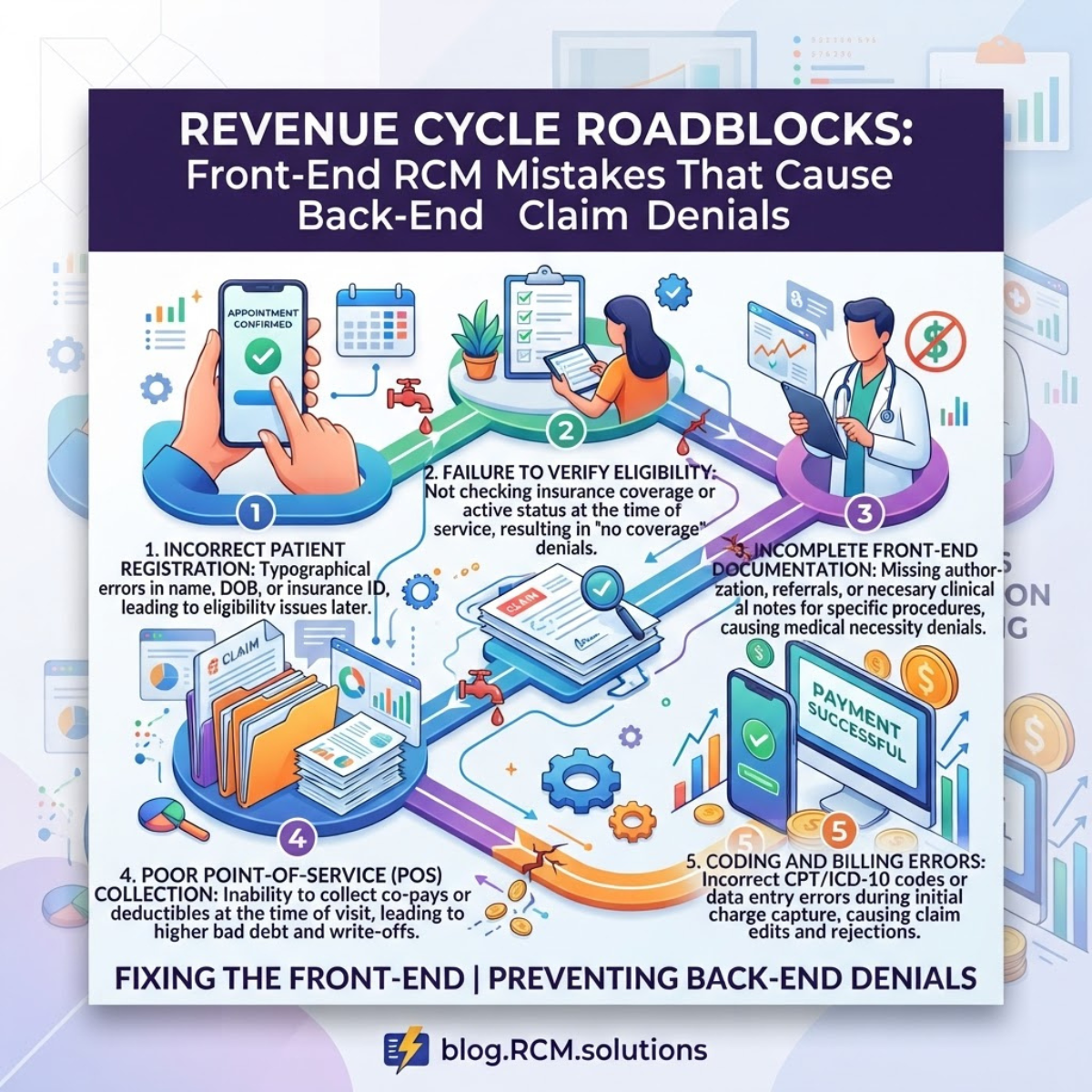
Medical claim denials do not always begin in the billing department. In many healthcare practices, the problems responsible for denied claims start much earlier, during patient scheduling, registration, insurance verification, or prior authorization.
A patient schedules an appointment, visits the provider, receives treatment, and leaves the clinic. The billing team prepares the claim, verifies the coding, and submits it within the payer's filing deadline. Everything appears to be working correctly.
Then the claim gets denied.
The reason may have nothing to do with the medical service itself. The patient's insurance information was outdated, an authorization was missing, a referral was not obtained, or the provider was not correctly registered with the payer.
These are **front-end RCM mistakes that cause back-end claim denials**.
Front-end revenue cycle management is the foundation of successful medical billing. When patient access processes fail, the consequences appear later as claim rejections, denials, delayed reimbursements, administrative rework, and revenue leakage.
According to the Healthcare Financial Management Association (HFMA), revenue cycle management begins with activities such as scheduling, patient registration, insurance verification, authorization, and financial clearance before continuing through claim submission and payment.
The relationship is straightforward: mistakes made before the encounter can create financial problems long after the service is delivered.
Understanding these mistakes and addressing their root causes is essential for improving clean claim rates, reducing administrative expenses, and strengthening healthcare revenue cycle performance.
## What Is Front-End Revenue Cycle Management?
Front-end revenue cycle management refers to the administrative and financial activities performed before or during a patient's appointment to prepare the encounter for accurate billing.
These activities typically include:
- Patient scheduling and preregistration
- Patient demographic collection
- Insurance eligibility verification
- Benefits verification
- Referral and prior authorization management
- Provider network verification
- Patient financial responsibility estimation
- Financial clearance
- Patient check-in and information validation
Each activity establishes information that will later appear in the claim submitted to the insurance payer.
If the information is inaccurate, incomplete, or outdated, the claim may fail payer validation or adjudication.
For example, an incorrect insurance identification number entered during registration may cause a claim rejection. An authorization obtained for the wrong procedure may contribute to a denial. Failure to identify the patient's primary insurer can create coordination-of-benefits problems.
The billing department may discover these issues weeks after the appointment, when correcting them becomes more expensive and time-consuming.
Effective front-end RCM prevents avoidable billing problems before they enter the claims process.
## Why Front-End Errors Lead to Back-End Denials
Healthcare reimbursement depends on more than clinical documentation and accurate medical codes.
Insurance payers also evaluate coverage, patient eligibility, provider participation, authorization requirements, referral rules, and other administrative conditions.
A medical service can be clinically necessary and correctly documented but still encounter reimbursement problems if these administrative requirements are not satisfied.
Consider a patient who receives an orthopedic procedure.
The scheduling team confirms the appointment but fails to identify the payer's prior authorization requirement. The provider performs the procedure, and the billing team submits an accurately coded claim.
The claim is denied because the required authorization was not obtained.
The coding department cannot resolve this problem simply by changing a CPT code. The issue originated before the patient received treatment.
This illustrates why denial prevention must begin at the front end rather than relying exclusively on back-end claim corrections.
It is also important to distinguish a claim rejection from a denial. A rejection generally occurs when a claim fails initial validation and does not enter adjudication. A denial occurs when the payer processes the claim but determines that payment is not appropriate under the applicable rules.
Both create additional work, although their correction processes differ.
## 1. Incorrect Patient Demographic Information
Patient demographic errors are among the most basic yet preventable causes of claim processing problems.
Common registration mistakes include incorrect names, dates of birth, addresses, subscriber relationships, insurance identification numbers, and policyholder information.
Even a minor discrepancy between the submitted information and the payer's enrollment records can result in a rejected claim.
For example, a patient's insurance coverage may be registered under a different legal name than the name entered in the practice management system.
If staff do not identify the discrepancy before the appointment, the payer may be unable to match the claim to the correct member.
The billing team must then investigate, correct the information, and resubmit the claim.
When these errors occur repeatedly, they increase administrative workload and delay payment.
**How to prevent demographic errors:**
Medical practices should verify patient information during scheduling, preregistration, and check-in.
Staff should compare insurance details against the payer's current records rather than relying exclusively on previously saved information.
Electronic registration forms, validation rules, and standardized patient intake procedures can reduce manual entry mistakes.
## 2. Failure to Verify Insurance Eligibility
Insurance eligibility verification is one of the most important front-end RCM activities.
A patient presenting an insurance card does not necessarily mean the coverage is active.
Insurance coverage may have terminated, changed, or become effective on a different date.
Patients may also switch employers, insurance plans, or coverage arrangements without notifying the healthcare provider.
When eligibility is not verified, the practice risks providing services under an inactive or incorrect insurance plan.
The claim may then be denied because the patient was not eligible for the billed service on the date of treatment.
CMS provides a HIPAA-compliant 270/271 eligibility transaction system that allows authorized Medicare providers and billing agents to check eligibility information.
This process helps providers prepare accurate claims and determine potential patient financial responsibility.
**How to prevent eligibility-related denials:**
Verify insurance eligibility before the appointment and recheck when appropriate near the date of service.
Confirm the coverage effective date, termination date, payer information, and applicable service benefits.
Eligibility verification should be an established workflow rather than a task performed only when problems arise.
## 3. Confusing Active Coverage With Service Benefits
One major front-end RCM mistake is assuming that active insurance coverage guarantees reimbursement.
It does not.
Eligibility verification confirms whether coverage exists. Benefits verification determines whether a particular service is covered and under what conditions.
A patient may have active insurance but lack coverage for a specific procedure, diagnostic test, therapy service, or specialist visit.
Certain services may also be subject to frequency limitations, medical necessity requirements, exclusions, or authorization rules.
For example, a patient may have active insurance coverage but limited physical therapy benefits.
If the practice fails to verify those limitations, it may provide services beyond the patient's covered benefit.
The claim may subsequently be denied or processed as patient responsibility, depending on the policy.
**How to prevent benefit-related denials:**
Front-desk and authorization teams should verify service-specific benefits whenever necessary.
They should identify limitations, exclusions, referral requirements, and authorization conditions before treatment.
Most importantly, staff must understand that verification of eligibility or benefits is not a guarantee of payment.
## 4. Missing or Incorrect Prior Authorization
Prior authorization errors create significant reimbursement challenges across multiple medical specialties.
Many insurance payers require authorization before certain medical services can be performed.
These requirements are common for selected imaging services, surgical procedures, specialty treatments, diagnostic services, medications, and therapy programs.
Problems occur when practices fail to obtain authorization or obtain authorization that does not match the service delivered.
Common mistakes include:
- Missing authorization entirely
- Using an expired authorization
- Obtaining approval for the wrong procedure
- Exceeding approved treatment units
- Using an authorization associated with another provider
- Performing services outside the approved date range
The billing team may submit a claim correctly, but the payer can still deny reimbursement because authorization conditions were not satisfied.
CMS emphasizes that prior authorization and pre-claim review do not replace medical necessity or documentation requirements.
Authorization should therefore be treated as one component of a compliant billing process, not as a payment guarantee.
**How to prevent authorization denials:**
Establish an authorization tracking system connected to scheduling and billing.
Confirm authorization numbers, service codes, approved units, provider details, locations, and effective dates before the appointment.
Cases awaiting authorization should have clear ownership and escalation procedures.
## 5. Missing Specialist Referrals
Certain insurance plans require patients to obtain referrals before receiving specialist care.
Referral requirements can affect services provided by cardiologists, neurologists, dermatologists, endocrinologists, orthopedic specialists, and other specialty providers.
A patient may schedule a specialist appointment without knowing that the insurance plan requires a primary care referral.
If the practice does not identify that requirement, the service may be delivered without the necessary referral.
The payer may subsequently deny payment under the patient's plan rules.
**How to prevent referral-related denials:**
Verify referral requirements when scheduling specialist appointments.
Confirm that the referral is valid for the correct specialist, service, date range, and number of visits.
Referral information should be accessible to scheduling, clinical, and billing teams.
A referral requirement identified before the appointment is usually easier to resolve than a denial received weeks afterward.
## 6. Incorrect Primary and Secondary Insurance Information
Coordination of benefits determines which insurance payer is responsible for processing a claim first when a patient has multiple insurance plans.
Problems arise when front-end teams fail to identify the correct primary and secondary coverage.
For example, a patient may have employer-sponsored insurance and Medicare.
The order of payment depends on applicable coordination-of-benefits rules.
If the practice submits the claim to the wrong primary payer, the claim may be denied or returned with instructions to bill another insurer first.
The billing team must then correct the payer sequence and resubmit the claim.
These delays can become especially problematic when filing deadlines differ between payers.
**How to prevent coordination-of-benefits errors:**
Ask patients about all active insurance coverage.
Verify the primary and secondary payer order using applicable coordination rules.
Update the insurance information whenever coverage changes.
Billing systems should maintain accurate coordination-of-benefits records and support secondary claim submission.
## 7. Failure to Verify Provider Network Participation
Provider network participation can significantly affect reimbursement.
Patients may assume that a healthcare provider accepts their insurance because the practice appears in an online directory.
However, network participation may vary by insurance product, provider, location, or effective date.
A physician participating with one plan offered by an insurer may not participate with every product that insurer offers.
If a practice fails to verify network status, claims may be processed under out-of-network benefits or encounter other payer-specific reimbursement restrictions.
This can create lower-than-expected reimbursement, increased patient responsibility, and payment disputes.
**How to prevent network-related billing problems:**
Verify provider participation for the patient's specific insurance product.
Maintain accurate provider enrollment and credentialing records.
Confirm that the billing provider, rendering provider, location, and relevant identifiers match the payer's records.
Network information should be reviewed whenever a provider joins the practice, changes locations, or begins participating with another payer.
## 8. Incorrect Appointment Type or Service Classification
Appointment scheduling is more than selecting a date and time.
The appointment type determines which administrative and billing requirements may apply.
For example, preventive visits, problem-oriented office visits, procedures, therapy sessions, diagnostic services, and telehealth encounters may follow different payer rules.
If scheduling staff classify a procedure as a routine office visit, they may fail to recognize the need for authorization or additional documentation.
Similarly, an incorrectly classified telehealth appointment may result in incomplete patient-location or modality information.
These errors can later affect coding, place-of-service reporting, modifier selection, or payer processing.
**How to prevent appointment classification errors:**
Create standardized appointment categories that reflect the practice's services.
Connect appointment types with relevant coverage checks, referral requirements, authorization workflows, and documentation prompts.
Staff should understand which appointment categories require additional financial clearance before the visit.
## 9. Failure to Capture Accurate Provider Information
Claims require accurate information identifying the healthcare professionals and organizations involved in the service.
Errors involving National Provider Identifier numbers, Tax Identification Numbers, provider enrollment records, billing addresses, service locations, or rendering provider details can result in claim processing failures.
These problems are especially common when practices add new providers, open additional locations, or change billing arrangements.
A physician may deliver a covered service, but the claim may be rejected or denied because the payer does not recognize the submitted provider information.
**How to prevent provider-related errors:**
Maintain a current provider enrollment database.
Confirm that provider records match information registered with each payer.
Establish a process for updating billing systems when providers join, leave, relocate, or change practice affiliations.
Provider credentialing and billing teams should coordinate before new providers begin generating claims.
## 10. Incomplete Financial Clearance
Financial clearance determines whether the administrative requirements needed for a patient's planned service have been addressed.
This may include reviewing eligibility, benefits, authorizations, referrals, network status, and expected financial responsibility.
When financial clearance is incomplete, appointments may proceed despite unresolved billing issues.
For example, an authorization request may still be pending when the patient arrives for an elective procedure.
Without a defined workflow, the service may proceed before the practice confirms whether the payer's requirements have been satisfied.
The result can be a preventable authorization-related denial.
**How to improve financial clearance:**
Use a standardized clearance checklist for services with significant billing requirements.
Assign unresolved items to specific employees.
Escalate missing authorizations, coverage concerns, and referral problems before the appointment.
Emergency care and legally protected services must still be handled according to applicable care obligations; financial clearance should not become an inappropriate barrier to medically necessary treatment.
## 11. Poor Communication Between Front-End and Back-End Teams
Revenue cycle problems frequently develop when scheduling, registration, clinical, authorization, coding, and billing departments operate independently.
The front desk may update insurance information without notifying billing.
The authorization department may obtain approval but fail to associate it with the correct encounter.
A provider may change the planned procedure without triggering another authorization review.
The billing team then receives incomplete or inconsistent information.
Even well-trained billers cannot consistently submit accurate claims when essential information is missing from earlier workflows.
**How to improve communication:**
Use shared work queues, standardized handoffs, and clearly assigned responsibilities.
Changes to insurance coverage, procedures, authorization status, or provider information should be visible across relevant departments.
Practices should also hold periodic meetings to review front-end errors that contributed to denied claims.
## 12. Relying on Outdated Patient Information
Many practices reuse previously stored patient information to speed up registration.
Although this reduces data entry, it can create problems when details are no longer current.
Insurance coverage, addresses, employment information, policyholders, and contact details may change between appointments.
A patient who visited the clinic three months ago may now have a completely different insurance plan.
If the practice automatically carries forward the previous payer information, the claim may be submitted incorrectly.
**How to prevent outdated information errors:**
Require patients to confirm key demographic and insurance details during each registration cycle.
Reverify eligibility when appropriate rather than assuming previous coverage remains valid.
Flag material changes for review before claim submission.
Automation should make verification easier, not replace verification entirely.
## 13. Weak Telehealth Registration Workflows
Telehealth adds another layer of front-end billing requirements.
Virtual appointments may require the practice to capture the patient's location, service modality, provider type, and other payer-specific information.
Incorrect information can affect place-of-service reporting and telehealth modifier selection.
For example, POS 02 generally identifies telehealth services provided when the patient is somewhere other than home, while POS 10 identifies telehealth received in the patient's home.
Payer-specific requirements may also distinguish audio-only services from synchronous audio-video services.
If these details are missing, the billing team may struggle to select the appropriate billing information.
**How to prevent telehealth billing errors:**
Capture the patient's location and expected communication modality during intake.
Confirm the actual modality used during the encounter.
Verify that the service is covered under the patient's insurance policy and applicable telehealth rules.
Use the correct codes, POS information, and modifiers based on the service and payer requirements.
## 14. Failure to Review Unresolved Registration and Authorization Issues
Another common mistake is allowing unresolved front-end problems to remain open without clear accountability.
Examples include pending eligibility verification, incomplete registration information, missing referrals, and authorization requests awaiting payer decisions.
If these issues are not actively monitored, patients may arrive for services before the practice has completed the required administrative review.
The billing department may discover the problem only after receiving a rejection or denial.
At that point, resolution may require additional calls, supporting documentation, corrected submissions, or formal appeals.
**How to prevent unresolved issues:**
Create front-end exception queues.
Every exception should have an assigned owner, current status, follow-up date, and escalation pathway.
High-risk appointments should receive priority review before the date of service.
Practices should monitor unresolved cases daily rather than relying on individual staff members to remember them.
## How Front-End RCM Mistakes Affect Practice Revenue
Front-end errors produce financial consequences beyond the value of an individual denied claim.
A preventable denial requires additional staff time to investigate the reason, communicate with the payer, gather records, submit corrections, or prepare appeals.
During this process, reimbursement remains delayed.
When the same errors occur repeatedly, they can increase accounts receivable, reduce operational efficiency, and create unnecessary collection costs.
Some denials may become uncollectible because filing or appeal deadlines expire.
Others may eventually be paid but only after avoidable administrative work.
Poor front-end processes can also affect the patient experience.
Patients may receive unexpected bills, repeated insurance-related phone calls, or confusing explanations of financial responsibility.
Therefore, front-end revenue cycle performance affects both financial stability and patient satisfaction.
## How to Build an Effective Front-End RCM Workflow
Reducing preventable claim denials requires a structured process that begins before the appointment.
### Step 1: Standardize Patient Scheduling
Scheduling teams should collect accurate demographic information, identify the planned service, and determine whether additional verification is necessary.
### Step 2: Verify Coverage and Benefits
Check active insurance coverage and review service-specific benefits.
Confirm applicable coverage restrictions, referral requirements, and authorization conditions.
### Step 3: Complete Authorization and Referral Reviews
Identify authorization and referral requirements before treatment.
Verify approved services, dates, units, providers, and locations.
### Step 4: Confirm Financial Clearance
Review unresolved administrative issues before the appointment.
Escalate potential billing problems according to established practice policies.
### Step 5: Validate Information at Check-In
Confirm patient identity, insurance details, appointment type, and relevant financial information.
### Step 6: Connect Front-End Information With Billing
Ensure verified insurance details, authorization records, referrals, and provider information are available in the billing workflow.
### Step 7: Analyze Denials and Correct Root Causes
Review rejected and denied claims to determine whether the original problem occurred during scheduling, registration, eligibility verification, authorization, or another front-end activity.
Use those findings to improve workflows and staff training.
This approach moves the practice from reactive denial correction toward proactive denial prevention.
## Key Metrics to Measure Front-End RCM Performance
Medical practices should evaluate front-end RCM using measurable performance indicators.
Important metrics include:
**Registration Accuracy Rate:** Measures the percentage of patient registrations completed without identified demographic or insurance errors.
**Eligibility Verification Completion Rate:** Tracks the percentage of applicable encounters with completed eligibility verification.
**Authorization Completion Rate:** Measures whether required authorizations were obtained before the applicable service.
**Front-End-Related Denial Rate:** Tracks claim denials attributed to registration, eligibility, referral, authorization, and related administrative issues.
**Claim Rejection Rate:** Measures claims rejected during initial processing or validation.
**Clean Claim Rate:** Evaluates the proportion of claims accepted for processing without requiring corrections.
**Financial Clearance Rate:** Measures how many applicable encounters meet established clearance requirements before the visit.
Tracking these indicators helps practices identify weak processes before they create substantial revenue loss.
Metrics should be reviewed by payer, location, specialty, and responsible workflow whenever possible.
## The Role of Technology in Preventing Front-End Claim Denials
Technology can improve front-end revenue cycle management by connecting administrative processes with billing workflows.
An integrated RCM platform may support:
- Electronic eligibility verification
- Automated insurance information checks
- Prior authorization tracking
- Referral management
- Provider enrollment validation
- Patient registration workflows
- Financial clearance monitoring
- Claim validation
- Denial analytics
- Reporting and performance dashboards
For example, an integrated system can identify that an appointment requires authorization and flag the encounter before the scheduled service.
It can also notify staff when eligibility information is missing or when a payer-related issue remains unresolved.
However, technology is not a substitute for accurate data entry, appropriate clinical decisions, trained staff, or payer-specific compliance review.
Its value comes from making problems visible earlier and reducing unnecessary manual work.
For multi-specialty practices, integration is particularly important because different specialties may have different authorization, referral, and coverage requirements.
## Front-End RCM and Prior Authorization Changes in 2026
Healthcare organizations must also keep front-end workflows aligned with changing regulatory requirements.
Under the CMS Interoperability and Prior Authorization Final Rule, certain impacted payers became subject to additional prior authorization requirements beginning in 2026.
These include decision timeframes of 72 hours for expedited requests and seven calendar days for standard requests, as well as requirements to communicate specific reasons for prior authorization denials.
The provisions apply to specified payer categories and are not universal requirements for every insurer or service. Drug authorizations are excluded from these particular provisions.
Additional electronic prior authorization API requirements are scheduled for 2027.
These developments reinforce the importance of maintaining accurate authorization workflows and monitoring payer-specific requirements.
Practices should verify current rules instead of assuming historical processes remain valid.
## Best Practices for Reducing Back-End Claim Denials
The most effective denial prevention strategy is to identify errors before services are billed.
Healthcare practices should focus on improving registration accuracy, verifying eligibility, checking benefits, completing prior authorizations, validating referrals, and maintaining reliable payer information.
They should also establish clear communication between administrative and billing departments.
Front-end employees must understand the financial consequences of inaccurate data.
Billing teams should share denial findings with the departments responsible for the original information.
Managers should review front-end performance regularly and update workflows when recurring problems appear.
Importantly, practices should separate preventable administrative denials from denials caused by clinical coverage criteria, payer policy disagreements, or other issues outside the front-end team's control.
This distinction helps leadership prioritize improvements accurately.
The objective is not to eliminate every possible claim denial. Some payment disputes require clinical review or formal appeal.
The objective is to eliminate avoidable administrative errors that prevent otherwise payable claims from being processed correctly.
## Final Thoughts
Front-end revenue cycle management is not simply an administrative function.
It is a critical component of medical billing accuracy, denial prevention, and financial performance.
Incorrect patient demographics, missed insurance verification, incomplete benefits checks, missing authorizations, referral problems, provider enrollment errors, and poor departmental communication can all create reimbursement problems after treatment has been delivered.
These issues often appear as back-end claim denials, but their root causes begin much earlier.
Medical practices that focus only on correcting denied claims remain stuck in a reactive revenue cycle.
Practices that strengthen front-end processes can identify potential problems before services are performed and claims are submitted.
**The key principle is straightforward: preventing an avoidable denial is generally more efficient than correcting it after submission.**
Accurate registration, timely verification, effective authorization tracking, coordinated workflows, and consistent monitoring provide the foundation for cleaner claims and stronger reimbursement performance.
A successful revenue cycle does not begin when the claim reaches the billing department.
It begins when the patient schedules the appointment.