
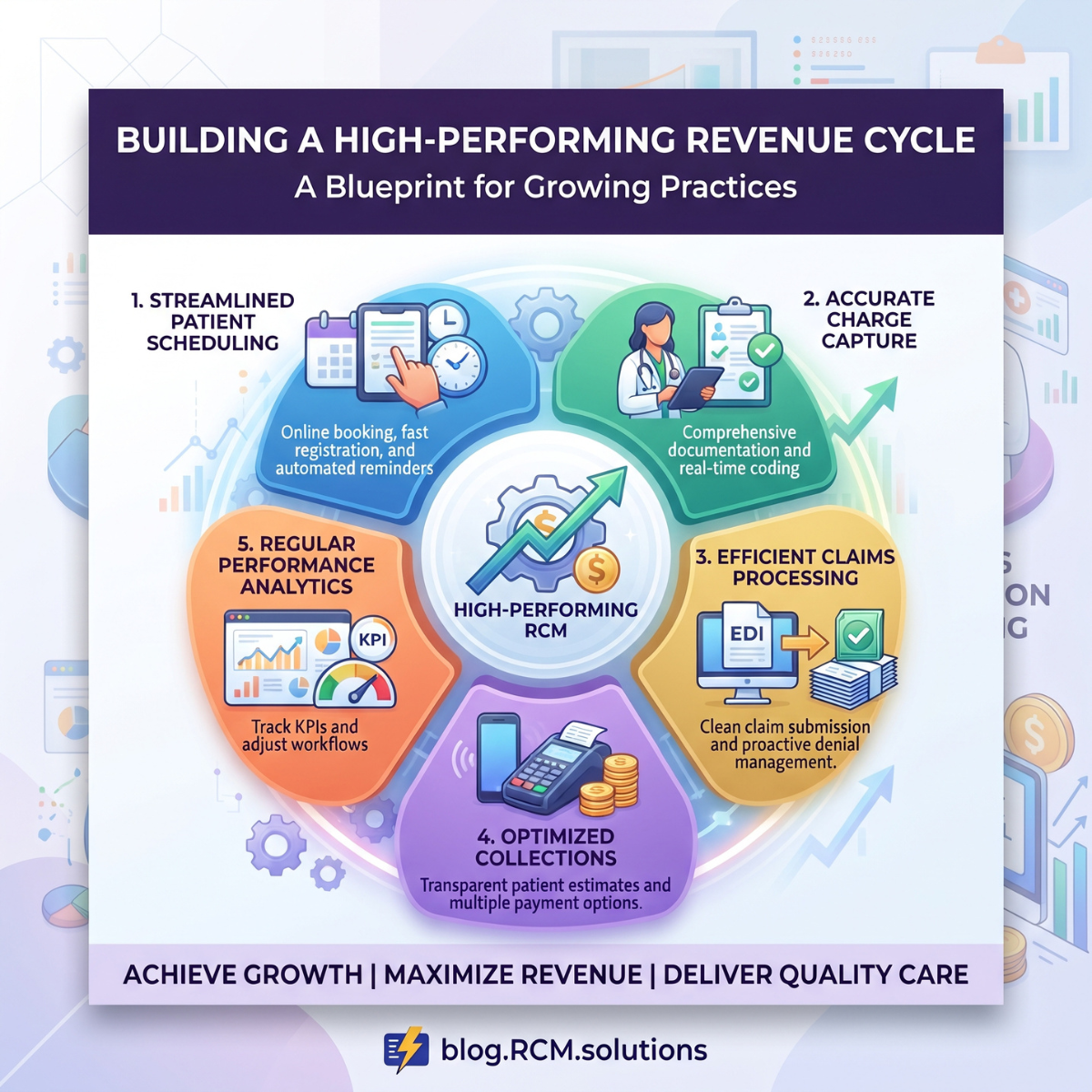
# How to Build a High-Performing Revenue Cycle for a Growing Practice
Growing a medical practice is an exciting milestone, but expansion also introduces significant financial and operational challenges. More patients, additional providers, new specialties, and multiple insurance contracts increase revenue opportunities while making medical billing and reimbursement more complicated.
A practice may experience higher patient volumes without seeing equivalent improvements in cash flow. Claims may be submitted regularly, but denials increase, accounts receivable grows, payments become delayed, and billing teams struggle to manage the workload.
This is where a high-performing revenue cycle becomes essential.
**A high-performing revenue cycle ensures that healthcare services are accurately documented, appropriately billed, efficiently processed, and reimbursed according to applicable payer requirements.**
It connects every financial touchpoint, from patient scheduling and insurance verification to medical coding, claim submission, denial management, payment posting, and final account resolution.
According to the Healthcare Financial Management Association (HFMA), revenue cycle management covers the financial process from the patient's initial appointment or encounter through final payment.
For a growing medical practice, effective RCM is not simply an administrative responsibility. It is a critical component of financial stability, operational scalability, and long-term success.
This guide explains how to build a high-performing revenue cycle that can support practice growth without sacrificing billing accuracy, compliance, or patient experience.
## Why Growing Medical Practices Need Strong Revenue Cycle Management
A revenue cycle that works for a small clinic may become inefficient as the organization expands.
A practice with two physicians may initially manage billing through a small administrative team. However, adding providers, expanding into new specialties, and accepting additional insurance plans creates new operational requirements.
Each provider may deliver different services. Each specialty may involve unique CPT codes, modifiers, documentation standards, and authorization requirements.
Insurance payers also maintain different coverage policies, reimbursement structures, filing deadlines, and appeal procedures.
Without standardized revenue cycle workflows, growth can create additional billing problems rather than stronger financial performance.
Common challenges include:
- Increased claim denials
- Delayed insurance reimbursements
- Inaccurate patient information
- Missing prior authorizations
- Inconsistent medical documentation
- Coding and modifier errors
- Growing accounts receivable
- Unidentified payer underpayments
- Higher administrative expenses
- Poor visibility into revenue performance
A strong revenue cycle helps practices manage these challenges through standardized processes, clearly assigned responsibilities, reliable technology, and continuous performance monitoring.
## 1. Evaluate Your Current Revenue Cycle Performance
Before improving revenue cycle performance, a medical practice must understand where the existing process is failing.
Many practices make the mistake of investing in additional billing software or hiring more employees without identifying the underlying problems.
That approach increases expenses without necessarily correcting operational inefficiencies.
Start with a complete assessment of the current revenue cycle.
Review patient registration, eligibility verification, authorization tracking, documentation, charge capture, coding, claim submission, denial management, payment posting, and collections.
Determine where claims are delayed, where errors originate, and which processes require repeated manual intervention.
Important questions include:
- How many claims require correction before submission?
- Which payers generate the most denials?
- How quickly are charges entered after patient visits?
- How much outstanding A/R is older than 90 days?
- How often are authorization-related denials received?
- Are payments being compared against contracted reimbursement?
- How much staff time is spent correcting preventable errors?
HFMA's MAP Keys provide standardized revenue cycle performance indicators covering patient access, pre-billing, claims, account resolution, and financial management.
Using consistent measurements allows management to establish a reliable performance baseline.
**The first step toward improvement is identifying where revenue is delayed, denied, underpaid, or lost.**
## 2. Build a Strong Patient Registration Process
A high-performing revenue cycle begins before the patient enters the examination room.
Patient scheduling and registration create the foundation for accurate claims.
If demographic or insurance information is incorrect, the error can travel through the entire billing workflow.
For example, an incorrect insurance identification number may cause a claim rejection even when the provider performed and documented the service correctly.
Growing practices should standardize patient registration across all providers and locations.
Essential information includes:
- Patient name and date of birth
- Current contact information
- Insurance identification and group numbers
- Subscriber information
- Primary and secondary coverage
- Appointment type
- Referral requirements
- Relevant authorization information
Digital preregistration can help reduce manual data entry and administrative workload.
However, automation should not replace verification.
Staff should confirm key information before the encounter, particularly when patients have changed insurance plans.
Accurate registration reduces downstream corrections and helps the billing department submit cleaner claims.
## 3. Make Insurance Verification a Standard Workflow
Insurance eligibility verification should never depend on whether an employee remembers to perform it.
It must be a standardized part of patient access.
An insurance card does not guarantee active coverage, and active coverage does not guarantee reimbursement for every service.
Practices need to verify both eligibility and relevant benefits.
Eligibility verification confirms whether coverage is active.
Benefits verification identifies applicable coverage limitations, copayments, deductibles, coinsurance, and service-specific requirements.
For growing practices, electronic eligibility verification can reduce repetitive administrative work.
A reliable verification process should identify coverage problems before treatment whenever possible.
For example, if a patient schedules a specialty procedure, the practice should verify coverage requirements before the appointment rather than discovering exclusions after submitting the claim.
This improves financial predictability and helps staff communicate expected patient responsibility.
## 4. Strengthen Prior Authorization and Referral Management
Prior authorization management becomes increasingly important as practices add specialties and procedures.
Certain imaging services, surgeries, therapies, medications, and diagnostic procedures may require payer approval before treatment.
Failure to obtain a required authorization can result in denial even when a claim is otherwise correctly prepared.
A scalable authorization workflow should track:
- Payer requirements
- Authorization numbers
- Approved procedure codes
- Effective and expiration dates
- Approved service units
- Referring and rendering providers
- Applicable service locations
- Pending requests and appeals
Growing practices should assign clear responsibility for authorization review.
Unresolved requests should be visible to scheduling and clinical teams so that appropriate decisions can be made before treatment.
Payer requirements must also be reviewed regularly.
For example, CMS's prior authorization rule establishes specific decision timeframes for certain impacted payers beginning in 2026, including seven calendar days for many standard requests and 72 hours for expedited requests. These provisions do not apply universally to every payer or to drug authorization requests.
Practices must therefore maintain payer-specific authorization procedures.
## 5. Improve Clinical Documentation Quality
Clinical documentation directly influences medical coding accuracy and reimbursement.
Providers must document the medical necessity, assessment, services performed, and treatment decisions supporting the codes billed.
Incomplete documentation can result in downcoding, medical necessity denials, additional payer requests, and compliance concerns.
Growing practices should establish documentation standards appropriate to each specialty.
For example, dermatology procedures may require lesion size, location, and treatment method.
Cardiology encounters may involve diagnostic test interpretation, medication management, and separately billable services.
Orthopedic procedures may require specific anatomical details, laterality, and procedural documentation.
Behavioral health services may involve time-based coding and service-specific documentation requirements.
The goal is not to produce unnecessarily lengthy notes.
The goal is to capture the clinical information required to support accurate billing.
Providers and coding teams should regularly review documentation patterns and identify recurring deficiencies.
Effective documentation supports both clinical continuity and compliant reimbursement.
## 6. Eliminate Charge Capture Gaps
Charge capture ensures that all medically necessary, appropriately documented, and billable services are recorded.
A practice cannot receive reimbursement for a service that never enters the billing workflow.
As organizations grow, missing charges can become harder to detect.
Providers may perform additional procedures, injections, diagnostic tests, or ancillary services during an encounter.
If those services are documented but not transferred into the billing system, legitimate revenue opportunities may be missed.
Charge capture reviews should compare clinical documentation against submitted charges.
Practices should investigate:
- Procedures documented but not charged
- Missing injection administration charges
- Incorrect medication units
- Unbilled diagnostic services
- Delayed provider documentation
- Incomplete charge entry
- Missing applicable supplies or ancillary services
Charge capture should remain connected to clinical documentation and coding compliance.
The goal is complete and accurate billing, not maximizing charges without justification.
## 7. Standardize Medical Coding and Modifier Accuracy
Medical coding becomes more complex when a practice adds providers or specialties.
Different clinical services require appropriate ICD-10-CM diagnosis codes, CPT codes, HCPCS codes, modifiers, units, and place-of-service information.
Errors may cause rejected claims, denials, payment reductions, or compliance risks.
For example, Modifier 25 may be appropriate when a significant, separately identifiable E/M service is performed on the same day as a procedure.
Modifier 59 may be appropriate when distinct procedural services meet applicable coding requirements.
However, modifiers should never be applied automatically to bypass payer edits.
Growing practices need specialty-specific coding workflows and regular quality reviews.
Effective coding controls include:
- Updated code sets
- Specialty-specific coding education
- Documentation validation
- Modifier review
- Payer policy checks
- Coding audits
- Error trend analysis
Coders should have access to current payer requirements and clear escalation procedures for documentation questions.
Accurate coding protects legitimate reimbursement while reducing audit exposure.
## 8. Establish a Clean Claim Submission Process
Fast claim submission is valuable, but accuracy matters more than speed alone.
A clean claim contains the necessary information for processing without avoidable manual correction.
Before submission, claims should be reviewed for missing information, coding errors, authorization problems, invalid modifiers, incorrect payer details, and other applicable edits.
An effective claim scrubbing process can identify potential problems before the payer receives the claim.
Practices should also distinguish between claim rejections and denials.
A rejected claim generally fails initial validation and requires correction before adjudication.
A denied claim has undergone payer processing but has not been approved for payment.
Both require timely follow-up.
Growing practices should maintain daily rejection work queues and assign responsibility for correcting rejected claims.
The goal is to prevent avoidable errors from becoming recurring reimbursement delays.
## 9. Create a Proactive Denial Management Strategy
Denial management should focus on prevention as well as recovery.
Many billing departments spend most of their time correcting individual denied claims.
However, repeatedly correcting the same problem does not improve the underlying process.
A high-performing revenue cycle identifies why denials occur and implements corrective actions.
Common denial categories include:
- Eligibility and registration errors
- Missing prior authorization
- Referral problems
- Coding inaccuracies
- Medical necessity issues
- Duplicate claims
- Coordination-of-benefits errors
- Timely filing problems
- Provider enrollment issues
Every denial should have a responsible owner and a defined resolution workflow.
Claims approaching appeal deadlines should receive priority attention.
Revenue cycle managers should review denial patterns by payer, specialty, provider, location, and reason code.
For example, repeated authorization denials may indicate a patient access problem rather than a coding problem.
Correcting the source of the error prevents additional denials.
**A high-performing denial management process measures both recovered revenue and preventable denial recurrence.**
## 10. Improve Accounts Receivable Management
Accounts receivable represents outstanding amounts owed to the practice.
As patient volume grows, A/R can increase even when overall operations appear successful.
The issue is whether outstanding balances are being resolved efficiently.
A/R teams should regularly review unpaid claims, payer delays, underpayments, denied claims, and unresolved patient balances.
Common aging categories include:
- 0–30 days
- 31–60 days
- 61–90 days
- 91–120 days
- More than 120 days
Older balances often require additional investigation and may become harder to collect.
A/R follow-up should prioritize claim value, aging, appeal deadlines, payer status, and likelihood of recovery.
High-dollar claims and claims approaching filing or appeal deadlines deserve particular attention.
Each unresolved account should have an identifiable next action.
A successful A/R process does not simply generate follow-up activity. It moves outstanding balances toward appropriate resolution.
## 11. Optimize Payment Posting and Reconciliation
Receiving payment does not automatically mean the claim was reimbursed correctly.
Payment posting should accurately record insurance payments, contractual adjustments, denials, and patient responsibility.
Electronic remittance advice can help automate this process.
CMS explains that electronic remittance advice contains claim-level and service-level payment information that can be automatically posted to billing applications, reducing manual processing effort.
However, automated payment posting still requires exception monitoring and reconciliation.
Practices should regularly review:
- Unapplied payments
- Incorrect contractual adjustments
- Duplicate posting
- Credit balances
- Missing remittance information
- Denied claim balances
- Refund obligations
- Secondary insurance balances
Payment posting should also support accurate financial reporting.
If payments and adjustments are recorded incorrectly, management may receive misleading information about collections and outstanding revenue.
## 12. Identify Payer Underpayments
A paid claim is not necessarily a correctly paid claim.
Insurance payers may reimburse less than the contracted amount because of configuration errors, incorrect fee schedules, modifier issues, or claims processing mistakes.
If the billing department posts payments without comparing them against expected reimbursement, underpayments may remain unnoticed.
For example, suppose a contracted service has an expected allowed amount of $180, but the payer processes the claim with an allowed amount of $145.
The $35 difference requires review.
It may represent an underpayment, but the practice must first account for applicable contract terms, adjustments, and payer policies.
Growing practices should maintain current payer fee schedules and establish payment variance reporting.
Potential underpayments should be reviewed before balances are written off.
This creates visibility into revenue that may otherwise be lost despite claims appearing paid.
## 13. Improve Patient Financial Communication
Patient collections are an essential part of modern revenue cycle management.
Patients may be responsible for deductibles, copayments, coinsurance, or non-covered services.
When financial responsibility is unclear, billing disputes and delayed payments become more likely.
A patient-centered financial process should explain expected costs before treatment whenever feasible.
Practices should offer understandable statements, accessible payment methods, and appropriate payment plan options.
For uninsured or self-pay patients, providers must also comply with applicable good faith estimate requirements under the No Surprises Act. CMS explains that qualifying patients generally must receive estimates of expected charges when they request one or schedule services sufficiently in advance.
Clear financial communication helps practices reduce avoidable collection problems while improving patient trust.
## 14. Use Technology to Support Scalable RCM
Manual workflows become increasingly difficult to maintain as patient volume grows.
Spreadsheets, disconnected billing applications, and repeated data entry create operational inefficiencies.
A unified revenue cycle management platform can connect scheduling, registration, eligibility verification, authorization tracking, coding, claims, payments, denials, and reporting.
Useful capabilities include:
- Automated eligibility checks
- Authorization status tracking
- Claim scrubbing
- Coding validation alerts
- Electronic claim submission
- ERA and EFT integration
- Payment reconciliation
- Denial work queues
- A/R aging dashboards
- Payer performance reporting
- Patient payment tools
Automation should be introduced where it reduces repeated manual tasks and improves accuracy.
However, practices should avoid assuming that purchasing software automatically solves workflow problems.
Technology must be supported by accurate information, trained employees, clear processes, and appropriate oversight.
## 15. Build a Reliable Compliance and Audit Program
Financial performance should never come at the expense of billing compliance.
A high-performing revenue cycle must support accurate coding, medical necessity, privacy requirements, and appropriate payer billing practices.
Growing practices should perform periodic internal audits, especially in higher-risk areas.
These may include:
- E/M coding levels
- Modifier usage
- Procedure documentation
- Medical necessity
- Duplicate billing
- Unbundling
- Overpayments
- Provider enrollment accuracy
The HHS Office of Inspector General recommends compliance program elements such as internal monitoring, written standards, employee education, open communication, and corrective action.
A structured compliance program helps practices identify errors before they become larger reimbursement or regulatory problems.
## 16. Monitor the Right Revenue Cycle KPIs
A high-performing revenue cycle must be measurable.
Tracking the number of claims submitted is not enough.
Practice leaders need visibility into financial outcomes and the operational activities driving them.
Important revenue cycle KPIs include:
**Clean Claim Rate**
Measures the percentage of claims passing defined claim edits without manual correction.
A low clean claim rate may indicate registration, coding, documentation, or payer-rule problems.
**Initial Denial Rate**
Measures how frequently claims receive an initial denial.
The organization should consistently define whether this is measured by claims, claim lines, or dollars.
**Days in Accounts Receivable**
Measures how long revenue remains outstanding relative to the practice's average daily net revenue.
Increasing A/R days can indicate slower payments or unresolved collection issues.
**Net Collection Rate**
Measures actual collections against collectible reimbursement after applicable contractual adjustments.
Practices must apply consistent period and adjustment definitions to make comparisons meaningful.
**Charge Lag**
Measures the time between the date of service and charge entry.
Excessive charge lag can delay claim submission and reimbursement.
**A/R Aging**
Shows how much outstanding revenue falls within different aging categories.
**Denial Overturn Rate**
Tracks the percentage of appealed denials successfully reversed under the organization's defined methodology.
**Cost to Collect**
Measures revenue cycle operating expenses relative to cash collections.
HFMA provides standardized MAP Keys that organizations can use to establish consistent revenue cycle measurements.
Practices should compare performance against their own historical baseline and appropriate external benchmarks rather than relying on arbitrary universal targets.
The purpose of reporting is to identify operational problems and support measurable improvement.
## 17. Assign Clear Responsibilities Across the RCM Team
A growing practice needs defined accountability.
Without clear ownership, unresolved claims, registration problems, authorization issues, and payment exceptions can move between departments without resolution.
Each stage of the revenue cycle should have an assigned owner.
For example:
Patient access teams manage registration and insurance verification.
Authorization specialists manage payer approvals.
Providers are responsible for accurate clinical documentation.
Coding teams validate code assignment.
Billing teams manage claim submission and rejections.
Denial specialists investigate and appeal denied claims.
A/R teams manage outstanding balances.
Payment posting teams reconcile reimbursements and adjustments.
Revenue cycle managers monitor performance across the entire process.
Smaller practices may combine these responsibilities, but the duties should still be clearly defined.
Weekly performance reviews can help teams identify recurring problems and coordinate improvements.
## 18. Create a 90-Day Revenue Cycle Improvement Plan
A growing medical practice does not need to redesign every workflow simultaneously.
A structured 90-day plan can prioritize the most important problems.
### Days 1–30: Evaluate and Establish Baselines
Begin with a revenue cycle assessment.
Review claim rejection rates, denial patterns, A/R aging, eligibility workflows, coding accuracy, and payment posting.
Identify the highest-impact sources of revenue leakage.
Assign responsible owners for each major issue.
Establish baseline KPI definitions and reporting procedures.
The objective is to understand current performance before introducing major operational changes.
### Days 31–60: Standardize and Improve Workflows
Introduce registration checklists, eligibility verification procedures, authorization tracking, coding review standards, and claim scrubbing controls.
Develop daily rejection and denial work queues.
Create an escalation process for high-value and aging claims.
Train employees on revised responsibilities.
Begin reviewing underpayments and unresolved payment posting exceptions.
The objective is to reduce avoidable errors and establish consistent processes.
### Days 61–90: Automate, Measure, and Refine
Evaluate opportunities to automate repetitive activities.
Implement or improve dashboard reporting.
Review whether denial rates, claim corrections, charge lag, and A/R performance are improving.
Compare current results with the original baseline.
Investigate workflows that continue to produce errors.
Set realistic performance targets for the next quarter.
The objective is to establish continuous improvement rather than treating revenue cycle optimization as a one-time project.
## Common Mistakes That Prevent RCM Growth
Some practices increase patient volume without upgrading their financial operations.
Others invest in software but fail to train employees or redesign inefficient processes.
Common mistakes include:
- Measuring claims submitted instead of payments collected
- Ignoring front-end registration problems
- Treating every denial as an isolated issue
- Failing to track payer underpayments
- Allowing aging A/R to accumulate
- Using inconsistent coding workflows
- Neglecting payment reconciliation
- Relying on manual spreadsheets for critical tasks
- Failing to assign responsibility for unresolved accounts
- Expanding services without reviewing payer requirements
The central problem is lack of coordination.
A practice cannot build a reliable revenue cycle when every department operates independently.
## How a High-Performing Revenue Cycle Supports Practice Growth
A stronger revenue cycle creates financial visibility and operational stability.
Accurate registration and eligibility verification reduce preventable administrative problems.
Better documentation and coding support defensible claims.
Clean claim submission reduces unnecessary rework.
Effective denial management helps practices identify the causes of reimbursement delays.
Accurate payment posting and contract monitoring improve visibility into actual collections.
A/R management helps prevent outstanding balances from remaining unresolved.
Together, these improvements make revenue cycle operations easier to manage as patient volumes increase.
They also help practice leaders make more informed decisions about staffing, technology investments, additional locations, and specialty expansion.
The objective is not simply to process more claims.
It is to create an operating model capable of managing more claims without allowing administrative costs and revenue leakage to grow disproportionately.
## Final Thoughts
Building a high-performing revenue cycle requires more than efficient medical billing software or fast claim submission.
It requires coordination across the entire patient financial journey.
For growing medical practices, success begins with accurate patient information, proactive insurance verification, reliable authorization workflows, complete clinical documentation, and compliant medical coding.
It continues through clean claim submission, denial prevention, payment posting, underpayment identification, and disciplined accounts receivable management.
Technology, staff accountability, performance dashboards, and internal audits make these processes more scalable.
A high-performing revenue cycle should be accurate, measurable, compliant, and capable of adapting as the practice grows.
**The ultimate goal is not simply to generate more billing activity. It is to collect appropriate reimbursement accurately and efficiently while maintaining a positive patient financial experience.**
Medical practices that strengthen these foundations are better positioned to support sustainable growth, protect earned revenue, and maintain financial stability as their operations expand.