
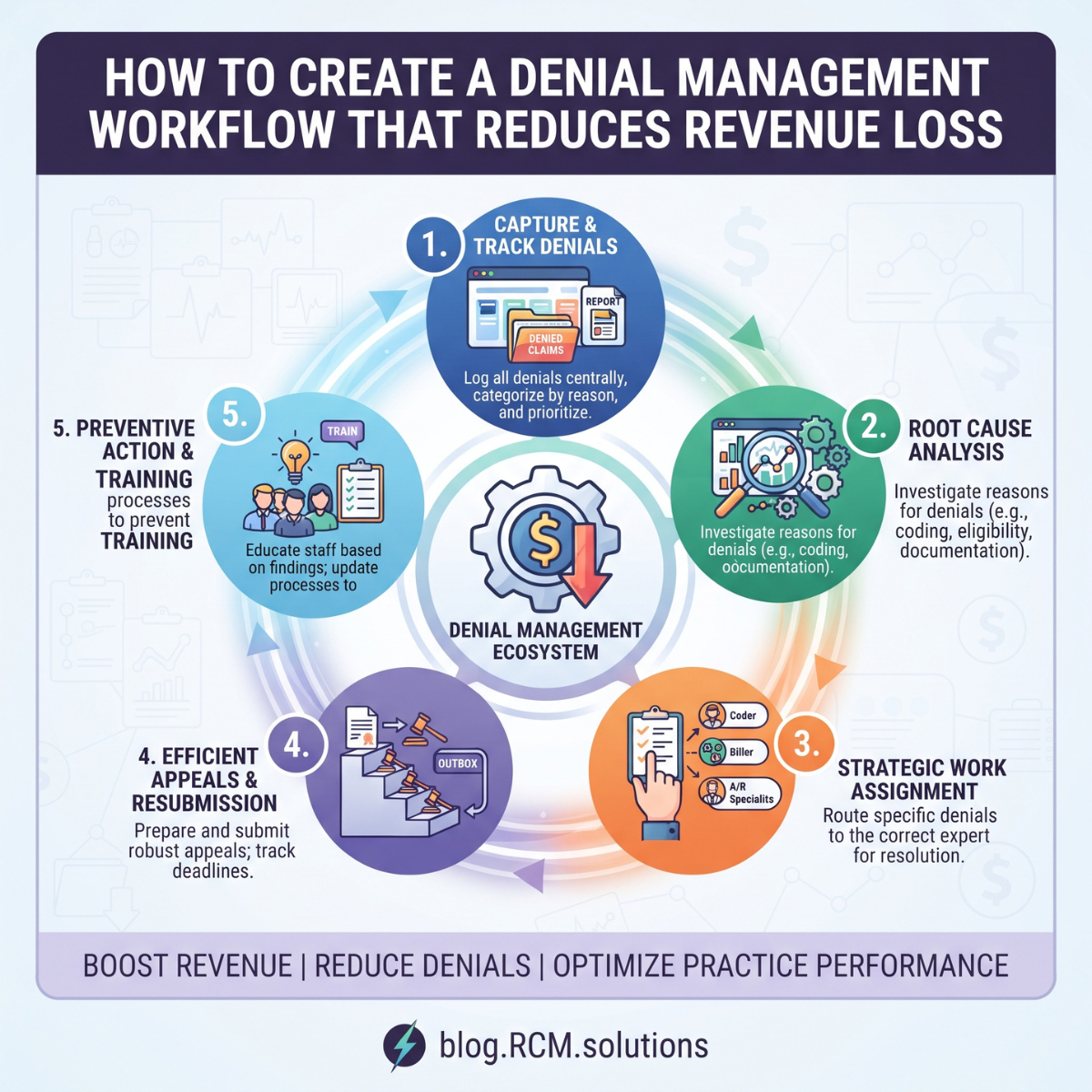
Medical claim denials are more than an administrative inconvenience. They are a significant source of delayed reimbursement, additional billing work, and potential revenue loss for healthcare practices.
A provider delivers treatment, the billing team submits the claim, and the insurance payer denies payment. The denied claim then enters a backlog, where it may remain unresolved for days or weeks.
Meanwhile, the practice continues paying staff, purchasing supplies, and managing operating expenses without receiving the expected reimbursement.
The problem becomes more serious when denied claims are handled without a structured process.
Billing employees may prioritize claims inconsistently, overlook appeal deadlines, repeatedly contact payers without documenting outcomes, or correct individual claims without addressing the errors that caused them.
This is why every healthcare organization needs a denial management workflow designed to identify problems, recover legitimate reimbursement, and prevent avoidable denials from recurring.
A successful workflow connects claim review, denial categorization, investigation, correction, appeals, payment follow-up, and root-cause analysis.
According to the Healthcare Financial Management Association (HFMA), standardized denial management processes and performance metrics are essential for improving claim resolution and reducing administrative costs.
The goal is not simply to work denied claims faster. It is to ensure that every denial receives the appropriate response while preventing similar problems from entering the revenue cycle.
This guide explains how medical practices can build a practical denial management workflow that reduces revenue loss and strengthens reimbursement performance.
What Is a Denial Management Workflow?
A denial management workflow is a structured process used to identify, investigate, correct, appeal, monitor, and resolve medical insurance claims that have received unfavorable payment determinations.
It establishes clear procedures for deciding what happens after a claim is denied.
A complete workflow should answer several questions:
- Why was the claim denied?
- Is the payer's decision valid?
- What documentation is required?
- Who is responsible for the claim?
- What is the appropriate correction or appeal process?
- When is the payer's deadline?
- How much reimbursement may be recoverable?
- What caused the denial?
- How can the same problem be prevented?
Without these answers, denial management becomes reactive.
Employees may work accounts based on whichever payer calls arrive first or whichever claims appear at the top of a spreadsheet.
That approach does not provide reliable control over unpaid revenue.
A structured denial management workflow creates accountability, standardized decision-making, and visibility across every denied account.
Why Medical Practices Need a Dedicated Denial Management Process
A medical practice can submit claims accurately and still encounter payment disputes.
Denials may result from eligibility problems, missing authorizations, documentation deficiencies, medical necessity disagreements, coding issues, benefit limitations, or payer processing errors.
Some denials are preventable. Others require clarification, additional documentation, or formal review.
Without an established process, these issues can produce unnecessary financial losses.
Denied claims may remain unpaid because staff do not identify them promptly.
Appeals may be submitted late.
The same coding mistakes may continue across multiple providers.
Authorization deficiencies may remain unresolved because denial findings never reach the patient access team.
In addition, management may struggle to distinguish recoverable denied revenue from amounts that were never payable.
An effective denial management system addresses these problems by connecting operational follow-up with financial reporting and process improvement.
It also provides healthcare leaders with a clearer understanding of why reimbursement is being delayed.
Step 1: Identify Denied Claims Immediately
The first step in an effective denial management workflow is identifying denied claims as soon as the payer communicates its decision.
Practices should not depend exclusively on manual payer portal checks or patient billing complaints.
Electronic remittance advice, or ERA, provides information about claim adjudication, payment adjustments, and denial reasons.
The Centers for Medicare & Medicaid Services (CMS) explains that remittance advice can include claim-level and service-level adjustment information using standardized codes.
These include:
Claim Adjustment Reason Codes (CARCs): Explain the general reason for a payment adjustment.
Remittance Advice Remark Codes (RARCs): Provide additional information about the adjustment or processing decision.
Claim Adjustment Group Codes: Help identify financial responsibility for an adjustment.
Billing teams should review these codes alongside the full remittance details rather than relying on a general denial label.
For example, an authorization denial requires a different investigation from a duplicate claim denial.
A reliable workflow should automatically import or regularly review denial information and create actionable work items.
Every denied claim should be visible in a centralized tracking system.
Step 2: Separate Claim Denials From Claim Rejections
Claim denials and rejections should not share the same correction process.
A claim rejection generally occurs when a claim fails validation before payer adjudication.
Common causes include invalid patient information, missing identifiers, incorrect electronic formats, or incomplete claim fields.
These claims typically require correction and resubmission.
A claim denial occurs after the payer processes the claim and makes an unfavorable payment determination.
Denials may require a corrected claim, administrative reopening, reconsideration, or formal appeal.
Confusing these processes wastes time.
For example, a rejected claim with an invalid member identification number generally does not need a medical necessity appeal.
Similarly, repeatedly resubmitting a denied claim as a new original claim may create duplicate billing problems.
The workflow should direct rejections and denials into separate work queues with different resolution procedures.
This distinction improves operational efficiency and prevents unnecessary follow-up.
Step 3: Categorize Denials by Reason
Once a denial is identified, it should be assigned to an appropriate category.
Categorization helps billing teams understand what went wrong and which department should investigate.
Common denial categories include:
Eligibility Denials
Problems involving inactive coverage, incorrect insurance information, or patient eligibility.
Prior Authorization Denials
Missing, expired, or incorrect authorizations.
Medical Necessity Denials
Disagreements involving clinical indications or applicable coverage requirements.
Coding Denials
Incorrect diagnosis codes, procedure codes, modifiers, or billing units.
Documentation Denials
Insufficient clinical records or missing information needed to support the billed service.
Duplicate Claim Denials
Claims identified as previously processed or inappropriately repeated.
Timely Filing Denials
Claims not received within applicable filing requirements.
Coordination-of-Benefits Denials
Problems involving primary and secondary insurance responsibilities.
Provider Enrollment Denials
Claims affected by provider participation, enrollment, or identification issues.
Consistent categorization enables accurate reporting and more effective root-cause analysis.
A single claim may involve more than one issue. Organizations should record the primary denial reason and additional contributing factors when necessary.
Step 4: Establish a Centralized Denial Work Queue
Denied claims should be managed through a centralized work queue rather than scattered spreadsheets, email messages, or individual employee notes.
A centralized system improves visibility and accountability.
Each denial record should contain:
- Patient or account reference
- Claim identification number
- Payer
- Date of service
- Denial notification date
- Denial reason and adjustment codes
- Expected collectible reimbursement
- Filing or appeal deadline
- Assigned employee
- Current workflow status
- Next required action
- Follow-up date
- Final resolution
Useful workflow statuses include:
New Denial, Under Review, Awaiting Documentation, Ready for Appeal, Appeal Submitted, Awaiting Payer Decision, Approved Pending Payment, Denial Upheld, Escalated, and Closed.
Statuses should clearly distinguish accounts awaiting staff action from those awaiting payer responses.
Most importantly, every unresolved denial must have an assigned owner.
An unassigned denial is an account at risk of being forgotten.
Step 5: Prioritize Denied Claims Strategically
Not every denied claim should receive the same priority.
Some claims involve substantial reimbursement, while others are low-value or unlikely to be recoverable.
Appeal deadlines may also differ.
A strong workflow should consider:
Deadline Urgency: Claims approaching the last permissible appeal date require immediate attention.
Expected Recoverable Revenue: Evaluate the amount potentially collectible under the applicable payer contract rather than relying only on billed charges.
Resolution Complexity: Straightforward administrative corrections may require less time than detailed medical necessity appeals.
Likelihood of Recovery: Determine whether documentation and payer policy support a reasonable basis for payment.
Claim Age: Older claims may require attention before available correction options expire.
Recurring Denial Patterns: Multiple claims affected by the same error may justify coordinated investigation.
For example, a $2,000 claim with an approaching appeal deadline may deserve higher priority than a $75 claim with several weeks remaining.
However, practices should not automatically ignore smaller claims.
Repeated low-value denials can produce meaningful cumulative losses and indicate systemic process problems.
Prioritization should balance reimbursement opportunity, deadlines, operational cost, and compliance requirements.
Step 6: Assign Clear Ownership and Responsibilities
A denial management workflow fails when employees are unsure who should resolve each issue.
Responsibilities should be defined according to the type of problem.
Patient Access Team: Investigates demographic errors, eligibility issues, and insurance information problems.
Authorization Specialists: Review prior authorization and referral deficiencies.
Medical Coders: Evaluate diagnosis codes, procedure codes, modifiers, and coding-related denials.
Clinical Documentation Teams: Coordinate requests for missing or incomplete clinical records.
Denial Specialists: Review payer decisions, coordinate appeals, and document outcomes.
Accounts Receivable Teams: Monitor outstanding balances, payment delays, and follow-up activities.
Revenue Cycle Managers: Review performance, resolve escalations, and implement corrective actions.
Smaller medical practices may combine these responsibilities.
However, every task still needs a clearly identified owner.
Departmental accountability prevents claims from repeatedly moving between teams without resolution.
Step 7: Investigate the Root Cause of Every Denial
Correcting a denied claim is necessary, but it does not automatically prevent future denials.
The billing team must determine why the problem occurred.
For example, a missing authorization denial may originate from several different failures.
The scheduling team may not have identified the requirement.
The authorization team may have requested approval for the wrong procedure.
The provider may have performed a service different from the authorized treatment.
The billing team may have omitted an existing authorization number.
Although all these situations can produce authorization-related denials, they require different corrective actions.
Root-cause analysis should identify the original workflow failure rather than simply repeating the payer's denial description.
Practices should review recurring denials by payer, specialty, provider, location, and administrative department.
This information should guide training, system configuration changes, and workflow improvements.
Step 8: Determine the Correct Resolution Method
Once the denial is investigated, staff must select the appropriate response.
Not every denial requires a formal appeal.
Possible resolution methods include:
Corrected Claim
Used when the payer permits correction of previously submitted claim information.
Administrative Reopening
May be available for certain minor errors or omissions, depending on the payer and program.
Reconsideration
Used when a payer offers an internal review process for a disputed decision.
Formal Appeal
Used to challenge an eligible adverse payment determination through the applicable appeals process.
Additional Documentation
May be appropriate when the payer requests specific supporting records.
Contractual Review
Necessary when the dispute involves payment terms, provider participation, or expected reimbursement.
For Original Medicare, CMS distinguishes certain clerical corrections handled through reopenings from payment determinations requiring formal appeals.
Therefore, staff should verify the payer's available resolution procedures before submitting additional information.
The objective is to choose the correct action the first time.
Step 9: Build an Effective Appeals Process
An effective denial management workflow needs a standardized appeals process.
Appeals should explain why the payer's payment determination should be reconsidered, using accurate claim information and relevant supporting evidence.
Depending on the denial, an appeal may require:
- Claim identification information
- Date of service
- Patient and provider information
- Denial explanation
- Relevant medical records
- Applicable authorization details
- Payer policy references
- Clinical justification
- Supporting documentation
- A clear request for reconsideration
Appeal letters should be specific to the claim.
Generic appeals containing unsupported statements are less useful than concise arguments addressing the payer's actual denial reason.
For example, a medical necessity appeal should identify the relevant clinical facts and coverage criteria.
An authorization dispute should focus on authorization requirements and documented approval details.
Appeals must be based on accurate records. Staff should never change clinical documentation or invent supporting information to obtain reimbursement.
Step 10: Track Appeal Deadlines Carefully
Missing an appeal deadline can convert a potentially recoverable claim into lost revenue.
Different insurance payers establish different appeal and correction timelines.
For Original Medicare, a first-level redetermination request generally must be submitted within 120 days from receipt of the initial claim determination.
That deadline does not automatically apply to Medicare Advantage, Medicaid, or commercial insurance plans.
Payer-specific appeal requirements should be maintained in the billing system.
Every denied claim should have a calculated deadline based on the applicable rules.
Work queues should flag approaching deadlines and escalate unresolved accounts.
Internal service standards can help teams act early.
For example, a practice might aim to categorize denials within one business day, complete initial investigation within three business days, and submit straightforward appeals within five business days.
These are suggested internal operational targets, not universal payer requirements.
The actual submission deadline must always be based on the relevant payer and applicable rules.
Step 11: Track Appeals Until Final Resolution
Submitting an appeal does not mean the claim is resolved.
After submission, the billing team must monitor the payer's acknowledgment, review status, determination, and any resulting payment.
Payers may request additional records or issue decisions requiring further action.
Some appeals are approved but reimbursement is not posted immediately.
Other appeals may be denied again, potentially creating additional review options.
The workflow should record every action, including contact dates, payer representatives when relevant, reference numbers, submitted documents, and promised response dates.
Follow-up should continue until the account reaches an appropriate final disposition.
Closing an account simply because an appeal was submitted creates inaccurate reporting and increases the risk of unpaid reimbursement being overlooked.
Step 12: Verify Payment and Reconcile Recovered Revenue
A successful appeal is not complete until the associated reimbursement is appropriately processed and reconciled.
Billing teams should review the updated remittance advice, confirm payment amounts, and compare reimbursement against applicable contract terms.
A denial may be overturned but still result in an underpayment.
Alternatively, a payer may process the claim differently from the amount originally expected.
Payment reconciliation should confirm:
- The correct claim was processed
- The applicable services were paid
- Adjustments were recorded accurately
- Contractual reimbursement was applied correctly
- Remaining balances were assigned appropriately
- No unresolved denial-related amounts remain
Recovered revenue should be tracked separately from the amount originally denied.
Gross billed charges are not the same as collectible reimbursement.
Accurate reconciliation helps leadership understand the financial value of denial management activities.
Step 13: Use Denial Analytics to Prevent Recurring Problems
The most effective denial management workflows use historical denial information to prevent future errors.
A healthcare practice should regularly analyze denial patterns and identify repeated causes.
For example, if one payer frequently denies a specific procedure because of missing authorization, the organization should investigate its authorization workflow.
If several providers receive documentation-related denials, targeted clinical documentation education may be necessary.
If modifier-related denials increase, coding guidelines and payer-specific editing rules should be reviewed.
Denial analytics should reveal where changes are needed, who is responsible, and whether corrective actions are working.
The objective is to reduce recurring problems rather than repeatedly recover the same types of claims.
Step 14: Monitor Essential Denial Management KPIs
Performance measurement is essential for determining whether a denial management workflow is reducing revenue loss.
HFMA recommends standardized denial metrics that allow organizations to evaluate claim integrity and compare performance consistently.
Important measures include:
Initial Denial Rate
Measures claims receiving an initial denial relative to a defined claim population.
Denial Dollars
Tracks the financial value of denied claims or claim lines under a consistent measurement methodology.
Denial Overturn Rate
Measures the proportion of denied claims successfully reversed.
Time From Denial to Appeal
Tracks how quickly the organization submits an appropriate appeal after receiving a denial.
Time to Claim Resolution
Measures how long denied claims remain unresolved.
Denial Write-Offs
Tracks expected reimbursement permanently written off because of unresolved denials.
Recovered Reimbursement
Measures the actual collectible amounts recovered through denial resolution.
Preventable Denial Rate
Tracks denials attributable to avoidable workflow errors using a documented classification method.
For example, if a practice receives 120 initial denials from 2,000 submitted claims during a consistently defined reporting period, its simplified claim-count denial rate is 6%.
This is an illustrative example, not a universal benchmark.
Practices should use standardized definitions, especially when reporting claim-level versus claim-line-level denials.
Step 15: Use Automation Without Removing Human Oversight
Denial management technology can reduce manual workload and improve consistency.
An integrated revenue cycle management platform may automatically import remittance information, identify denial codes, assign work queues, monitor deadlines, and generate performance dashboards.
Potential capabilities include:
- Automated ERA processing
- Denial code categorization
- Work queue assignment
- Appeal deadline alerts
- Supporting document tracking
- Payer response monitoring
- Automated reporting
- Root-cause analysis
- Payment reconciliation
- Denial trend dashboards
Artificial intelligence may also help summarize denial patterns or assist in preparing appeal drafts.
However, automated recommendations must be validated.
Incorrect payer rules, incomplete documentation, or unsupported clinical arguments can make an appeal ineffective or create compliance risks.
Any AI-assisted process handling patient information must also satisfy applicable privacy, security, and contractual requirements.
Technology should support qualified billing professionals rather than replace necessary judgment.
Step 16: Connect Denial Management With Front-End RCM
Many denials originate before the claim reaches the billing department.
A missing authorization may be traced to scheduling.
Incorrect insurance information may originate during registration.
A referral problem may result from incomplete patient access verification.
These issues will continue unless denial management findings reach the departments responsible for the original workflow.
A strong revenue cycle should create feedback loops between denial specialists, registration teams, authorization staff, clinical providers, coders, and practice leadership.
For example, when eligibility-related denials rise, front-end staff should review verification procedures.
When medical necessity denials increase, coding and clinical teams should investigate documentation and payer policies.
Denial prevention must be shared across the organization.
It cannot remain the responsibility of the billing department alone.
Step 17: Establish a Denial Review Meeting
Regular denial review meetings help ensure that findings lead to operational improvements.
A weekly operational review can focus on approaching deadlines, high-value accounts, unresolved payer issues, and claims requiring clinical documentation.
A monthly management review should examine trends and financial performance.
Useful discussion topics include:
- Denial rate changes
- High-frequency denial categories
- Payer-specific problems
- Appeal outcomes
- Outstanding denied balances
- Denial write-offs
- Root-cause findings
- Corrective actions
- Staff training requirements
Every recurring problem should have an assigned corrective action and a follow-up date.
Review meetings should not become repetitive discussions without measurable results.
Step 18: Create a 30-Day Denial Management Implementation Plan
Healthcare practices can establish a more structured workflow through a focused 30-day plan.
Week 1: Assess Existing Denials
Collect recent denial data and separate rejections from adjudicated denials.
Identify denial categories, pending appeals, deadlines, payer patterns, and potentially recoverable balances.
Establish baseline performance metrics.
Week 2: Build the Workflow
Create centralized denial work queues.
Define statuses, assign employees, establish priority rules, and record payer-specific correction and appeal deadlines.
Prepare standardized investigation and appeal documentation checklists.
Week 3: Resolve High-Priority Claims
Investigate high-value and time-sensitive denials.
Submit appropriate corrections or appeals.
Document payer responses and establish regular follow-up.
Begin addressing recurring root causes.
Week 4: Measure and Improve
Review appeal timeliness, unresolved denied balances, recovery outcomes, and denial categories.
Evaluate whether employees are following the new process.
Identify areas requiring automation, training, or revised procedures.
Set objectives for the following reporting period.
Thirty days is a starting point for implementing basic workflow controls, not a guarantee that all outstanding denials will be resolved.
Common Denial Management Mistakes to Avoid
Even practices with dedicated denial management teams can experience preventable revenue loss.
Common mistakes include working claims without prioritization, confusing claim rejections with denials, applying generic appeal templates, failing to verify payer policies, missing appeal deadlines, and closing accounts before reimbursement is reconciled.
Another serious mistake is measuring performance solely through the number of appeals submitted.
A high appeal volume may indicate productivity, but it may also indicate that preventable claim errors are continuing.
Likewise, collecting more money through appeals does not necessarily mean the revenue cycle is becoming more efficient.
The practice should also evaluate whether initial denials and administrative rework are declining.
Denial management should balance recovery, prevention, compliance, and cost efficiency.
How a Strong Denial Management Workflow Reduces Revenue Loss
A structured workflow can improve revenue cycle performance in several ways.
Early denial detection allows teams to respond before critical deadlines approach.
Categorization reduces unnecessary investigation by directing problems to qualified employees.
Prioritization helps the organization focus on urgent and financially significant accounts.
Accurate appeal preparation improves the quality of payer disputes.
Consistent follow-up reduces the chance that recoverable claims will remain unresolved.
Payment reconciliation helps identify reimbursement that has been approved but not fully received.
Root-cause analysis helps prevent the same errors from affecting future claims.
Together, these controls create a more reliable process for protecting reimbursement.
The exact financial improvement depends on the practice's claim volume, payer mix, historical denial patterns, staffing, and operational maturity.
Frequently Asked Questions
What is the first step in denial management?
The first step is identifying and reviewing the payer's denial information, including the reason codes and affected claim lines.
Should every denied claim be appealed?
No. Each denial should be reviewed to determine whether the payer's decision is valid and whether correction, reopening, reconsideration, or appeal is appropriate.
How should practices prioritize denied claims?
Prioritize using appeal deadlines, expected recoverable reimbursement, claim age, resolution complexity, and recurring denial patterns.
What is the most important denial management KPI?
No single metric provides a complete picture. Initial denial rate, denial write-offs, resolution time, overturn rate, and recovered reimbursement should be evaluated together.
Can denial management software eliminate revenue loss?
No. Software can improve tracking, validation, and workflow efficiency, but reimbursement still depends on accurate information, documentation, payer policies, and effective follow-up.
Final Thoughts
An effective denial management workflow is essential for protecting healthcare practice revenue.
Medical claims may be denied for many reasons, including eligibility problems, missing authorizations, coding errors, incomplete documentation, coverage disputes, and payer processing mistakes.
Without a structured process, these denials can remain unresolved, increase administrative expenses, and contribute to permanent revenue loss.
A high-performing denial management workflow should identify denials promptly, categorize their causes, prioritize accounts, assign responsibility, track deadlines, select appropriate resolution methods, monitor appeals, and reconcile reimbursement.
It should also use denial analytics to identify recurring errors and improve processes across the entire revenue cycle.
The most important principle is that denial management should not stop at recovering individual claims. It should prevent avoidable denials from recurring.