
Telehealth is no longer a temporary workaround. It has become a permanent part of healthcare delivery across primary care, behavioral health, dermatology, cardiology, endocrinology, neurology, urgent care, women’s health, physical therapy, and chronic care management.
But telehealth billing is still one of the easiest areas for practices to get wrong.
The mistake many practices make is assuming that a virtual visit is billed exactly like an in-person visit with one extra modifier added. That is too simplistic. Telehealth billing depends on the service type, the patient’s location, the provider type, the communication method, the payer policy, and the specialty involved.
A primary care follow-up visit, a behavioral health session, a dermatology image review, a cardiology medication management visit, and a physical therapy telehealth encounter may all be delivered remotely. But they may not follow the same billing logic.
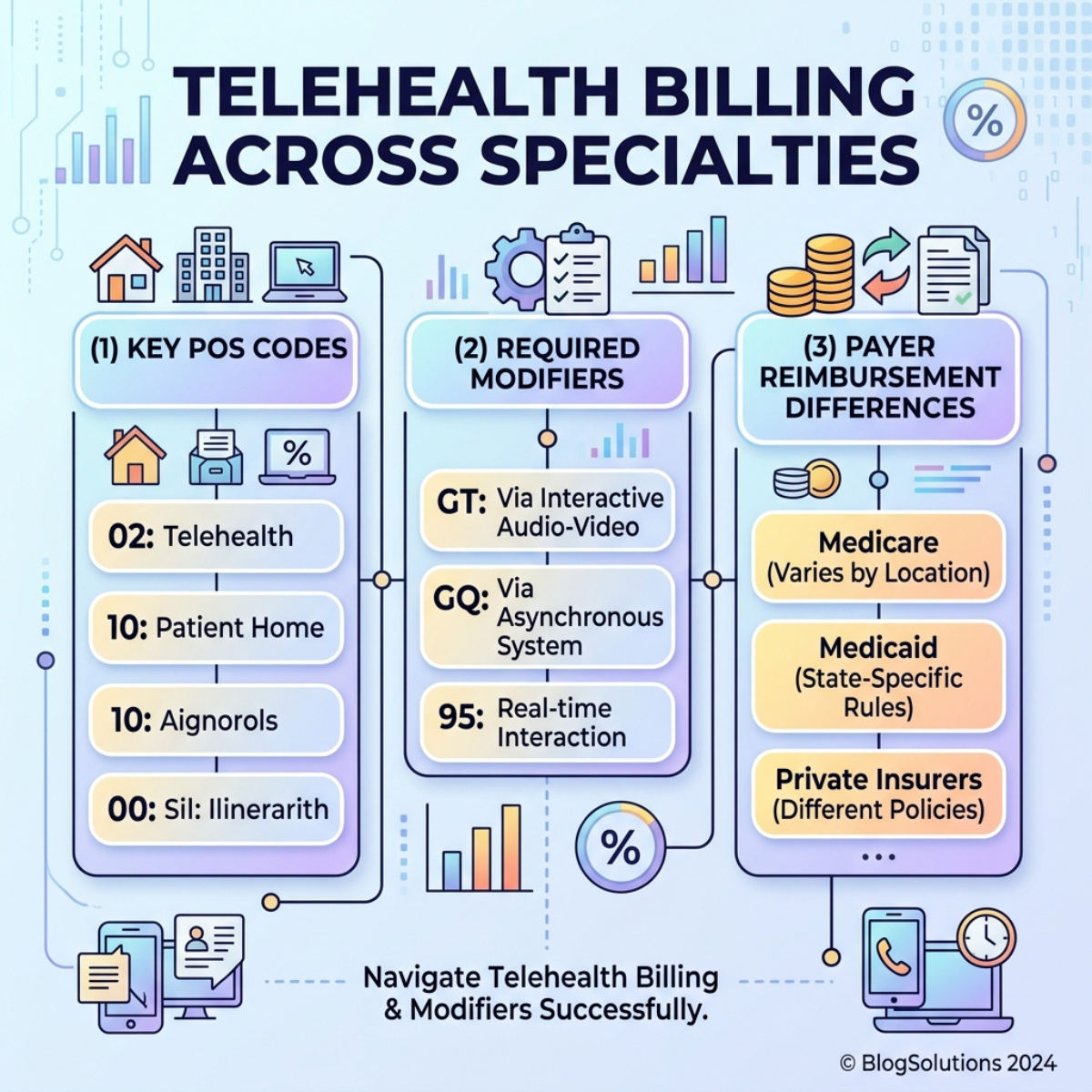
This is where POS codes, modifiers, and payer reimbursement differences become critical.
A clean telehealth claim must answer four questions:
What service was performed?
Where was the patient located?
How was the service delivered?
Does the payer cover and reimburse that service under its current policy?
If any of those answers are wrong, the claim can be denied, underpaid, delayed, or flagged for review.
Why Telehealth Billing Is Different Across Specialties
Telehealth billing is not one universal process because specialties use telehealth differently.
Primary care commonly uses telehealth for follow-up visits, medication management, lab result review, chronic disease monitoring, and minor acute complaints.
Behavioral health uses telehealth for psychotherapy, psychiatric evaluation, medication management, substance use disorder treatment, and ongoing counseling.
Dermatology may use telehealth for acne follow-ups, rash evaluations, medication monitoring, wound checks, or post-procedure follow-ups. Some dermatology visits may require images, but the billing still depends on whether the service meets payer requirements for synchronous or asynchronous care.
Cardiology may use telehealth for hypertension management, medication adjustment, symptom review, post-hospital follow-up, and remote monitoring coordination.
Endocrinology may use telehealth for diabetes management, thyroid follow-up, medication titration, and lab review.
Physical therapy, occupational therapy, and speech-language pathology may use telehealth for therapy sessions when payer rules allow remote delivery.
The billing problem is that each specialty may have different CPT codes, documentation expectations, medical necessity standards, and payer restrictions.
That means a billing team cannot use a generic “telehealth modifier checklist” and assume every claim is correct. Specialty context matters.
The Role of POS Codes in Telehealth Billing
Place of Service codes identify where a service is provided or received. For telehealth, POS coding focuses heavily on the patient’s location during the service.
CMS defines POS 02 as telehealth provided other than in the patient’s home. This means the patient receives the telehealth service while located somewhere other than home, such as a clinical site or other non-home location. CMS defines POS 10 as telehealth provided in the patient’s home, meaning the patient is located in a private residence or qualifying home-based location when receiving the service.
This distinction matters because POS selection can affect reimbursement. HHS specifically notes that POS codes are important in telehealth billing because they affect reimbursement, and it identifies POS 02 as telehealth provided outside the patient’s home and POS 10 as telehealth provided in the patient’s home.
The key point is simple:
POS 02 = patient is not at home.
POS 10 = patient is at home.
The POS code follows the patient’s location, not the provider’s location.
That is one of the most common billing mistakes in telehealth. A provider may be sitting in the office, but if the patient is at home, POS 10 may be appropriate depending on payer policy. If the patient is at a facility or another non-home location, POS 02 may apply.
POS 02 vs POS 10: Why the Difference Matters
POS 02 and POS 10 may look like minor claim details, but they can change how a payer processes the claim.
Some payers reimburse telehealth provided to a patient at home differently from telehealth provided to a patient at another originating site. Medicare policy has also treated patient location as relevant to payment methodology. KFF reported that Medicare pays telehealth providers at different rates depending on the beneficiary’s location, with home-based telehealth paid at a higher rate than telehealth provided when the beneficiary is in a separate clinical setting.
For billing teams, the practical risk is underpayment or denial.
Using POS 02 when POS 10 should have been reported can create reimbursement errors. Using POS 10 when the patient was not actually at home can create compliance risk. Using the same POS for every telehealth visit is weak billing discipline.
The patient’s location should be captured during scheduling, intake, or check-in. It should also be reflected in the encounter documentation.
A clean telehealth workflow should include:
Patient location at the time of service
Provider location at the time of service
Modality used
Consent for telehealth, when required
Clinical service performed
Medical necessity
Time or medical decision-making, where applicable
Any specialty-specific documentation requirements
Without this information, the billing team is guessing. Guessing is not a billing process.
Modifier 95 in Telehealth Billing
Modifier 95 is commonly associated with synchronous telemedicine services delivered through real-time audio and video communication. In simple terms, it tells the payer that the service was delivered through an interactive audio-video telehealth platform rather than face-to-face in a traditional office setting.
However, Modifier 95 rules are not identical across every payer.
Some commercial payers require Modifier 95 for audio-video telehealth claims. Some Medicare Administrative Contractor guidance says Modifier 95 is not required for many telehealth visits but may still apply in specific situations, such as certain hospital-to-home clinician visits or outpatient therapy services. Noridian’s Medicare guidance, for example, states that Modifier 95 is used for a telehealth visit when the clinician is in the hospital and the patient is in the home, or for outpatient therapy provided by a PT, OT, or SLP, and notes it is not required on other telehealth visits under that guidance.
This is exactly why payer-specific billing rules matter.
A practice that bills Medicare, Medicaid, Medicare Advantage, and commercial insurance cannot assume one modifier policy applies to all claims.
Modifier 95 should be used when the payer requires or recognizes it for the telehealth service billed. It should not be added blindly to every claim without checking payer rules.
Modifier 93 in Telehealth Billing
Modifier 93 is used for synchronous telemedicine services delivered through telephone or other real-time interactive audio-only communication.
Audio-only telehealth is especially important for patients who do not have reliable internet access, cannot use video technology, have limited digital literacy, or do not consent to video.
HHS states that audio-only communication may be used for certain Medicare telehealth services when the patient is in the home and the distant site practitioner is capable of audio-video technology but the patient is not capable of, or does not consent to, video. HHS also states that required modifiers for those services include CPT Modifier 93 and/or Medicare Modifier FQ for Federally Qualified Health Centers and Rural Health Clinics.
This matters across specialties.
Behavioral health often has strong use cases for audio-only access, especially for patients with barriers to video. Chronic care management and follow-up visits may also involve audio-only services when allowed by payer policy.
But audio-only coverage is not automatic for every service, payer, or specialty. Some payers cover audio-only visits under specific codes. Others restrict them. Some may require Modifier 93. Others may require different payer-specific coding logic.
Billing teams need to verify the payer policy before assuming audio-only reimbursement.
Modifier FQ, GT, and Other Telehealth Modifiers
Telehealth billing is not limited to Modifier 93 and Modifier 95.
Modifier FQ is used in certain Medicare contexts, especially for audio-only behavioral health-related services and FQHC/RHC billing scenarios. HHS specifically references Modifier FQ in connection with required modifiers for certain audio-only services billed by FQHCs and RHCs.
Modifier GT was historically used for interactive audio-video telecommunication services, but its role has narrowed. Some Medicare guidance states that GT continues to be required for distant site services billed under Critical Access Hospital Method II on institutional claims.
The practical takeaway is this:
Modifier 95 usually points to real-time audio-video service.
Modifier 93 usually points to real-time audio-only service.
Modifier FQ may apply in certain Medicare audio-only and safety-net provider contexts.
Modifier GT may still apply in limited institutional or payer-specific settings.
The payer’s rule controls the claim.
A clean telehealth billing process should maintain payer-specific modifier rules inside the billing workflow. Relying on staff memory is inefficient and risky.
Medicare Telehealth Billing Updates
Medicare telehealth rules have changed repeatedly since the pandemic, and practices need to treat them as active policy areas rather than fixed billing rules.
HHS states that recent legislation extended many Medicare telehealth flexibilities through December 31, 2027. These include allowing Medicare patients to receive non-behavioral and mental health telehealth services in the home, removing geographic originating-site restrictions for many services through that date, allowing eligible Medicare providers to furnish telehealth services through that date, and allowing non-behavioral and mental health telehealth services to be delivered using audio-only platforms through that date.
Behavioral health telehealth has more permanent support. HHS states that Medicare patients can permanently receive behavioral and mental health telehealth services in their home, there are no geographic restrictions for the originating site for Medicare behavioral and mental health telehealth services on a permanent basis, and behavioral and mental health telehealth services can permanently be delivered using audio-only communication platforms.
CMS also updates the Medicare Telehealth Services List annually. HHS notes that there are currently more than 250 codes on the Medicare telehealth services list eligible for reimbursement, and that additions and deletions generally occur annually.
For 2026, CMS finalized additions to the Medicare Telehealth Services List, including multiple-family group psychotherapy, group behavioral counseling for obesity, an infectious disease add-on code, and auditory osseointegrated sound processor services. CMS also finalized changes to streamline the process for adding services to the Medicare telehealth list and removed the distinction between provisional and permanent services.
That means billing teams should not rely on old telehealth code lists. The code list must be updated every year.
Payer Reimbursement Differences
Telehealth reimbursement depends heavily on payer policy.
Medicare has federal rules, but Medicare Advantage plans may apply plan-specific requirements. Medicaid coverage varies by state. Commercial payers may have different rules for POS codes, modifiers, eligible services, audio-only coverage, prior authorization, patient cost-sharing, and reimbursement parity.
This creates several billing risks:
A service covered by Medicare may not be covered by a commercial payer.
A commercial payer may require Modifier 95 even when another payer does not.
A Medicaid program may allow audio-only services under state-specific rules.
A payer may reimburse telehealth at parity with in-person services for some specialties but not others.
A payer may require the patient’s location to be documented in a specific way.
A payer may reject a claim if POS 02 or POS 10 does not match its policy.
A payer may treat therapy, behavioral health, urgent care, and specialist follow-up differently.
This is why “payer reimbursement differences” should not be handled after denial. They should be built into the front-end billing process.
Every practice offering telehealth should maintain a payer matrix that includes:
Covered telehealth CPT/HCPCS codes
Allowed specialties
Allowed provider types
Allowed patient locations
Required POS codes
Required modifiers
Audio-video rules
Audio-only rules
Documentation requirements
Prior authorization rules
Reimbursement parity status
Frequency limits
State-specific Medicaid rules
Commercial payer exceptions
Without this matrix, claim submission becomes reactive. Reactive billing leads to avoidable denials.
Specialty-Specific Telehealth Billing Considerations
Primary Care
Primary care telehealth often involves E/M services, medication management, lab review, chronic disease follow-up, and acute minor conditions.
The main billing risk in primary care is overusing telehealth for services that require an in-person exam or under-documenting medical decision-making. The provider must clearly document the reason for the visit, the modality, the assessment, the plan, and why telehealth was clinically appropriate.
For primary care, POS 10 is common because many patients connect from home. Modifier requirements depend on payer rules.
Behavioral Health
Behavioral health is one of the strongest telehealth specialties because many services can be clinically appropriate through audio-video or audio-only communication.
Medicare behavioral health telehealth has permanent home-based flexibility and no permanent geographic originating-site restriction, according to HHS.
Billing teams should still confirm whether the service was psychotherapy, psychiatric diagnostic evaluation, medication management, crisis service, or substance use disorder treatment. Each service type may carry different code and documentation requirements.
Behavioral health documentation should clearly support the time, modality, patient consent where required, clinical content, diagnosis, risk assessment where relevant, and treatment plan.
Dermatology
Dermatology telehealth can be useful for acne, eczema, psoriasis follow-ups, rash triage, medication monitoring, post-procedure checks, and some lesion reviews.
The main billing issue is modality. Some dermatology workflows involve patient-submitted images. If the service is asynchronous, it may not be billed the same way as a synchronous audio-video visit. If the payer requires real-time interaction for a telehealth E/M service, image review alone may not qualify.
Dermatology practices should document whether the visit was live audio-video, audio-only, store-and-forward, or a combination of methods.
Cardiology
Cardiology telehealth often supports chronic disease management, hypertension follow-up, medication adjustment, post-discharge review, anticoagulation discussion, and remote monitoring coordination.
The billing team should distinguish a telehealth E/M visit from remote physiologic monitoring, chronic care management, or device-related services. These are not interchangeable billing categories.
Cardiology documentation should include symptoms, vitals when available, medication changes, risk assessment, test review, and follow-up plan.
Endocrinology
Endocrinology telehealth is commonly used for diabetes, thyroid disorders, obesity counseling, metabolic conditions, and medication management.
The billing risk is insufficient documentation of data reviewed. For diabetes visits, the provider may review glucose logs, CGM data, labs, medication adherence, hypoglycemia risk, diet, and treatment changes.
If data review drives medical decision-making, the documentation should show it clearly.
Physical Therapy, Occupational Therapy, and Speech Therapy
Therapy telehealth requires special attention because coverage rules may be more limited or payer-specific.
CMS’s 2026 Medicare Physician Fee Schedule summary notes that providers of PT, OT, SLP, diabetes self-management training, and medical nutrition therapy services that remain on the Medicare Telehealth Services List can continue billing these remotely through the end of CY 2027.
Therapy documentation should support the skilled nature of the service, patient participation, treatment performed, progress, limitations, and why remote delivery was appropriate.
Common Telehealth Billing Mistakes
Telehealth denials usually come from preventable workflow failures.
The most common errors include:
Using the wrong POS code
Missing Modifier 93 or Modifier 95 when required
Adding modifiers when the payer does not recognize them
Billing audio-only as audio-video
Failing to document patient location
Failing to document modality
Using outdated telehealth code lists
Ignoring payer-specific rules
Confusing telehealth visits with remote monitoring
Billing a service that is not eligible for telehealth reimbursement
Failing to update policies after CMS or payer rule changes
HHS also identifies common telehealth billing mistakes, including wrong billing codes, incorrect modality, location errors, and weak documentation.
These are not small administrative issues. They directly affect cash flow.
A telehealth claim can be clinically valid and still fail because the claim form does not match payer rules.
Documentation Requirements for Clean Telehealth Claims
Telehealth documentation should be as complete as in-person documentation, with additional telehealth-specific elements.
A strong telehealth note should include:
Patient consent, when required
Patient location
Provider location
Date of service
Start and stop time, if time-based coding is used
Modality used
Whether the service was audio-video or audio-only
Reason for visit
Relevant history
Exam elements possible through telehealth
Assessment and diagnosis
Medical decision-making
Treatment plan
Prescriptions or orders
Follow-up instructions
Limitations of telehealth, when clinically relevant
Documentation should not simply say “telehealth visit completed.” That does not prove enough.
The note must support the code billed, the modality used, and the medical necessity of the service.
How Practices Should Build a Better Telehealth Billing Workflow
A strong telehealth billing process begins before the provider enters the visit.
First, scheduling staff should confirm whether the payer covers telehealth for the requested service.
Second, intake should capture the patient’s location and confirm whether the visit will be audio-video or audio-only.
Third, the provider should document the modality, location, clinical findings, and medical necessity.
Fourth, coders should verify whether the CPT or HCPCS code is eligible for telehealth.
Fifth, billers should apply the correct POS code and modifier based on payer rules.
Sixth, the revenue cycle team should track denials by payer, specialty, POS code, and modifier.
This workflow protects reimbursement and reduces repeated errors.
The worst process is waiting for denials and then trying to fix claims one at a time. That wastes staff time and delays payment.
Why Unified Billing Technology Matters for Telehealth
Telehealth billing becomes difficult when scheduling, documentation, coding, claim submission, and denial management are handled in disconnected systems.
A unified billing platform can help practices manage telehealth more accurately by connecting front-end intake with coding and claims rules.
For example, if the patient selects a video visit from home, the system should capture that location and guide the claim toward POS 10. If the visit is audio-only, the system should alert the billing team to review Modifier 93 or payer-specific requirements. If a payer does not cover audio-only for a specific specialty, the system should flag the issue before the claim is submitted.
A strong billing platform should support:
Payer-specific telehealth rules
POS 02 and POS 10 validation
Modifier logic
Specialty-specific code rules
Audio-only and audio-video workflows
Eligibility verification
Claim scrubbing
Denial tracking
Reporting by payer and specialty
Annual code updates
Technology will not replace coding judgment. But it can prevent obvious errors, standardize workflows, and reduce avoidable denials.
For multi-specialty clinics, this is especially important. A single practice may bill telehealth for primary care, behavioral health, dermatology, cardiology, and therapy services. Each specialty may have different rules. Managing that manually is inefficient and risky.