
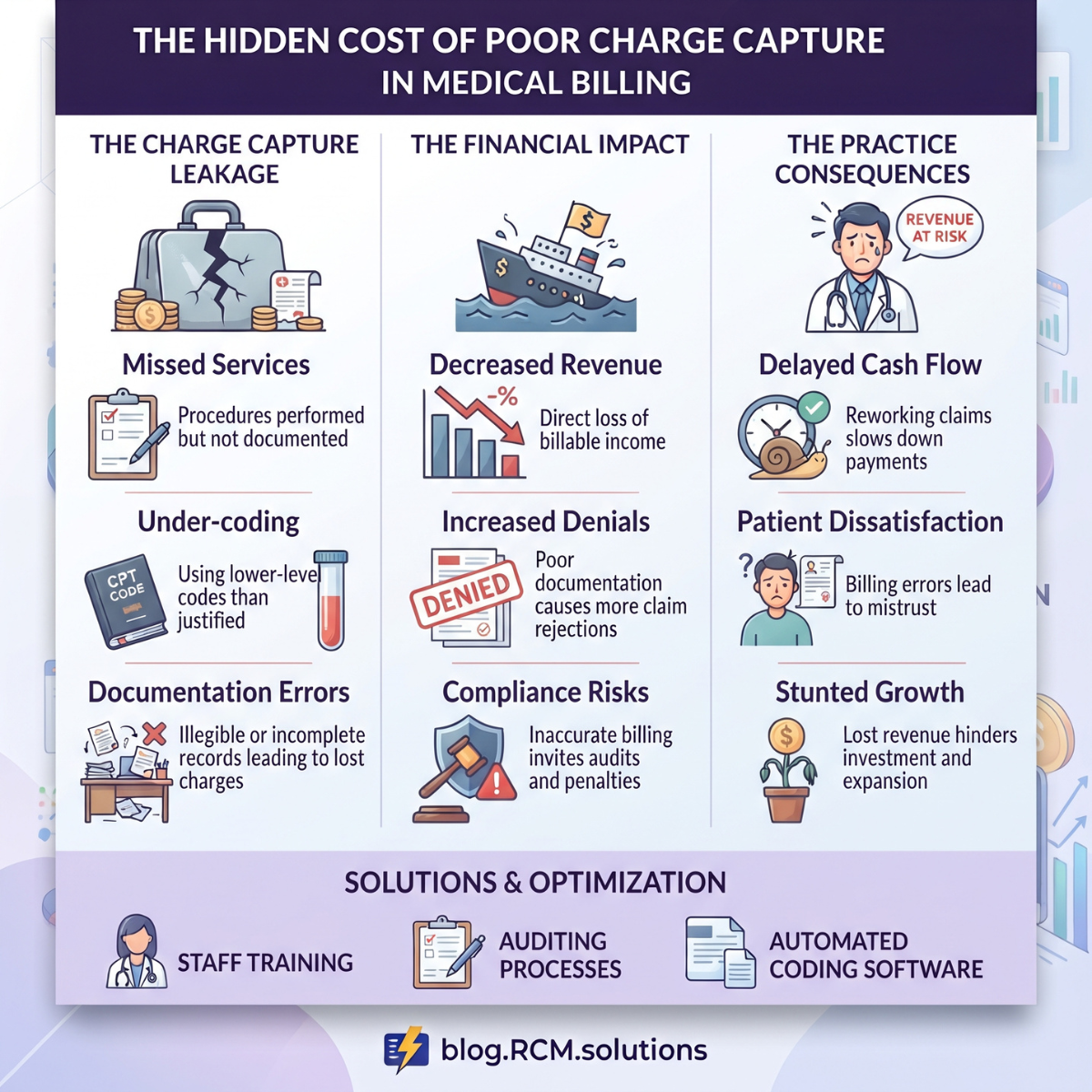
Medical practices can deliver excellent patient care, maintain full appointment schedules, and submit insurance claims on time while still losing significant revenue.
The problem is not always denied claims, delayed insurance payments, or incorrect reimbursement rates.
Sometimes, the services provided never make it onto a claim.
A physician performs a procedure, administers an injection, orders a diagnostic test, or provides another medically necessary service. The clinical work is completed, but the corresponding charge is missing, delayed, entered incorrectly, or never transferred into the medical billing system.
This is known as poor charge capture, and it is one of the most overlooked sources of revenue leakage in healthcare.
Unlike claim denials, which appear in payer responses and denial reports, missed charges may remain completely invisible. When a service is never billed, there may be no rejected claim, denial notification, or outstanding insurance balance to alert the revenue cycle team.
The financial impact can accumulate quietly over time.
According to the Healthcare Financial Management Association (HFMA), charge capture is an essential component of healthcare revenue cycle management because accurate recording of services is necessary for proper claim processing and reimbursement.
For medical practices, **poor charge capture in medical billing is not simply an administrative inconvenience. It is a revenue integrity problem that can affect cash flow, financial reporting, operational efficiency, and long-term profitability.**
Understanding where charge capture errors originate and how to prevent them is essential for building a financially sustainable healthcare organization.
## What Is Charge Capture in Medical Billing?
Charge capture is the process of identifying, documenting, coding, and recording billable healthcare services so they can be included in insurance claims or patient billing.
It connects clinical care delivery with financial reimbursement.
When a provider performs a service, the relevant clinical information must be documented. The service must then be evaluated for appropriate coding, payer coverage, medical necessity, and applicable billing requirements.
Once validated, the charge enters the billing workflow.
Charge capture commonly involves:
- Office visits and evaluation and management services
- Minor surgical procedures
- Diagnostic tests
- Injections and medication administration
- Billable medications and biological products
- Therapy services
- Wound care procedures
- Certain medical supplies
- Ancillary services
- Other separately reportable procedures
Not every documented activity generates a separate charge. Some services are bundled into another procedure, included in a global payment, or otherwise not separately reimbursable.
The objective is to identify all legitimate billable services without creating duplicate charges, unbundling errors, or unsupported claims.
Effective charge capture therefore requires coordination between providers, clinical staff, medical coders, billers, and revenue cycle managers.
## Why Poor Charge Capture Creates Invisible Revenue Leakage
Most medical practices actively monitor claim denials and outstanding accounts receivable.
However, those reports typically focus on claims that have already entered the billing process.
Missed charges are different.
If a service is performed but never billed, the claim management system may have no record of the expected reimbursement.
For example, a dermatologist may document a separately reportable procedure during an office visit, but the procedure charge might never be transferred into the billing system.
The practice may receive payment for the office visit while losing the opportunity to bill for the additional service.
No denial is generated for the omitted procedure.
The account may even appear fully paid.
This makes missed charges particularly difficult to identify using traditional billing reports.
Poor charge capture creates a gap between the care delivered and the services ultimately billed.
Over time, that gap can become a meaningful source of financial loss.
## 1. Lost Reimbursement From Unbilled Services
The most direct consequence of poor charge capture is lost reimbursement.
When an eligible service is omitted from the claim, the practice cannot receive payment for that service unless the omission is discovered and corrected within applicable billing requirements.
Consider a medical practice that misses eight legitimately billable services each week.
If the average expected collectible reimbursement is $75 per service, the potential annual impact across 48 operating weeks would be:
8 missed services × $75 × 48 weeks = **$28,800 in potential annual reimbursement.**
This is an illustrative calculation, not an industry average or guaranteed recoverable amount. Actual reimbursement depends on documentation, coverage, coding rules, payer contracts, and filing deadlines.
The example demonstrates how relatively small omissions can accumulate.
For larger practices with multiple physicians and locations, the financial exposure can be substantially greater.
A few missing procedure charges each week may seem insignificant individually.
Combined across hundreds or thousands of encounters, they can create substantial revenue leakage.
## 2. Delayed Cash Flow From Late Charge Entry
Poor charge capture does not always mean a service is permanently missed.
Sometimes the service is captured, but the charge is entered days or weeks after treatment.
This creates charge lag.
Charge lag is the time between the date of service and the posting of the charge into the billing workflow.
Delayed charge entry can postpone coding, claim preparation, submission, adjudication, and reimbursement.
For example, a provider performs a procedure on Monday but does not complete the documentation until the following week.
The billing department may be unable to finalize the claim until the chart is completed.
Even if the claim is eventually paid, the practice experiences an unnecessary delay in cash collection.
The American Medical Association identifies charge capture lag as an important revenue cycle performance measure and emphasizes timely chart closure.
Growing practices should regularly monitor delayed documentation, unbilled encounters, and charge posting timelines.
**A service that cannot enter the billing process promptly cannot generate timely reimbursement.**
## 3. Higher Administrative and Rework Costs
Missing charges also increase administrative expenses.
When billing teams discover an omitted service, they may need to review clinical records, contact providers, investigate documentation, verify coding, correct the account, and submit an additional or corrected claim.
This creates work that could have been avoided through accurate initial charge capture.
The cost is not limited to employee time.
Delayed corrections can interfere with other responsibilities, including denial management, accounts receivable follow-up, payment posting, and patient billing.
As patient volume grows, repeated charge capture errors can create an expanding backlog.
Organizations may respond by hiring additional billing staff without addressing the underlying process failure.
This increases operating expenses while leaving the original source of revenue leakage unresolved.
A more effective strategy is to prevent missing charges before claims are submitted.
## 4. Increased Claim Denials and Rejections
Charge capture problems can also create claim denials and rejections.
An incorrect or incomplete charge may produce errors involving procedure codes, units, modifiers, or diagnosis relationships.
For example, a medication administration service may be documented incorrectly or submitted with an inaccurate drug quantity.
Another encounter may include multiple procedures that require coding review to determine whether they are separately reportable.
If charges are added without validating coding rules, the claim may fail payer edits.
However, missing charges and denied charges are not identical.
A missing charge may never reach a payer.
A denied charge has entered the claim process but was not approved for payment.
Both require attention, but their detection and prevention methods differ.
Effective charge integrity programs should monitor omitted services alongside coding errors, rejections, and denials.
## 5. Incorrect Coding and Billing Units
Accurate charge capture requires more than identifying that a service occurred.
The charge must also reflect the appropriate code, quantity, and billing units.
This is particularly important for injections, medications, diagnostic procedures, and time-based services.
For example, the quantity administered to a patient may not equal the number of HCPCS billing units.
The billing team must review the relevant code descriptor and convert the documented dosage into appropriate billing units.
Medicare also has specific requirements for reporting certain discarded drugs from single-dose containers, including the appropriate use of JW and JZ modifiers.
These requirements depend on the circumstances and applicable CMS guidance.
Incorrect billing units can result in underbilling, overbilling, claim denials, or repayment obligations.
Practices should establish specific validation processes for high-risk charge categories.
## 6. Weak Clinical Documentation
Clinical documentation is the foundation of accurate charge capture.
When providers fail to document a service completely, the billing team may be unable to determine whether the service is separately reportable.
Common documentation deficiencies include:
- Missing procedure details
- Unclear treatment locations
- Incomplete medication administration records
- Missing dosage information
- Unspecified procedure quantities
- Incomplete time documentation
- Missing medical necessity
- Unclear distinction between bundled and separate services
Consider a dermatologist who documents that multiple lesions were treated but does not record sufficient information about the lesions and procedures.
The coder may need clarification before assigning the appropriate procedure codes.
Similarly, a therapy provider may document treatment activities without enough information to support applicable time-based billing.
Poor documentation can delay charge capture or prevent compliant billing altogether.
The solution is not to automatically bill services based on assumptions.
The solution is to improve clinical documentation and establish an appropriate provider clarification process.
## 7. Manual Charge Entry and Human Error
Manual charge entry introduces opportunities for omissions, duplication, and inaccurate information.
In practices using paper superbills, spreadsheets, or disconnected applications, charges may pass through several employees before reaching the billing system.
Each handoff creates risk.
A procedure might be documented in the electronic health record but omitted from the billing spreadsheet.
An injection may be entered without the associated drug charge when that drug is separately billable.
A diagnostic service may be completed but remain in an unprocessed work queue.
Manual processes can function effectively when supported by strong controls, but they become harder to manage as patient volumes increase.
Growing practices should evaluate whether their charge entry workflows can reliably handle additional providers, specialties, and services.
Where appropriate, EHR-to-billing integrations can reduce duplicate data entry and improve charge visibility.
## 8. Incomplete Charge Reconciliation
Charge reconciliation is the process of comparing services performed with charges recorded in the billing system.
Without reconciliation, missed charges may remain undetected.
For example, a clinic performs 40 procedures during one day.
If only 36 corresponding charges appear in the billing system, the discrepancy requires investigation.
However, the organization should not assume that every procedure requires a separate claim line.
Some services may be bundled, included in another service, or not independently reimbursable.
Reconciliation must therefore compare clinical activity against legitimate billing expectations.
Useful reconciliation sources include:
- Appointment schedules
- Completed encounter records
- Procedure logs
- Medication administration records
- Diagnostic equipment logs
- Clinical orders and results
- Billing charge reports
- Claims submission records
An order alone does not prove that a service was performed.
Reconciliation should confirm actual service delivery before identifying a charge as missing.
## 9. Missed Charges Across Medical Specialties
Charge capture risks vary by specialty because different clinical services follow different billing rules.
### Dermatology
Dermatology practices perform biopsies, excisions, lesion destruction, injections, and other procedures.
Charge capture errors may occur when separately reportable procedures are omitted or lesion-specific documentation is incomplete.
### Cardiology
Cardiology practices may provide diagnostic testing, monitoring, interpretations, and procedural services.
Billing teams must identify the services actually performed and determine whether professional or technical components are separately reportable.
### Orthopedics
Orthopedic encounters may involve procedures, injections, imaging, and follow-up services.
Global surgical rules, procedure bundling, and medical necessity requirements can affect which charges are appropriate.
### Primary Care
Primary care practices may perform office visits alongside diagnostic tests, vaccinations, injections, or minor procedures.
Charge capture should identify eligible services while respecting bundling and same-day E/M requirements.
### Oncology and Infusion Services
Medication administration and infusion workflows require detailed documentation of drugs, doses, administration services, and applicable time information.
Errors involving drug billing units or administration documentation can create substantial financial and compliance exposure.
Each specialty needs charge capture controls aligned with its clinical workflow and payer requirements.
## 10. Inaccurate Financial Reporting
Poor charge capture can distort financial reporting.
If services are performed but never billed, financial reports may understate expected revenue.
Leadership may conclude that reimbursement rates are falling or provider productivity is lower than expected.
In reality, the issue may be incomplete charge capture.
Missing charges can also affect departmental comparisons and service-line profitability analysis.
For example, one provider's revenue may appear lower than another provider's because procedures are not being captured consistently.
Decisions about staffing, expansion, equipment investment, and service availability may then rely on incomplete financial data.
Accurate charge capture supports more reliable revenue reporting and operational planning.
## 11. Increased Compliance and Audit Risk
Charge capture improvement must balance revenue recovery with billing compliance.
The objective is not to bill every activity separately.
Healthcare providers must bill only services that are appropriately documented, medically necessary when required, separately reportable, and supported by applicable coding and payer rules.
Some services are considered integral components of broader procedures.
CMS's National Correct Coding Initiative includes procedure-to-procedure edits designed to prevent inappropriate payment for services that should not be reported together.
A practice that responds to missed revenue by indiscriminately adding charge lines may create overbilling and unbundling problems.
Likewise, unsupported late charges may introduce compliance concerns.
Internal charge audits should therefore identify both underbilling and overbilling.
**Effective charge integrity means accurate reimbursement—not simply higher claim amounts.**
## 12. Why Traditional Denial Reports Miss Charge Capture Problems
Denial reports are valuable, but they cannot provide a complete picture of revenue leakage.
A denial report identifies claims or claim lines that have entered payer processing and encountered payment problems.
It does not ordinarily identify a service that was never entered into billing.
This creates a significant blind spot.
For example, a practice may maintain a relatively low denial rate while still experiencing substantial missed charges.
Leadership may assume that billing performance is strong because most submitted claims are paid.
However, that conclusion ignores potential revenue associated with unbilled services.
Practices should evaluate charge capture performance separately from payer denial performance.
Both affect revenue integrity, but they measure different risks.
## 13. How to Identify Missing Charges
The first step in correcting charge capture problems is establishing visibility.
Medical practices should conduct regular charge reconciliation and targeted audits.
Begin by selecting high-volume or high-risk services.
Compare clinical records against the charges submitted.
Identify documented, completed services that may not have corresponding billable charges.
Review whether any omitted service was legitimately separately reportable.
Investigate the reason for the omission.
Potential root causes may include incomplete documentation, workflow delays, coding uncertainty, missing system integration, or staff training gaps.
Audit findings should be categorized by provider, specialty, service type, and error source.
This allows revenue cycle managers to determine whether charge capture problems are isolated incidents or recurring operational weaknesses.
## 14. Establish a Standardized Charge Capture Workflow
A strong charge capture process should begin when the clinical service is performed.
The workflow should clearly define how services are recorded, validated, coded, and transferred into billing.
An effective process includes the following stages.
**Step 1: Document the service.**
Providers record the clinically necessary details supporting the services delivered.
**Step 2: Confirm service completion.**
Clinical teams verify that the service was performed rather than merely ordered or scheduled.
**Step 3: Identify potentially billable services.**
The charge capture process identifies services requiring coding and reimbursement review.
**Step 4: Validate documentation and coding.**
Coders confirm applicable codes, units, modifiers, and separately reportable status.
**Step 5: Transfer validated charges.**
Approved charges enter the billing workflow.
**Step 6: Reconcile completed encounters.**
Billing teams compare documented services and expected charges against recorded claim lines.
**Step 7: Resolve exceptions.**
Missing or questionable charges are assigned for investigation before applicable deadlines.
This workflow supports completeness without sacrificing compliance.
## 15. Automate Charge Capture Where Appropriate
Technology can reduce the administrative burden associated with charge capture.
Modern revenue cycle platforms may connect scheduling, electronic health records, clinical documentation, charge entry, coding, and claim submission.
Automation can help identify completed encounters without corresponding charges.
It may also flag missing billing units, delayed documentation, or procedure records that require coding review.
Useful capabilities include:
- EHR and billing system integration
- Automated encounter reconciliation
- Charge completion alerts
- Unbilled encounter work queues
- Coding validation rules
- Medication administration reconciliation
- Charge lag monitoring
- Specialty-specific charge review
- Audit trails
- Revenue integrity dashboards
However, automated charge generation requires appropriate controls.
A scheduled procedure should not automatically become a billable charge without confirmation that the service occurred.
Similarly, automated coding suggestions should be reviewed when documentation or payer rules require additional judgment.
Technology should reduce omissions and improve accuracy rather than encourage unsupported billing.
## 16. Track Charge Capture Performance Metrics
Revenue cycle managers should measure charge capture performance independently from overall collections.
Important indicators include:
**Charge Capture Lag**
Measures the time between the date of service and charge entry.
Monitoring median and aging charge lag helps identify documentation and workflow delays.
**Missed Charge Rate**
Measures verified omitted billable charges relative to the eligible services reviewed.
The denominator should be defined consistently.
**Unbilled Encounter Volume**
Tracks completed encounters that have not progressed into the appropriate billing workflow.
**Late Charge Rate**
Measures charges entered after the organization's defined posting window.
**Charge Correction Rate**
Tracks how frequently recorded charges require correction.
**Charge Reconciliation Completion Rate**
Measures the percentage of eligible encounters or service records reconciled within the required timeframe.
**Net Recoverable Revenue**
Measures the estimated or actual collectible reimbursement associated with verified omitted charges, after considering payer rules and filing requirements.
Practices should review these indicators by specialty, provider, location, and service category.
The goal is to detect patterns before they become persistent revenue problems.
## 17. Improve Communication Between Clinical and Billing Teams
Charge capture failures frequently originate from communication gaps.
Providers may assume that documenting a procedure automatically generates the appropriate charge.
Billing teams may assume that all performed services have already been entered.
Clinical staff may record medication administration in one system while billing staff work in another.
When responsibilities are unclear, omissions become more likely.
Medical practices should establish clear accountability.
Providers should understand the documentation required for accurate coding.
Clinical staff should know how completed procedures and administered medications enter the billing workflow.
Coders should have a reliable process for requesting clarification.
Billing teams should regularly share charge capture findings with clinical departments.
Revenue integrity improves when clinical and administrative employees understand their responsibilities within the same workflow.
## 18. Conduct Regular Charge Capture Audits
Charge capture audits are essential for identifying recurring revenue leakage.
A practical audit program should prioritize services that involve higher reimbursement, frequent procedures, complex units, or repeated documentation problems.
Rather than auditing every encounter equally, practices can use risk-based sampling.
For example, an organization may begin with injection services, office-based procedures, diagnostic testing, or high-volume specialty encounters.
Auditors should examine whether services were performed, appropriately documented, accurately coded, and included in billing when separately reportable.
They should also identify duplicate or unsupported charges.
Audit findings should produce specific corrective actions.
If missed charges originate from incomplete procedure documentation, provider education may be required.
If charges disappear during system transfer, the practice may need technical reconciliation controls.
If incorrect units occur repeatedly, coding education or automated validation may be appropriate.
An audit is valuable only when its findings lead to measurable operational improvements.
19. Build a 30-Day Charge Capture Improvement Plan
Medical practices can begin addressing charge capture problems through a focused implementation plan.
Week 1: Assess Current Performance
Review charge lag, unbilled encounters, procedure logs, and charge entry workflows.
Identify high-risk specialties and services.
Establish baseline performance measurements.
Week 2: Perform Targeted Reconciliation
Compare completed services against recorded charges.
Investigate missing charges and coding discrepancies.
Categorize recurring errors.
### Week 3: Correct Workflow Gaps
Introduce standardized documentation and charge transfer procedures.
Assign responsibility for unresolved charges.
Train clinical and billing teams on common errors.
### Week 4: Monitor and Improve
Review charge capture metrics.
Measure whether unresolved encounters and late charges are decreasing.
Evaluate opportunities for automation.
Establish recurring audits and management reporting.
This approach allows practices to begin improving charge capture without attempting to redesign the entire revenue cycle simultaneously.
20. Why Charge Capture Matters for Growing Practices
As medical practices expand, charge capture complexity increases.
More providers generate more encounters.
Additional specialties introduce different procedure codes, modifiers, medication requirements, and billing rules.
New locations may use different clinical workflows or technology.
Without standardized processes, these differences create inconsistent charge capture practices.
A growing medical group may have strong documentation and charge entry at one location but recurring omissions at another.
This inconsistency makes financial performance difficult to compare.
A unified revenue cycle management platform can help standardize how services move from clinical documentation into billing.
It can also provide centralized visibility into unresolved charges, charge lag, reconciliation exceptions, and coding review requirements.
For expanding practices, this operational consistency is essential.
The goal is not simply to handle a larger volume of billing activity.
It is to ensure that growth does not produce a corresponding increase in missed revenue and administrative rework.
## Final Thoughts
Poor charge capture is a hidden but preventable source of revenue leakage in medical billing.
Unlike denied claims, omitted services may never enter the billing system, making them difficult to detect through traditional revenue cycle reports.
The consequences extend beyond lost reimbursement.
Delayed charge entry affects cash flow. Missing documentation creates coding uncertainty. Manual corrections increase administrative expenses. Incomplete financial information affects operational decisions.
For healthcare organizations, the solution is to establish a reliable connection between care delivery, clinical documentation, coding, charge entry, and claim submission.
This requires standardized workflows, charge reconciliation, accurate billing units, trained employees, appropriate automation, and continuous performance monitoring.
Practices must also distinguish legitimate missed charges from bundled, non-covered, or otherwise nonbillable services.
Revenue protection should never compromise billing compliance.
The most important principle is simple: every legitimate billable service should be accurately documented, appropriately coded, and captured within the revenue cycle.**
Medical practices cannot collect appropriate reimbursement for services that never enter the billing process.
Improving charge capture helps close that gap, strengthen revenue integrity, and build a more efficient and financially sustainable healthcare organization.