MEDICAL CODING API & RCM INTEGRATION GUIDE — 2026

How to Integrate a
Medical Coding API
into an RCM Workflow

Quick Answer: To integrate a medical coding API into a Revenue Cycle Management (RCM) workflow, connect your EHR's signed clinical notes via secure REST/FHIR endpoints, trigger automated ICD-10/CPT extraction before claim scrubbing, pass results through a confidence-threshold human review interface, and post approved codes directly into your clearinghouse 837 batch engine.
Automated
ICD-10 / CPT
Faster
Claims
FHIR R4
Ready
HIPAA
Compliant
AutonomousAI Coding
RCMIntegration
BAAHIPAA Ready
Accurate Codes.
Better Care.
Who Should Read This Guide

Introduction & Who This Guide Is For

Written for software engineers, health-system CIOs, enterprise architects, and RCM operations directors building automated medical coding pipelines.

In modern healthcare organizations, medical coding sits directly at the critical intersection of clinical documentation and financial solvency. Historically, medical coding has been an intensely manual, human-labor bottleneck: certified professional coders must read narrative clinical encounter charts, interpret clinical acronyms, cross-reference ICD-10-CM diagnosis guidelines and CPT procedural rules, check payer medical policies, and manually assign billing codes.

As physician shortages grow and encounter volumes surge, healthcare systems face delayed claim submissions, coder backlogs, and soaring accounts receivable (A/R) days. This technical guide helps you build a production-grade coding API integration that cuts claim turnaround times without compromising billing compliance.

Need Engineering Support? Evaluating medical coding APIs for your hospital or billing service?
API Architecture Primer

What a Medical Coding API Actually Does

A modern medical coding API is a specialized cloud or on-premise microservice that ingests unstructured clinical documentation and returns standardized, machine-readable clinical classification codes. Engineers must distinguish between two fundamentally distinct categories:

Terminology & Lookup APIs

These act as standardized digital code dictionaries. Examples include NLM Clinical Tables API, LOINC FHIR Terminology servers, and the WHO ICD-11 API. They excel at typeahead autocompletion inside EHR user interfaces and concept mapping between SNOMED CT and ICD-10-CM.

NLP-Driven Autonomous Coding Engines

These ingest entire multi-page clinical notes. Using biomedical NLP, transformer architectures, and rule-based compliance engines, they recognize named clinical entities, extract anatomical laterality, apply NCCI edits, and output suggested ICD-10-CM/CPT/HCPCS codes with confidence scores.

Code Sets Handled by Modern APIs

ICD-10-CM ICD-10-PCS CPT / Category II HCPCS Level II SNOMED CT LOINC RxNorm ICD-11 HCC Risk Scores X12 837P/I EDI FHIR R4 Bundles HL7 v2 ADT/ORU

Medical coding APIs can harmonize these cross-system terminologies for seamless EHR-to-clearinghouse billing pipelines. Explore our Clinical Code Dictionary for real-world terminology data.

Revenue Cycle Architecture

Where the API Fits in the RCM Workflow

The API call sits after physician documentation sign-off and before pre-billing claim scrubbing — the exact point where it delivers maximum impact.

RCM Workflow Integration Diagram 1. EHR Note Signed SOAP / Operative Note FHIR / HL7 Trigger INTEGRATION POINT 2. Coding API Call NLP Entity Extraction ICD-10 / CPT / Modifiers Confidence Scoring Score ≥ 90% Score < 90% 3A. Straight-Through Direct Code Acceptance 3B. Coder Review UI CPC Auditor Verification 4. Claim Scrubber & EDI Payer LCD/NCD Validation ANSI X12 837 Submission
Figure 1 — The medical coding API sits between EHR documentation sign-off and pre-billing claim scrubbing. High-confidence codes flow straight through; complex charts route to a CPC auditor review queue.

To explore how specialized modules interact with hospital finance operations, see our dedicated Revenue Cycle Management enterprise solution.

Implementation Framework

Step-by-Step Integration Guide

A 10-phase engineering approach for connecting a medical coding API to your existing EHR, claim scrubber, and clearinghouse pipeline.

1

Define Scope & KPIs

Identify target encounter types. Establish baseline metrics: coder throughput, clean claim first-pass rate, and historical denial percentages.

2

Select API Type & Provider

Choose between a terminology crosswalk (NLM, LOINC FHIR) and an autonomous deep-learning NLP engine (AWS Comprehend Medical, Azure Health NLP).

3

Provision Sandbox & Read Docs

Register developer accounts, download OpenAPI 3.0 specs and Postman collections, and configure mock test suites with synthetic patient records.

4

Map Data Sources

Create ingestion pipelines that extract text from EHR SOAP notes, HL7 v2 MDM^T02 messages, or FHIR R4 DocumentReference and DiagnosticReport resources.

5

Build Authentication Layer

Implement secure OAuth 2.0 Client Credentials handshakes with JWT token caching. Store client secrets in a cloud vault (AWS Secrets Manager, Azure Key Vault).

6

Design Request/Response Contract

Enforce unique X-Request-ID headers and deterministic Idempotency-Key values on all POST operations to prevent duplicate billed encounters.

7

HITL Review UI

Configure confidence score thresholds. Charts ≥ 90% flow to claim generation; charts < 90% route to a coder verification queue with highlighted source evidence.

8

Push Codes into Claims

Inject accepted ICD-10-CM, CPT, and modifier codes into your billing module. Translate to ANSI X12 837P or 837I EDI format for clearinghouse submission.

9

Error Handling, Retries & Webhooks

Configure exponential backoff with random jitter for HTTP 429 and 5xx faults. Use asynchronous webhooks for long-running batch document processing.

10

Parallel Audit & Phased Go-Live

Run the API in shadow mode alongside human coders on 500–1,000 de-identified encounters. Calibrate thresholds, then deploy by department in structured phases.

Specialty-Specific Rules Engine

How Does a Medical Coding API Handle Specialty Coding?

Medical coding rules vary dramatically across specialties. Advanced coding APIs apply specialty-trained neural classification heads alongside deterministic compliance rules engines.

Specialty-Specific Rule Sets

Dermatology APIs evaluate excision margins for total excised diameter. Orthopedics APIs parse laterality and ICD-10 7th character encounter extensions. Cardiology APIs trace hierarchical coronary vessel family rules.

NCCI / MUE Edit Enforcement

The NCCI publishes PTP edits to prevent improper unbundling. APIs automatically validate when Modifier 25 or 59/XS is legally justified, cross-referencing Medically Unlikely Edits (MUE) to cap billed units.

E/M MDM Leveling

Under AMA/CMS guidelines, outpatient E/M levels (CPT 99202–99215) are scored by Medical Decision Making complexity or total provider time. APIs compute MDM across problems, data reviewed, and risk of morbidity.

HCC Risk Adjustment Capture

For Medicare Advantage contracts, APIs extract persistent chronic conditions (e.g., Type 2 DM with neuropathy, CKD Stage 4) to ensure appropriate Hierarchical Condition Category risk score capture.

Explainability & Confidence Scores

Each code prediction is paired with the exact clinical sentence span that justified it, plus an explanation of applicable NCCI bundling rules, so coders can audit and override with full transparency.

Date-of-Service Code Set Binding

APIs maintain dual-version code repositories tied strictly to the encounter Date of Service. October 1 ICD-10 fiscal year updates are applied automatically based on DOS, never the transaction date.

Specialty Clinical Challenges vs. API Solutions

Specialty Typical Clinical & Billing Challenge How the API Handles It
Dermatology Biopsy vs. shave removal vs. excision with margins; multiple lesion tracking; anatomic site modifier specificity. NLP parses lesion diameter plus surgical margin in mm to select exact excision CPT codes; auto-attaches site modifiers (e.g., -RT, -LT, -E1) and bundles routine repairs per NCCI.
Orthopedics & Fracture Care ICD-10 7th character encounter extensions (A=initial, D=subsequent, S=sequela); laterality; open vs. closed reduction. Synthesizes surgical notes to identify fracture displacement and fixation methods; enforces 7th character validity rules; alerts when bilateral modifier -50 or laterality codes are missing.
Cardiology & Interventional Hierarchical coronary vascular families; selective vs. non-selective catheter placement; bundled fluoroscopic guidance. Analyzes catheterization operative narrative against vessel tree topologies; automatically suppresses separately billed vascular access codes under NCCI column-one edits.
Radiology High volume; view count discrepancies (e.g., 2 views vs 3 views of chest); separating technical and professional components (-TC / -26). Extracts exact view counts from study technique protocols; maps to tailored CPT codes (71045 vs 71046); splits claims with -26 modifiers for reading physicians automatically.
Obstetrics & Gynecology (OB/GYN) Global prenatal/postpartum packages vs. split antepartum care; gestational age week coding (Z3A codes); trimester-specific ICD-10 codes. Tracks encounter histories across the gestational lifecycle; holds global CPT 59400 until delivery, or unbundles into 59425/59426 when coverage switches mid-pregnancy.
Anesthesia Base unit values plus exact documented anesthesia start/stop times; physical status modifiers (P1-P6); emergency and hypothermia add-ons. Parses electronic anesthesia records (AIMS) for microsecond timestamps to calculate 15-minute time units; appends qualifying circumstance add-ons (99100, 99140).
Behavioral Health Time-based psychotherapy thresholds (16-37 mins for 90832; 38-52 mins for 90834); medical E/M add-on codes (+90833); interactive complexity. Enforces CPT midpoint time rules from clinical duration notes; pairs base E/M visit codes with psychotherapy add-on codes while preventing dual primary billing.
Emergency Medicine High-acuity charting under 2023 MDM guidelines; critical care time documentation; bedside procedures (splints, sutures, intubation). Calculates Medical Decision Making complexity (problems addressed, data reviewed, risk of morbidity); flags unbundled procedures that need -25 modifier on the E/M code.
Pathology & Clinical Lab Specimen level differentiation (Level IV vs Level V surgical pathology); special stains (88312, 88313); reflex genetic testing panels. Maps tissue origin descriptors to surgical pathology levels; aggregates immunohistochemistry units per block, cross-referencing CMS Medically Unlikely Edits (MUE).
Vendor Landscape

Provider Comparison & Decision Guide

Selecting the right API depends on encounter volume, clinical specialties, data residency mandates, and internal engineering resources.

Last verified: November 2026
Provider Type Code Sets Auth Pricing Best For Docs
NLM Clinical Tables API Lookup & Terminology ICD-10-CM, HCPCS, RxNorm, LOINC Public / No API Key required for basic queries Free (US Government open public service) Fast client-side autocomplete & clinical keyword lookups View
WHO ICD API Classification & Terminology ICD-11, ICD-10 (Legacy) OAuth 2.0 (Client Credentials) Free with registration / terms of use Global health systems & ICD-11 modernization roadmaps View
NLM UMLS / RxNorm / VSAC Crosswalk & Value Sets RxNorm, SNOMED CT, MeSH, CPT (license required) UTS API Key (requires UMLS Metathesaurus License) Free for UMLS licensees (annual renewal) Cross-system vocabulary harmonization & eCQM value sets View
LOINC FHIR Terminology Service Laboratory & Observation Codes LOINC, Relma mappings Basic Auth / Free LOINC user account Free (Regenstrief Institute license) Standardizing lab orders, panels, and clinical observations View
AMA CPT Licensing & Web Services Procedure Code System CPT (Current Procedural Terminology), Category II/III Partner API Key & Commercial Distribution License Commercial royalty per end-user/provider (Contact AMA) Official procedural coding, RVU fee schedules, and modifier descriptors View
Amazon Comprehend Medical Cloud Clinical NLP InferICD10CM, InferRxNorm, InferSNOMEDCT AWS IAM / SigV4 Credentials Pay-per-unit text (per 100 characters processed) Serverless AWS pipelines extracting diagnoses & medications from unstructured clinical notes View
Azure AI Language (Text Analytics for Health) Cloud Clinical NLP & FHIR ICD-10-CM, SNOMED CT, LOINC, RxNorm, UMLS Azure Entra ID / Cognitive Services API Key Pay-as-you-go per text record (Azure pricing tier) Enterprise Microsoft ecosystems requiring FHIR bundling and clinical relation extraction View
John Snow Labs Healthcare NLP On-Premises / Private Cloud NLP ICD-10-CM, ICD-10-PCS, CPT, HCPCS, SNOMED, RxNorm License Key / Air-Gapped Container Token Annual enterprise license per node/server Zero data-leakage environments and high-throughput hospital clusters View
Solventum (Formerly 3M HIS) Enterprise CAC / Encoder Engine ICD-10-CM/PCS, CPT, APR-DRG, MS-DRG, HCC Proprietary Enterprise Gateway / SOAP & REST Contact vendor (Institutional license) Health system inpatient DRG grouping and enterprise hospital coding View
Optum Enterprise Encoders Enterprise Encoder & Compliance ICD-10-CM/PCS, CPT, HCPCS, APC, DRG Enterprise API Gateway (Optum Developer Portal) Contact vendor (Contractual tier) Payer-facing claims validation and large multi-specialty RCM operations View
Autonomous Coding Engines (Fathom, CodaMetrix, Nym) Autonomous Deep-Learning Coding ICD-10-CM, CPT, HCPCS, Modifiers Verify with vendor (Enterprise REST / HL7 / FHIR) Contingency / Per-encounter volume (Contact vendor) High-volume emergency, radiology, pathology, and outpatient encounters View
Downstream Clearinghouse APIs (Stedi, Candid Health, Availity) EDI Clearinghouse & Adjudication X12 837P, 837I, 835 Remittance, 270/271 Eligibility OAuth 2.0 / API Keys Per transaction / Monthly platform tier (Check official docs) Injecting coded claims directly into clearinghouses for electronic submission View

Which Provider Should You Choose?

Small Clinic or Independent Practice

Recommended: NLM Clinical Tables API + Cloud NLP (Amazon Comprehend or Azure AI Language)

Keeps infrastructure zero-maintenance and upfront licensing low, while providing fast autocomplete for providers and automated ICD-10 extraction from progress notes.

High-Volume Medical Billing Company (RCM)

Recommended: Autonomous Coding Engines (e.g. Fathom/Nym) + Stedi/Candid Clearinghouse APIs

High chart volumes justify automated end-to-end coding for outpatient, emergency, and radiology specialties, routing straight into 837 EDI generators.

Acute Care Hospital & Inpatient Health System

Recommended: Solventum 3M Encompass or Optum Enterprise + John Snow Labs Private NLP

Inpatient billing requires complex MS-DRG and APR-DRG grouper logic, ICD-10-PCS procedural precision, and strict on-premise PHI boundary controls.

HealthTech SaaS / Digital Health Startup

Recommended: FHIR R4 Terminology Services + Unified Clinical API (CodesForMD Partner Integration)

Enables rapid software delivery without signing multiple multi-year vendor contracts or building custom X12 EDI translators from scratch.

Vendor Agnostic Need help benchmarking APIs against your clinical notes?
Developer Implementation

Programming Language Implementation Examples

Each sample demonstrates OAuth 2.0 authentication, idempotency enforcement, exponential backoff on 429/5xx, and request-ID audit logging.

Endpoint https://api.example-coding-provider.com/v1/... is an illustrative placeholder — replace with your vendor-assigned sandbox endpoint.

# 1. Obtain an OAuth 2.0 Bearer token
ACCESS_TOKEN=$(curl -s -X POST "https://api.example-coding-provider.com/v1/oauth/token" \
  -H "Content-Type: application/x-www-form-urlencoded" \
  -d "grant_type=client_credentials&client_id=YOUR_CLIENT_ID&client_secret=YOUR_CLIENT_SECRET" \
  | grep -o '"access_token": *"[^"]*"' | cut -d'"' -f4)

# 2. Transmit de-identified clinical note with idempotency key
curl -X POST "https://api.example-coding-provider.com/v1/encounters/suggest-codes" \
  -H "Authorization: Bearer $ACCESS_TOKEN" \
  -H "Content-Type: application/json" \
  -H "X-Request-ID: req_69a7b8c2_2026" \
  -H "Idempotency-Key: idemp_enc_8921_v1" \
  -d '{
    "encounter_id": "ENC-892144",
    "specialty": "dermatology",
    "date_of_service": "2026-11-02",
    "place_of_service": "11",
    "clinical_text": "Patient presents for full-body skin exam. Found a 6mm pigmented lesion on left upper back. Margins excisional biopsy performed under local anesthesia. Total excised diameter including 2mm margins equals 1.0cm. Closed with 4-0 Ethilon sutures.",
    "strict_compliance_mode": true
  }'
import time
import uuid
import logging
import requests
from requests.adapters import HTTPAdapter
from urllib3.util import Retry

logging.basicConfig(level=logging.INFO)
logger = logging.getLogger("MedicalCodingAPIClient")

API_BASE = "https://api.example-coding-provider.com/v1"
CLIENT_ID = "YOUR_CLIENT_ID"
CLIENT_SECRET = "YOUR_CLIENT_SECRET"

def get_session_with_retries():
    """Configures HTTP session with exponential backoff for 429 and 5xx errors."""
    session = requests.Session()
    retries = Retry(
        total=4,
        backoff_factor=1.5,
        status_forcelist=[429, 500, 502, 503, 504],
        raise_on_status=False
    )
    session.mount("https://", HTTPAdapter(max_retries=retries))
    return session

def analyze_encounter(note_text: str, specialty: str, encounter_id: str):
    session = get_session_with_retries()
    request_id = f"req_{uuid.uuid4().hex[:12]}"
    
    # 1. Fetch Bearer Token
    token_resp = session.post(
        f"{API_BASE}/oauth/token",
        data={"grant_type": "client_credentials", "client_id": CLIENT_ID, "client_secret": CLIENT_SECRET},
        timeout=10
    )
    token_resp.raise_for_status()
    token = token_resp.json()["access_token"]
    
    # 2. Send Clinical Document for Automated Code Extraction
    headers = {
        "Authorization": f"Bearer {token}",
        "Content-Type": "application/json",
        "X-Request-ID": request_id,
        "Idempotency-Key": f"idemp_{encounter_id}"
    }
    payload = {
        "encounter_id": encounter_id,
        "specialty": specialty,
        "date_of_service": "2026-11-02",
        "place_of_service": "11",
        "clinical_text": note_text,
        "require_explanations": True
    }
    
    logger.info(f"Submitting encounter {encounter_id} [X-Request-ID: {request_id}]")
    resp = session.post(f"{API_BASE}/encounters/suggest-codes", json=payload, headers=headers, timeout=25)
    
    if resp.status_code == 200:
        data = resp.json()
        logger.info(f"Received {len(data['suggested_codes'])} codes. Server Request-ID: {resp.headers.get('X-Request-ID')}")
        return data
    else:
        logger.error(f"Coding API Error {resp.status_code}: {resp.text}")
        resp.raise_for_status()

# Example usage with de-identified clinical note
if __name__ == "__main__":
    sample_note = "Patient presents with persistent right knee pain following a sports twist. Exam confirms joint line tenderness. MRI confirms right lateral meniscus tear."
    results = analyze_encounter(sample_note, specialty="orthopedics", encounter_id="ENC-90212")
    print(results)
import crypto from 'crypto';

const API_BASE = 'https://api.example-coding-provider.com/v1';

async function fetchWithRetry(url, options, maxRetries = 3) {
  let attempt = 0;
  while (attempt < maxRetries) {
    try {
      const response = await fetch(url, options);
      if (response.status === 429 || response.status >= 500) {
        attempt++;
        const retryAfter = response.headers.get('Retry-After');
        const delayMs = retryAfter ? parseInt(retryAfter, 10) * 1000 : Math.pow(2, attempt) * 1000;
        console.warn(`[HTTP ${response.status}] Retrying in ${delayMs}ms (Attempt ${attempt}/${maxRetries})...`);
        await new Promise(r => setTimeout(r, delayMs));
        continue;
      }
      return response;
    } catch (err) {
      attempt++;
      if (attempt >= maxRetries) throw err;
      await new Promise(r => setTimeout(r, Math.pow(2, attempt) * 1000));
    }
  }
}

export async function processClinicalNote(clinicalText, specialty, encounterId) {
  const requestId = `req_${crypto.randomBytes(6).toString('hex')}`;

  // 1. Authenticate with OAuth 2.0
  const tokenResp = await fetch(`${API_BASE}/oauth/token`, {
    method: 'POST',
    headers: { 'Content-Type': 'application/x-www-form-urlencoded' },
    body: new URLSearchParams({
      grant_type: 'client_credentials',
      client_id: process.env.CODING_API_CLIENT_ID,
      client_secret: process.env.CODING_API_SECRET
    })
  });
  const { access_token } = await tokenResp.json();

  // 2. Transmit Clinical Data
  const response = await fetchWithRetry(`${API_BASE}/encounters/suggest-codes`, {
    method: 'POST',
    headers: {
      'Authorization': `Bearer ${access_token}`,
      'Content-Type': 'application/json',
      'X-Request-ID': requestId,
      'Idempotency-Key': `idemp_${encounterId}`
    },
    body: JSON.stringify({
      encounter_id: encounterId,
      specialty: specialty,
      date_of_service: '2026-11-02',
      clinical_text: clinicalText
    })
  });

  const codingResult = await response.json();
  console.log(`[Success] Extracted codes for ${encounterId}:`, codingResult.suggested_codes);
  return codingResult;
}
package com.codesformd.rcm.client;

import java.net.URI;
import java.net.http.HttpClient;
import java.net.http.HttpRequest;
import java.net.http.HttpResponse;
import java.time.Duration;
import java.util.UUID;

public class MedicalCodingApiClient {
    private static final String API_BASE = "https://api.example-coding-provider.com/v1";
    private final HttpClient client;

    public MedicalCodingApiClient() {
        this.client = HttpClient.newBuilder()
                .version(HttpClient.Version.HTTP_2)
                .connectTimeout(Duration.ofSeconds(10))
                .build();
    }

    public String submitEncounterForCoding(String jwtToken, String encounterId, String noteJson) throws Exception {
        String requestId = "req_" + UUID.randomUUID().toString().substring(0, 8);
        int maxRetries = 3;

        for (int attempt = 1; attempt <= maxRetries; attempt++) {
            HttpRequest request = HttpRequest.newBuilder()
                    .uri(URI.create(API_BASE + "/encounters/suggest-codes"))
                    .timeout(Duration.ofSeconds(20))
                    .header("Authorization", "Bearer " + jwtToken)
                    .header("Content-Type", "application/json")
                    .header("X-Request-ID", requestId)
                    .header("Idempotency-Key", "idemp_" + encounterId)
                    .POST(HttpRequest.BodyPublishers.ofString(noteJson))
                    .build();

            HttpResponse<String> response = client.send(request, HttpResponse.BodyHandlers.ofString());

            if (response.statusCode() == 200) {
                System.out.printf("[Audit] Successfully coded %s on attempt %d%n", encounterId, attempt);
                return response.body();
            } else if (response.statusCode() == 429 || response.statusCode() >= 500) {
                long backoff = (long) (Math.pow(2, attempt) * 1000);
                System.err.printf("[Warning] HTTP %d: Backing off %d ms%n", response.statusCode(), backoff);
                Thread.sleep(backoff);
            } else {
                throw new RuntimeException("API Call Failed: " + response.statusCode() + " " + response.body());
            }
        }
        throw new RuntimeException("Exhausted retries for encounter " + encounterId);
    }
}
using System;
using System.Net.Http;
using System.Net.Http.Headers;
using System.Text;
using System.Text.Json;
using System.Threading.Tasks;

namespace CodesForMD.RCM.Integration
{
    public class MedicalCodingService
    {
        private readonly HttpClient _httpClient;
        private const string ApiBase = "https://api.example-coding-provider.com/v1";

        public MedicalCodingService(HttpClient httpClient)
        {
            _httpClient = httpClient;
            _httpClient.Timeout = TimeSpan.FromSeconds(30);
        }

        public async Task<string> SuggestCodesAsync(string bearerToken, string encounterId, object clinicalPayload)
        {
            var requestId = $"req_{Guid.NewGuid():N}";
            var jsonBody = JsonSerializer.Serialize(clinicalPayload);

            var request = new HttpRequestMessage(HttpMethod.Post, $"{ApiBase}/encounters/suggest-codes")
            {
                Content = new StringContent(jsonBody, Encoding.UTF8, "application/json")
            };

            request.Headers.Authorization = new AuthenticationHeaderValue("Bearer", bearerToken);
            request.Headers.Add("X-Request-ID", requestId);
            request.Headers.Add("Idempotency-Key", $"idemp_{encounterId}");

            // Execute call (Polly resilience pipeline handles 429/5xx backoff in production)
            var response = await _httpClient.SendAsync(request);

            if (response.IsSuccessStatusCode)
            {
                var content = await response.Content.ReadAsStringAsync();
                Console.WriteLine($"[Audit] Coding API Success for {encounterId} [ReqId: {requestId}]");
                return content;
            }

            var err = await response.Content.ReadAsStringAsync();
            throw new HttpRequestException($"Coding API returned {response.StatusCode}: {err}");
        }
    }
}

Sample JSON Request

{
  "encounter_id": "ENC-2026-94810",
  "specialty": "dermatology",
  "date_of_service": "2026-11-02",
  "place_of_service": "11",
  "provider_npi": "1982736450",
  "clinical_text": "A 54-year-old female presents for biopsy of changing irregular pigmented skin lesion on the left upper back. Lesion measured 6mm with irregular borders. Under local anesthesia with 1% lidocaine with epinephrine, excisional biopsy performed with 2mm margins (total excised diameter 1.0 cm). Intermediate layered closure performed with 4-0 Monocryl subcutaneous and 5-0 Ethilon cuticular. Specimen sent to surgical pathology.",
  "include_confidence_scores": true,
  "enforce_ncci_edits": true
}

Sample JSON Response

{
  "encounter_id": "ENC-2026-94810",
  "request_id": "req_88f01a92_2026",
  "status": "completed",
  "processing_time_ms": 384,
  "suggested_codes": [
    {
      "code_system": "ICD-10-CM",
      "code": "D48.5",
      "descriptor": "Neoplasm of uncertain behavior of skin",
      "confidence": 0.96,
      "clinical_rationale": "Changing irregular pigmented skin lesion pending pathology results.",
      "is_primary": true
    },
    {
      "code_system": "CPT",
      "code": "11601",
      "descriptor": "Excision, malignant lesion including margins, trunk, arms, or legs; excised diameter 0.6 to 1.0 cm",
      "confidence": 0.93,
      "modifiers": [],
      "clinical_rationale": "Lesion 6mm + 2mm margins each side equals 10mm (1.0cm) total excised diameter on back.",
      "is_primary": true
    },
    {
      "code_system": "CPT",
      "code": "12031",
      "descriptor": "Repair, intermediate, wounds of scalp, axillae, trunk and/or extremities; 2.5 cm or less",
      "confidence": 0.89,
      "modifiers": ["59"],
      "clinical_rationale": "Layered intermediate closure explicitly documented. NCCI edit requires Modifier 59/XS to distinguish distinct procedural service from excision.",
      "is_primary": false
    }
  ],
  "hcc_risk_factors": [],
  "auditing_alerts": [
    {
      "type": "NCCI_UNBUNDLING_MODIFIER_DETECTED",
      "severity": "info",
      "message": "Appended Modifier 59 to CPT 12031 due to intermediate repair documentation supporting distinct closure service."
    }
  ]
}
Developer Readiness

Documentation & Healthcare Interoperability Standards

Healthcare integrations differ from conventional consumer APIs because they interface with heavily regulated standards governing patient data exchange and financial claims. When evaluating a medical coding API vendor, examine their developer documentation against this essential checklist.

Organizations seeking interoperability guidance can review our specialized HL7 and FHIR integration consulting services.

What Good Medical Coding API Docs Include

  • OpenAPI 3.0 / Swagger Specs: Machine-readable definitions enabling instant SDK generation.
  • Postman Collections: Pre-configured auth scripts, environment vars, and sample requests.
  • Interactive Sandbox: Deterministic environment with synthetic non-PHI clinical notes.
  • HL7 FHIR R4 Compatibility: Direct support for Condition, Procedure, and Claim FHIR resources.
  • ANSI X12 Alignment: Cross-mapping to 837P/837I EDI transaction loops and segments.
  • Deprecation Changelogs: Scheduled lead-time notices for October ICD-10 and quarterly CPT updates.
Privacy & Regulatory Compliance

Security, Privacy, and HIPAA Compliance

Business Associate Agreement

If an external API vendor processes unencrypted PHI on cloud infrastructure, a formal BAA is legally mandatory prior to streaming production data. The BAA governs breach notification obligations and employee access restrictions.

Minimum Necessary PHI

Never transmit entire patient charts when only the operative narrative is required. Remove patient names, SSNs, and residential addresses client-side using certified Safe Harbor or Expert Determination de-identification pipelines before transmitting to third-party endpoints.

Encryption & Secret Management

Mandate TLS 1.3 in transit, enforce customer-managed encryption keys (CMEK) at rest, rotate API secrets on automated 90-day intervals, and record immutable audit logs for at least six years as required by HIPAA administrative safeguards.

Data Residency & Audit Trails

Record every request timestamp, user identifier, and returned code set in an immutable audit log. For EU/GDPR deployments, verify that PHI never crosses regional cloud boundaries without explicit data processing agreements.

CodesForMD is a healthcare engineering and clinical systems integration consultancy. We do not resell third-party clinical software and make no independent regulatory certification claims. Medical coding remains an administrative and clinical decision requiring certified professional oversight and human validation.
Quality Assurance

Testing Strategies & Revenue Cycle KPIs

Three-Tier Testing Framework

1

Synthetic Unit Testing

Verify that known test notes consistently resolve to predetermined ICD-10 and CPT codes across API version updates.

2

Historical Shadow Run

Run 1,000 historical charts through the API in parallel with your human coding team to benchmark precision, recall, and discordance rates.

3

Phase-Gate Department Rollout

Deploy first to low-complexity outpatient clinics before expanding to high-acuity surgical departments.

Essential Revenue Cycle KPIs

Clean Claim First-Pass Acceptance Rate

Target: > 96%

Coder Productivity (Charts per Hour)

Target Uplift: 40–75%

Coding-Related Claim Denial Rate

Target: < 2.5%

Days in Accounts Receivable (A/R)

Track reduction from baseline
Lessons Learned

Common Integration Pitfalls & Solutions

Synchronous Blocking Timeouts

Problem: Processing 15-page operative notes via synchronous HTTP calls often causes API gateway timeouts.

Solution: Implement asynchronous background job queues (Celery, Redis) with webhook callbacks for long-running documents.

Date-of-Service Boundary Errors

Problem: Submitting encounters across the October 1 fiscal year threshold against outdated code sets causes instant payer rejection.

Solution: Bind all API requests strictly to the encounter Date of Service (DOS), never the transaction or batch date.

Missing Network Idempotency

Problem: Re-transmitting unacknowledged requests during network drops can generate duplicate clinical encounters.

Solution: Enforce deterministic UUID-based Idempotency-Key headers on every POST endpoint throughout the pipeline.

No Human-in-the-Loop Safeguards

Problem: Blindly submitting low-confidence algorithm output directly to clearinghouses creates billing compliance exposure.

Solution: Route encounters below your defined confidence threshold to a CPC human review queue before claim generation.

Hardcoded API Credentials

Problem: Embedding API tokens directly in application code violates HIPAA Technical Safeguard requirements.

Solution: Manage all secrets using cloud vault microservices with automated 90-day rotation cycles.

Frequently Asked Questions

Medical Coding API Integration FAQ

Can a medical coding API fully replace human medical coders?
No. Modern medical coding APIs—including advanced autonomous AI engines—are designed for autonomous coding of routine, high-volume outpatient charts (such as screening radiology, uncomplicated emergency visits, and diagnostic pathology) and automated assistance for complex charts. Complex inpatient surgical charts, multi-specialty trauma, and ambiguous clinical documentation still require certified professional coders (CPC/CIC) in a human-in-the-loop (HITL) model. The API acts as a high-speed copilot and pre-scrubber, increasing coder throughput by 40-70% while flagging ambiguous charts for specialist human review.
Is CPT free to use via API?
No. The Current Procedural Terminology (CPT) code set is copyrighted and maintained by the American Medical Association (AMA). Any commercial software, API, or clearinghouse displaying or querying CPT descriptors or Relative Value Units (RVUs) must obtain a commercial distribution license directly from the AMA. While public terminology servers (such as NLM Clinical Tables) provide free access to ICD-10-CM and HCPCS Level II codes, CPT requires proper licensing agreements to maintain regulatory compliance.
How long does a medical coding API integration typically take?
A standard cloud-to-cloud REST integration for routine chart pre-coding typically takes 2 to 4 weeks. This covers sandbox credentials setup, authentication handshake, FHIR/HL7 mapping, and error handling. Full enterprise-grade integrations—including EHR bi-directional webhooks, human-in-the-loop review dashboards, NCCI rule overrides, and clearinghouse 837 claim batching—typically take 6 to 12 weeks, followed by a 30-day parallel audit period to benchmark coding accuracy and denial rates against historical human coding baselines.
How does the API handle annual updates to code sets like the October 1 ICD-10-CM release?
Production-grade medical coding APIs maintain dual-version or multi-version code repositories tied strictly to the encounter's Date of Service (DOS). For dates of service on or before September 30, the API resolves against the prior fiscal year code set; for DOS on or after October 1, it automatically queries the new CMS fiscal year tables. Good APIs provide automated deprecation alerts and grace-period warnings for upcoming crosswalk shifts months in advance.
What is the difference between an NLP entity extractor and an autonomous coding engine?
A clinical NLP entity extractor (such as AWS Comprehend Medical or Azure Text Analytics for Health) scans text for clinical keywords and maps them to raw terminology codes (e.g. detecting 'asthma' and returning J45.909). In contrast, an autonomous coding engine applies payer-specific coding guidelines: it determines primary vs. secondary diagnosis sequencing, selects between excision vs. biopsy CPT codes based on margins, applies NCCI PTP edits, attaches procedure modifiers (-25, -59, -RT), and calculates Medical Decision Making (MDM) E/M levels compliant with CMS 1500 and UB-04 claim standards.
Does using a medical coding API require a Business Associate Agreement (BAA)?
Yes. If your application sends Protected Health Information (PHI)—including patient clinical notes, dates of service, or provider IDs—to a third-party API hosted outside your internal infrastructure, the vendor is legally considered a Business Associate under US HIPAA regulations. You must execute a formal Business Associate Agreement (BAA) with the provider before transmitting production data. Alternatively, organizations requiring zero PHI transmission can deploy on-premises containerized models (such as John Snow Labs) or apply certified client-side de-identification (Safe Harbor / Expert Determination) before making API calls.
Integration Standards We Work With

Seamless Clinical Data Connectivity

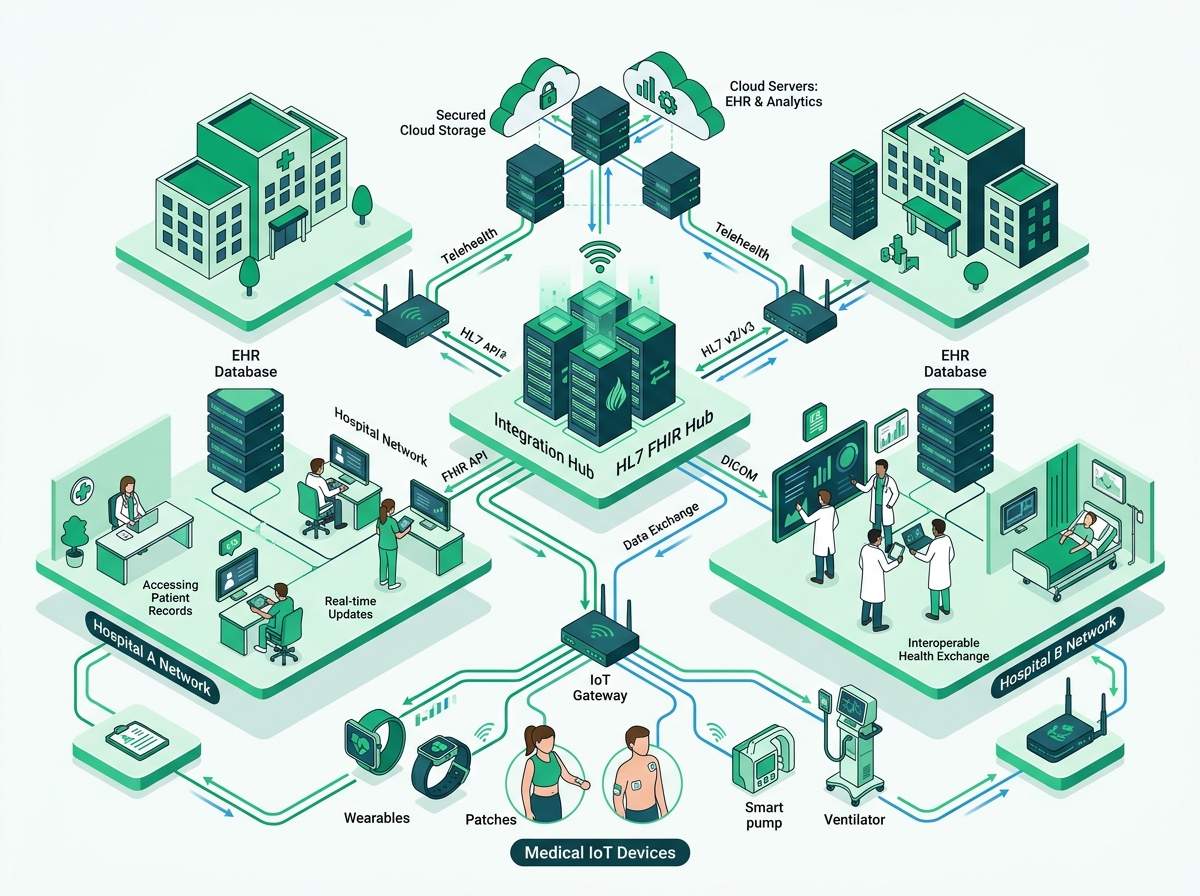
CodesForMD specializes in bridging medical coding APIs with existing hospital information systems using open, vendor-neutral healthcare interoperability standards.

HL7 v2.x & v3 HL7 FHIR R4 & R5 SMART on FHIR ANSI X12 837P / 837I ANSI X12 835 ERA DICOM Imaging LOINC & SNOMED CT ICD-10-CM / CPT-4 OpenAPI 3.0 / REST OAuth 2.0 / JWT
View HL7 / FHIR Integration Services
CodesForMD Healthcare Interoperability and Medical Coding API Architecture Diagram
Medical Coding API Integration Partner

Need Help Integrating a Medical Coding API into Your RCM Workflow?

CodesForMD is a specialized healthcare engineering and clinical systems integration partner. We help health systems, medical billing firms, and digital health startups connect EHRs, clinical NLP models, and clearinghouses securely and compliantly.

Confidential Consultation  ·  HIPAA Compliant Discussion  ·  Dedicated Clinical Informatics Experts