Medical coding is one of the most important and demanding functions in healthcare revenue cycle management. Every patient encounter generates clinical information that must be accurately translated into standardized diagnosis and procedure codes.
Medical coders review physician notes, operative reports, treatment records, and other documentation to identify the services and conditions that can appropriately be reported.
The work requires clinical understanding, knowledge of coding guidelines, and attention to detail.
As healthcare organizations manage increasing volumes of clinical information, manual coding workflows can create documentation backlogs, delayed claims, and additional administrative costs.
Artificial intelligence offers a way to support these processes.
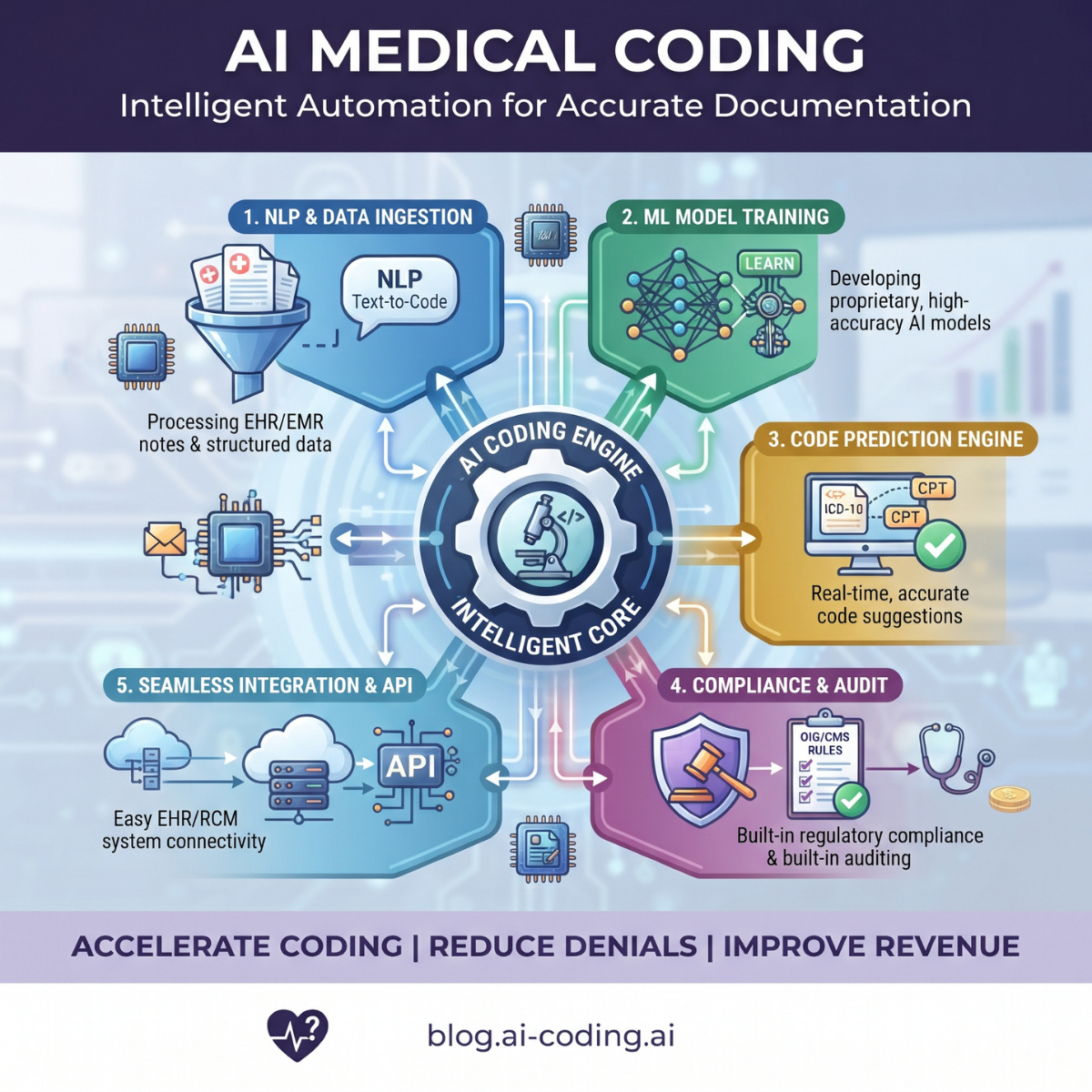
AI medical coding uses technologies such as natural language processing, machine learning, and large language models to analyze clinical records and assist with code selection, validation, and review.
However, artificial intelligence does not automatically make medical coding accurate or compliant.
A system that assigns an unsupported diagnosis or recommends the wrong procedure code can create billing errors, reimbursement disputes, and compliance risks.
For healthcare organizations, the challenge is not simply to automate medical coding. It is to use AI in a way that improves efficiency while preserving clinical accuracy, documentation integrity, and billing compliance.
This guide explores how AI medical coding works, its benefits, practical applications, limitations, and role in modern revenue cycle management.
What Is AI Medical Coding?
AI medical coding refers to the use of artificial intelligence to assist with assigning standardized codes to documented healthcare conditions and services.
Traditional medical coding relies on qualified professionals interpreting the clinical record and applying coding guidelines.
AI-assisted systems can perform selected supporting activities, including identifying diagnoses, extracting procedure details, searching code references, and generating coding recommendations.
Depending on the technology, an AI medical coding platform may:
- Analyze physician documentation
- Identify relevant clinical concepts
- Suggest diagnosis and procedure codes
- Flag incomplete documentation
- Validate code status and effective dates
- Identify potential modifier issues
- Check selected coding edits
- Route complex encounters for professional review
- Support claim preparation
These capabilities vary significantly between products.
A basic computer-assisted coding system may suggest codes from clinical notes, while a more advanced platform may combine documentation analysis, coding rules, and revenue cycle integrations.
The primary objective is to support accurate coding decisions, not generate codes without evidence.
How Does AI Medical Coding Work?
AI medical coding generally follows a sequence that connects clinical documentation with validated coding information.
The process begins when relevant medical records become available.
An AI system analyzes the documentation, identifies clinical details, and generates potential code recommendations.
Those recommendations are then checked against applicable coding references and rules.
Complex or uncertain cases are reviewed by qualified coding professionals.
A typical workflow is:
Clinical Documentation → AI Analysis → Candidate Codes → Coding Validation → Human Review → Claim Preparation
Each stage plays a different role.
Clinical documentation provides the evidence.
AI identifies potentially relevant information.
Coding references establish recognized code descriptions and instructions.
Validation checks detect potential problems.
Human oversight addresses ambiguity and determines whether recommendations are appropriately supported.
Not every AI product performs all these stages, making software capability evaluation essential.
1. Natural Language Processing in Medical Coding
Natural language processing, or NLP, helps computers analyze human language.
This is particularly useful in healthcare because clinical information is often stored in unstructured physician notes.
A medical record may contain symptoms, diagnoses, negative findings, treatment histories, procedures, and follow-up plans.
NLP can identify those concepts and make them available for coding review.
For example, consider a physician's note stating:
"The patient reports a history of asthma but has no evidence of an acute exacerbation."
The system must distinguish the documented medical history from an active exacerbation.
A simple keyword-based tool may incorrectly interpret every mention of "exacerbation" as a positive finding.
A more capable clinical NLP system considers negation, context, and temporality.
This matters because medical coding requires the correct interpretation of documented clinical information, not merely recognition of medical terms.
2. Machine Learning and Large Language Models
Machine learning can identify patterns in clinical documentation and historical coding decisions.
Large language models can also interpret complex notes, summarize relevant findings, and propose coding candidates.
However, these systems have important limitations.
An LLM may produce a plausible diagnosis that the provider never documented.
It may confuse a planned procedure with a completed service.
It may suggest a code that appears relevant but lacks the specificity required for the encounter.
These errors are especially concerning because AI-generated answers may sound confident even when they are incorrect.
For this reason, reliable AI coding workflows should combine model outputs with authorized coding references, deterministic validation rules, and appropriate professional review.
An AI-generated recommendation should always remain distinguishable from an approved coding decision.
3. Which Medical Code Sets Does AI Use?
AI medical coding applications commonly work with established healthcare classification systems.
ICD-10-CM
ICD-10-CM is used to report diagnoses and medical conditions in U.S. healthcare settings.
AI may help identify candidate diagnoses, but the codes must reflect documented conditions and applicable coding instructions.
CPT
Current Procedural Terminology, or CPT, describes medical procedures and professional services.
CPT content is owned by the American Medical Association and is subject to applicable licensing requirements.
HCPCS Level II
HCPCS Level II codes describe certain products, equipment, supplies, medications, and services.
ICD-10-PCS
ICD-10-PCS is used for procedure coding in applicable U.S. inpatient hospital settings.
Not every code system applies to every encounter.
A professional office visit and an inpatient hospital admission may require very different coding workflows.
AI coding systems must account for these distinctions.
4. AI-Assisted Coding vs Autonomous Medical Coding
Not all AI coding systems provide the same level of automation.
AI-assisted coding presents suggestions, highlights documentation, and identifies errors for a qualified professional to review.
Autonomous medical coding refers to systems designed to complete specified coding tasks with limited or no routine human intervention.
Autonomous coding is typically most appropriate to evaluate within carefully defined encounter types and documented workflows.
However, a vendor's claim that its software can operate autonomously does not establish that it is sufficiently accurate for every specialty.
Organizations must determine whether the system has been independently validated for the intended clinical setting.
Higher-risk, ambiguous, or complex encounters may need additional human review.
The appropriate level of automation should depend on demonstrated accuracy, coding complexity, compliance requirements, and organizational risk tolerance.
5. The Benefits of AI Medical Coding
AI can provide several operational advantages when implemented appropriately.
Faster Documentation Review
AI can identify potentially relevant diagnoses and procedures without requiring coders to manually search every section of a lengthy note.
Reduced Repetitive Work
Routine terminology searches and selected validation checks can be automated.
More Consistent Coding Review
Standardized rules can help identify similar issues across different providers and departments.
Earlier Error Detection
Potentially invalid codes, documentation gaps, and inconsistent coding combinations can be flagged before claim submission.
Improved Workflow Visibility
AI-supported dashboards can display pending encounters, review queues, coding exceptions, and turnaround times.
Better Use of Coding Expertise
Qualified coders may spend less time on repetitive tasks and more time reviewing complex or uncertain encounters.
These are potential benefits rather than guaranteed results. Actual performance depends on the software, clinical setting, and quality of implementation.
6. AI Medical Coding and Revenue Cycle Management
Medical coding is a critical component of the healthcare revenue cycle.
After a patient receives care, clinical information moves through documentation, charge capture, coding, claim preparation, and insurance processing.
AI coding can support the transition between documentation and billing.
A connected workflow may follow this sequence:
EHR → AI Coding → Coding Review → Charge Capture Reconciliation → Claim Scrubbing → Clearinghouse → Payer
For example, AI may identify a potentially reportable procedure in a completed encounter.
The coding team can verify whether the service was performed, documented, and separately reportable.
The approved charge then enters claim preparation.
However, AI coding cannot replace insurance eligibility verification, authorization management, payer policy checks, or payment posting.
It supports specific parts of RCM rather than replacing the complete revenue cycle.
7. Can AI Medical Coding Reduce Claim Denials?
AI can help prevent certain coding-related claim errors.
For example, an application may detect an inactive diagnosis code or flag a procedure combination requiring additional review.
It may identify insufficient documentation before the claim is submitted.
These checks can reduce avoidable rework.
However, a coding recommendation can be accurate while the payer still denies the claim.
The patient may lack active coverage.
The procedure may require prior authorization.
The service may not meet the payer's medical necessity criteria.
A claim may also contain incorrect administrative information unrelated to medical coding.
Therefore, AI medical coding can support denial prevention, but it cannot guarantee clean claims or reimbursement.
Healthcare organizations should measure coding-related denials separately from broader eligibility, authorization, and coverage denials.
8. Specialty-Specific Applications of AI Medical Coding
Different medical specialties have different documentation and coding requirements.
A general-purpose AI model may not adequately handle every specialty without additional validation and rules.
Dermatology
AI can help identify lesion details, procedure types, anatomical locations, and documentation gaps.
It may flag encounters involving biopsies, excisions, or same-day E/M services for additional coding review.
Cardiology
AI may support diagnostic code selection and identify when professional or technical component reporting requires attention.
Orthopedics
Applications can flag missing laterality, fracture details, procedure documentation, and global surgical considerations.
Behavioral Health
AI may identify documented psychotherapy time, service type, and potentially incomplete information.
Primary Care
AI can assist with diagnosis coding, E/M documentation review, and encounters involving separately reportable procedures.
Specialty-aware systems should be evaluated using real examples from the intended clinical environment.
9. AI for Evaluation and Management Coding
Evaluation and management coding is an important application area for AI.
E/M services are frequently billed in physician offices and other healthcare settings.
For many E/M visit families, code selection can depend on the documented level of medical decision-making or qualifying practitioner time, according to applicable instructions.
AI may help extract information relevant to the E/M level.
For example, it may organize documented problems addressed, data reviewed, and management risk.
However, the system should not equate longer notes with higher-level services.
The amount of documentation does not automatically establish the appropriate E/M level.
Likewise, an AI system should not infer undocumented clinical work.
CMS emphasizes that medical records must support the reported CPT, HCPCS, and diagnosis codes.
A reliable AI E/M tool should make supporting evidence visible and flag uncertainty for review.
10. AI Medical Coding and Modifier Accuracy
Modifiers communicate additional information about services or procedures.
Certain modifiers affect whether services may be separately reported.
For example, Modifier 25 can apply to a significant, separately identifiable E/M service performed on the same day as another procedure.
Modifier 59 may apply to certain distinct procedural services when supported by coding rules and documentation.
AI coding tools can identify combinations that require modifier review.
However, they should never automatically add a modifier simply to bypass a payment edit.
The coding team must verify whether the documented circumstances support it.
Modifier misuse can create overbilling and compliance risks.
Accurate modifier reporting requires a combination of current coding rules, clinical context, and professional judgment.
11. AI and the National Correct Coding Initiative
The National Correct Coding Initiative helps prevent certain improper Medicare payments caused by incorrect coding combinations or units.
CMS maintains procedure-to-procedure edits and Medically Unlikely Edits.
AI-powered claim validation tools can incorporate applicable edit information.
For example, the system may flag two procedures that ordinarily should not be reported together.
It can then direct the claim for review when additional documentation or modifier analysis is needed.
However, NCCI edits are not a complete measure of billing compliance.
They do not establish whether every service is medically necessary or covered under a patient's insurance plan.
Commercial payers may also apply different rules.
An effective AI coding platform should distinguish Medicare coding edits from payer-specific coverage and reimbursement requirements.
12. The Importance of Accurate Clinical Documentation
AI cannot reliably assign codes when the necessary clinical information is missing.
A procedure may require details about location, technique, duration, size, or another documented characteristic.
When those details are absent, software should identify the deficiency rather than invent the answer.
For example, an orthopedic note that does not specify the affected side may not support the precise code an AI system initially recommends.
The appropriate response may be a documentation clarification request.
AI can improve visibility into missing information, but it cannot replace the provider's responsibility to document the encounter accurately.
Documentation improvement should focus on representing the care delivered.
It should not pressure providers to add unsupported details solely to obtain higher reimbursement.
13. Coding Accuracy: The Biggest Challenge
Medical coding accuracy is more complicated than predicting one correct label.
A single encounter may require multiple diagnosis codes, specific sequencing, procedure codes, and modifiers.
A system may correctly identify one diagnosis while missing another reportable condition.
It may generate an inappropriate additional code even when most of its recommendations are correct.
Therefore, overall accuracy percentages can be misleading.
Healthcare organizations should examine different error types, including:
- Unsupported code recommendations
- Omitted reportable codes
- Incorrect code specificity
- Sequencing mistakes
- Wrong procedures
- Inappropriate modifiers
- Incorrect billing units
Testing should also examine how well the AI identifies cases requiring clarification.
An effective system must know when not to make a coding recommendation.
14. Human Medical Coders Remain Essential
AI medical coding changes the work of coding professionals, but it does not eliminate the need for coding expertise.
Qualified coders interpret documentation, apply official guidelines, resolve uncertain cases, and review complex coding relationships.
They also investigate situations in which software recommendations conflict with the clinical record.
For example, an AI system may recommend a separately reportable procedure that was actually bundled into a broader service.
A coder must determine whether the recommendation is appropriate.
Human oversight also helps organizations identify recurring model weaknesses.
Coding professionals can evaluate incorrect suggestions and provide feedback for system improvement.
The strongest workflows use AI to reduce repetitive tasks while preserving accountability for accurate coding decisions.
15. HIPAA Compliance and Patient Data Security
AI medical coding systems may process electronic protected health information.
When used by HIPAA-covered entities or business associates, applicable privacy and security requirements must be addressed.
Important considerations include:
- Security risk analysis
- Appropriate user access controls
- Secure authentication
- Protected data transmission
- Audit logging
- Vendor security reviews
- Data retention and disposal
- Incident response procedures
Third-party AI providers require particular attention.
Healthcare organizations must determine whether vendors create, receive, maintain, or transmit PHI on their behalf and whether Business Associate Agreements are required.
The organization should also understand how clinical records, AI prompts, outputs, and logs are handled.
Using a well-known AI platform does not automatically make the workflow HIPAA compliant.
Privacy and security protections must apply to the complete system.
16. CPT Licensing and AI Medical Coding in 2026
Medical coding software requires appropriate rights to use licensed coding information.
The American Medical Association owns the CPT code set and has issued specific licensing guidance for AI applications.
Under its current terms, use of the CPT Standard Data File to train, fine-tune, or improve AI models is prohibited.
Certain licensed retrieval-based uses are permitted within the applicable agreement and approved product scope.
This creates an important distinction between retrieving authorized CPT information during a coding workflow and using licensed CPT content as unrestricted model training data.
Healthcare software developers should verify their rights before implementing AI-powered CPT functionality.
They should also avoid treating AI-generated code descriptions or explanations as official CPT guidance.
Proper licensing is a fundamental part of responsible AI coding development.
17. Current Medical Code Sets and AI Updates
Medical code sets change, and AI coding systems must account for those changes.
The FY 2027 ICD-10-CM release became effective October 1, 2026, for the applicable reporting period.
CMS also publishes changes to HCPCS Level II and Medicare coding edits on their respective update schedules.
A system that uses outdated coding references may recommend deleted or inappropriate codes.
However, applying the newest code set to every encounter is also incorrect.
Historical claims should be evaluated using the code versions and rules applicable to their service dates.
Version-aware validation is essential for corrected claims, delayed billing, audits, and appeals.
AI model updates should be tested separately from coding rules and terminology updates so that changes do not introduce unexpected errors.
18. How to Choose AI Medical Coding Software
Healthcare organizations should evaluate AI coding products based on actual coding performance and operational suitability.
Important selection criteria include:
Coding Quality: Are recommendations supported by documented clinical evidence?
Specialty Support: Has the product been validated for the organization's services?
Integration: Can the tool connect with existing EHR and RCM platforms?
Code-Set Updates: Does it support current and historical coding versions?
Human Review: Can coding professionals approve, reject, and correct suggestions?
Security: Are PHI handling, access controls, and vendor responsibilities appropriately addressed?
Licensing: Does the vendor have the necessary rights for its use of CPT and other protected content?
Reporting: Can the organization track errors, overrides, processing times, and claim outcomes?
Request independent validation results rather than relying only on vendor demonstrations.
19. Measuring the ROI of AI Medical Coding
AI coding should be evaluated using measurable operational and financial outcomes.
Relevant performance indicators include coding turnaround time, reviewer productivity, unsupported suggestion rates, correction frequency, coding-related denials, and cost per approved encounter.
Consider a hypothetical practice processing 1,000 eligible encounters monthly.
If the existing coding workflow requires 12 minutes per encounter, the total is 200 staff hours.
If an AI-assisted workflow reduces the comparable average to 8 minutes while maintaining coding quality, the monthly requirement becomes approximately 133.3 hours.
That represents about 66.7 hours of capacity potentially released.
This is an illustrative scenario, not a prediction of actual savings.
The financial value depends on labor deployment, software costs, implementation expenses, validation, and ongoing support.
Faster coding is only beneficial when accuracy and compliance are preserved.
20. Common AI Medical Coding Mistakes
Several implementation mistakes can undermine AI coding systems.
One is relying on generative AI without a structured coding validation process.
Another is using historical claims as training data without reviewing their accuracy.
Organizations may also underestimate specialty-specific requirements or fail to maintain current code sets.
Other significant mistakes include:
- Automatically approving unsupported diagnoses
- Adding modifiers without documentation
- Ignoring medical necessity and payer coverage
- Using CPT content without appropriate licensing
- Exposing PHI through unapproved AI services
- Trusting vendor accuracy claims without independent testing
- Removing coder review before validation
- Failing to monitor model performance after deployment
These problems can turn a productivity initiative into a source of billing and compliance risk.
The solution is controlled automation supported by reliable data, appropriate validation, and documented human oversight.
21. A Practical AI Medical Coding Implementation Plan
Healthcare organizations can introduce AI coding through a phased approach.
Phase 1: Assess Existing Coding Workflows
Review coding turnaround times, current error patterns, denial categories, specialties, and documentation quality.
Identify tasks where AI could provide measurable value.
Phase 2: Evaluate Vendors and Security
Review coding capabilities, supported specialties, licensing, security safeguards, integration requirements, and vendor responsibilities.
Phase 3: Pilot With Defined Encounter Types
Begin with a limited set of encounters and qualified reviewers.
Compare AI recommendations with independently reviewed coding decisions.
Phase 4: Validate Accuracy
Measure unsupported codes, omissions, specificity errors, coding turnaround time, and review workload.
Investigate discrepancies before increasing automation.
Phase 5: Integrate With RCM
Connect validated coding results to charge capture, claim preparation, and appropriate claim editing workflows.
Phase 6: Monitor and Improve
Track coding quality, changes in denials, model updates, staff feedback, and operational performance.
Expand only after the organization demonstrates that the system is reliable for its intended use.
22. The Future of AI Medical Coding
AI medical coding is likely to become increasingly integrated with clinical documentation and revenue cycle workflows.
Future applications may provide more effective evidence highlighting, documentation clarification support, specialty-aware coding review, and automated identification of billing exceptions.
However, broader automation will also create new requirements for evaluation and governance.
Healthcare organizations will need to monitor coding accuracy across specialties, ensure that models use current references, and maintain appropriate oversight as systems evolve.
The most useful AI products will not simply produce code lists.
They will help professionals understand which codes are supported, which decisions are uncertain, and which information requires further review.
Automation should make coding decisions easier to verify, not harder to explain.
Frequently Asked Questions
What is AI medical coding?
AI medical coding uses artificial intelligence to analyze clinical documentation and assist with identifying, validating, and reviewing medical diagnosis and procedure codes.
Is AI medical coding accurate?
Accuracy varies by product, specialty, encounter complexity, and documentation quality. Performance should be measured against independently reviewed coding decisions rather than assumed from vendor claims.
Can AI replace medical coders?
Some limited coding tasks can be automated, but complex and uncertain encounters still require appropriate professional oversight. Organizations should validate any autonomous workflow carefully.
Can AI medical coding reduce claim denials?
It can help reduce selected coding-related errors, but it cannot prevent all denials involving eligibility, authorization, coverage, or payer adjudication.
Is AI medical coding HIPAA compliant?
Not automatically. Compliance depends on the organization, vendor relationships, information flows, technical safeguards, and applicable contractual and regulatory requirements.
What is the difference between AI medical coding and traditional coding?
Traditional coding primarily relies on qualified professionals manually reviewing records and selecting codes. AI-assisted coding uses technology to extract information, suggest codes, and support validation while retaining appropriate professional oversight.
Final Thoughts
AI medical coding offers important opportunities to improve medical coding efficiency, documentation review, and revenue cycle operations.
By combining natural language processing, machine learning, terminology resources, and coding validation, healthcare organizations can identify potential errors earlier and reduce repetitive administrative work.
However, speed should never come at the expense of accuracy.
AI-generated diagnoses, procedures, and modifiers must remain supported by the clinical record and applicable coding requirements.
Healthcare organizations must also address patient data security, appropriate CPT licensing, code-set maintenance, and system validation.
Human coding expertise remains critical for complex situations and for maintaining accountability.
The future of medical coding is not simply about replacing manual work with AI. It is about combining intelligent automation with verified clinical evidence, coding rules, and professional judgment.
When implemented responsibly, AI medical coding can help healthcare practices improve operational efficiency, strengthen coding consistency, and build a more accurate and reliable revenue cycle.