
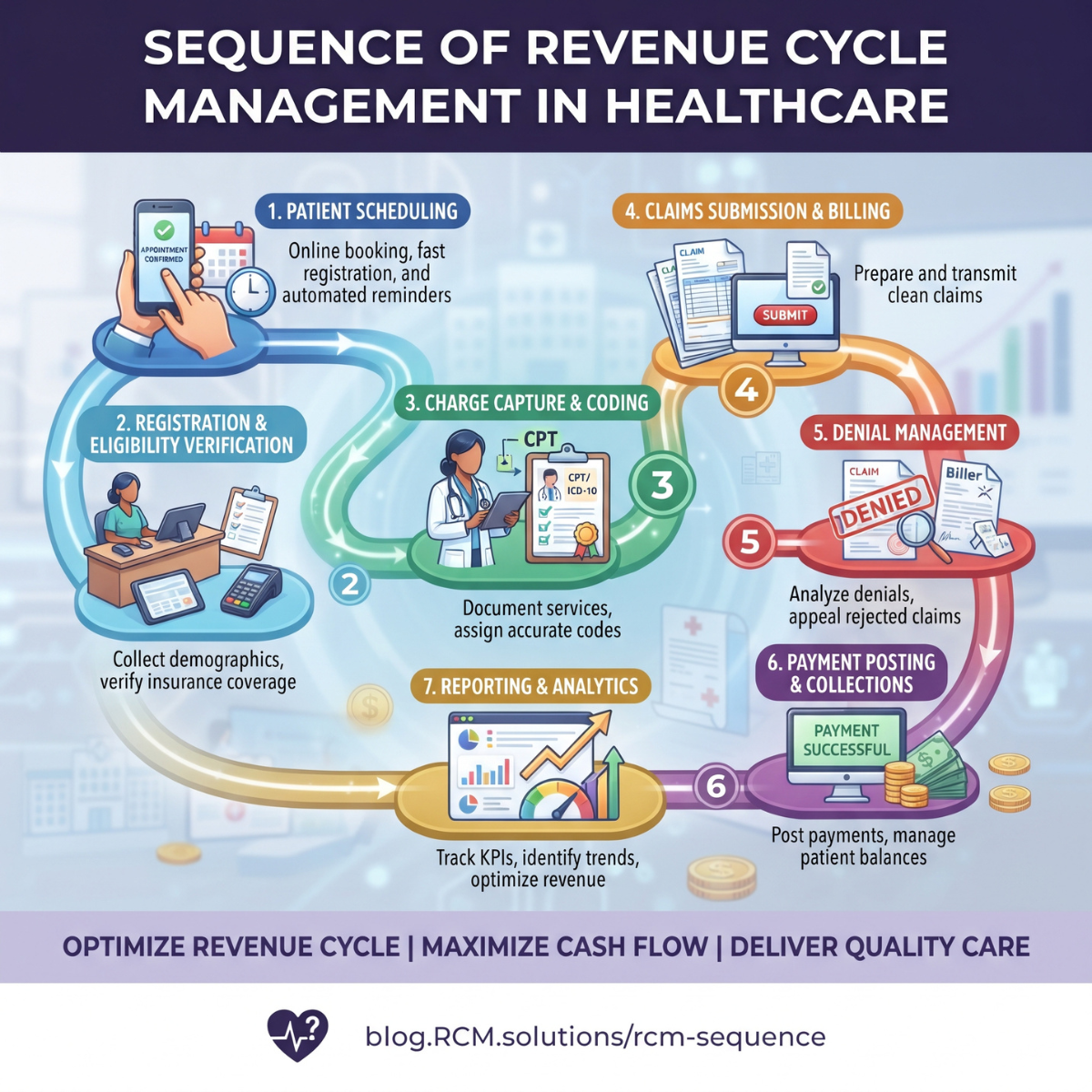
Revenue cycle management is the financial foundation of every healthcare organization. From the moment a patient schedules an appointment to the final resolution of insurance payments and patient balances, multiple departments work together to ensure that healthcare services are documented, billed, and reimbursed appropriately.
However, revenue cycle management is much more than submitting medical claims to insurance companies.
It includes patient registration, insurance verification, prior authorization, clinical documentation, charge capture, medical coding, claim preparation, payer adjudication, payment posting, denial management, and patient collections.
Each stage depends on accurate information from the previous stage.
An incorrect insurance identification number can disrupt claim processing. A missing authorization can lead to a payment denial. Incomplete documentation can prevent accurate coding, while missed charges may never enter the billing system at all.
Understanding the sequence of revenue cycle management in healthcare helps medical practices identify where problems originate and how to prevent revenue leakage.
The Healthcare Financial Management Association (HFMA) describes RCM as the process of tracking revenue from the patient's initial appointment or encounter through final payment and account resolution.
This guide explains the 13 essential stages of healthcare RCM, their operational responsibilities, common challenges, and practical strategies for improving financial performance.
What Is Revenue Cycle Management in Healthcare?
Revenue cycle management, or RCM, is the coordinated process healthcare organizations use to manage the financial aspects of delivering patient care.
It connects clinical operations with administrative and financial activities.
The revenue cycle begins before the patient receives treatment and continues until appropriate payments, adjustments, disputes, and remaining balances are resolved.
A successful RCM process should ensure that:
- Patient information is accurate.
- Insurance eligibility and benefits are appropriately verified.
- Required authorizations are addressed.
- Healthcare services are correctly documented.
- Legitimate billable services are captured.
- Diagnosis and procedure codes are accurate.
- Claims meet applicable submission requirements.
- Payer payments and adjustments are posted correctly.
- Denials and outstanding balances receive appropriate follow-up.
- Patient responsibility is accurately calculated and communicated.
The objective is to support accurate, compliant billing and timely collection of legitimate reimbursement.
The Complete Sequence of Revenue Cycle Management
The healthcare revenue cycle can be organized into three major phases: front-end, middle, and back-end RCM.
| PhaseStagesPrimary objective | ||
| Front-end RCM | 1–5 | Prepare accurate patient, insurance, and financial information |
| Middle RCM | 6–9 | Document care, capture services, assign codes, and create accurate claims |
| Back-end RCM | 10–13 | Process claims, reconcile reimbursement, resolve denials, and close accounts |
The complete sequence follows this pathway:
Scheduling & Preregistration → Eligibility Verification → Authorization → Financial Clearance → Check-In → Care Delivery & Documentation → Charge Capture → Medical Coding → Claim Scrubbing → Claim Submission → Payer Adjudication → Payment Posting → Follow-Up, Patient Collections & Account Closure
Although the stages are presented in order, some activities overlap. For example, patient payments may be collected before treatment, and coding or charge review may occur alongside documentation completion.
Step 1: Patient Scheduling and Preregistration
The revenue cycle begins when a patient requests an appointment or healthcare service.
During scheduling, the practice collects information required to establish the encounter and prepare for billing.
This may include the patient's legal name, date of birth, contact details, insurance information, reason for the visit, and referral information when applicable.
Preregistration allows staff to identify missing or inconsistent information before the appointment.
Common problems: Incorrect demographics, outdated insurance records, duplicate patient accounts, and incomplete referral information.
Best practices: Standardize registration fields, verify patient identity, review existing records, and identify services that may require additional financial clearance.
Accurate preregistration reduces preventable administrative errors later in the revenue cycle.
Step 2: Insurance Eligibility and Benefits Verification
After collecting patient information, the practice verifies insurance coverage and relevant benefits.
Eligibility verification establishes whether the reported coverage is active for the expected service date.
Benefits verification helps determine the financial rules applicable to the planned treatment.
Important details may include copayments, deductibles, coinsurance, network participation, referral requirements, and benefit limitations.
Electronic eligibility transactions commonly use the HIPAA-adopted ASC X12 270 inquiry and 271 response.
Common problems: Inactive coverage, incorrect subscriber information, wrong payer selection, and overlooked benefit restrictions.
Best practices: Verify information before service, review discrepancies, and confirm relevant benefits rather than assuming that active coverage guarantees payment.
Eligibility verification supports financial planning, but it does not guarantee coverage or reimbursement for a particular service.
Step 3: Prior Authorization and Referral Management
Certain procedures, diagnostic tests, medications, and treatments require approval or referrals under the patient's plan.
The authorization team must determine whether these requirements apply before the service whenever practical.
When authorization is required, staff should verify the approved procedure, service units, rendering provider, location, and effective dates.
For example, an imaging procedure may require prior authorization from a commercial insurer.
If the practice performs the procedure without satisfying the plan's requirements, the claim may be denied.
Common problems: Missing authorization, expired approvals, incorrect procedure details, and inadequate tracking.
Best practices: Maintain an authorization work queue, validate approval details against scheduled services, and establish escalation procedures for unresolved approvals.
Prior authorization is not a guarantee of reimbursement. Other coverage, coding, and medical necessity requirements may still apply.
Step 4: Patient Financial Clearance and Cost Estimation
Financial clearance involves reviewing the patient's expected payment responsibilities and addressing relevant administrative or financial issues before treatment.
The practice may provide estimates, explain insurance benefits, collect appropriate advance payments, or offer financial counseling.
For example, a patient may have an active insurance plan but an unmet deductible.
A cost estimate can help the patient understand the possible financial implications of treatment.
However, an estimate should not be presented as the final adjudicated patient balance.
For eligible uninsured and self-pay patients, the No Surprises Act establishes specific good faith estimate requirements.
Common problems: Unexpected bills, unclear payment expectations, and incomplete financial communication.
Best practices: Explain estimated costs in plain language, document applicable estimates, and provide information about payment arrangements or assistance where appropriate.
Financial clearance should support access to care rather than create inappropriate financial barriers.
Step 5: Patient Check-In and Registration Confirmation
When the patient arrives, registration staff should confirm that the information collected earlier remains accurate.
This may involve verifying demographic details, insurance records, referral documents, and required forms.
Staff may also collect a verified copayment or other appropriate amount according to the applicable plan and practice policies.
Changes should be recorded promptly.
For example, a patient may present a new insurance card at check-in after changing employers.
If the practice continues using an outdated policy, the claim may be sent to the wrong payer.
Common problems: Failure to update insurance information, duplicate records, and incorrect account selection.
Best practices: Confirm critical information at check-in, resolve registration discrepancies, and synchronize updates across scheduling, EHR, and billing systems.
The information captured here becomes part of the foundation for accurate claim generation.
Step 6: Care Delivery and Clinical Documentation
After administrative preparation, the provider delivers the healthcare service.
The clinical team documents the encounter, including the services performed and other information necessary to support accurate coding.
Depending on the encounter, documentation may include diagnoses, medical decision-making, examination findings, procedures, medication administration, service duration, and relevant treatment details.
For example, a dermatology procedure may require information about lesion location, size, and treatment method.
Clinical documentation must reflect what actually happened.
Common problems: Incomplete procedure details, delayed chart completion, unclear diagnoses, and unsupported service descriptions.
Best practices: Establish clear documentation expectations, use appropriate EHR templates, and identify records requiring clarification.
Documentation is a central connection between patient care and reimbursement.
A billing team cannot accurately report services that are not sufficiently supported by the clinical record.
Step 7: Charge Capture and Charge Entry
Charge capture identifies services performed that may generate legitimate billable charges.
The information is transferred into the medical billing system for further review and claim preparation.
Potential charges may include office visits, diagnostic services, procedures, injections, medications, and other separately reportable services.
For example, a clinic may administer an injection during an office visit.
The practice must determine which services and products are separately billable under the documentation and applicable rules.
Common problems: Missing procedure charges, duplicate charges, delayed charge entry, and incorrect quantities.
Best practices: Reconcile completed encounters and procedures against recorded charges, monitor charge lag, and investigate unbilled services.
Charge capture should not automatically convert every documented activity into a separate claim line.
Some activities are bundled into broader services or are otherwise not independently reportable.
The goal is accurate charge integrity, not simply higher billed charges.
Step 8: Medical Coding and Coding Validation
Medical coding converts documented diagnoses and services into standardized codes.
For U.S. billing, common coding systems include:
- ICD-10-CM: Diagnoses and medical conditions.
- CPT: Medical procedures and professional services.
- HCPCS Level II: Applicable supplies, products, equipment, medications, and services.
In inpatient hospital settings, ICD-10-PCS may also apply.
Coders must select appropriate codes based on the documentation, applicable coding guidelines, and relevant service dates.
They also review billing units, modifiers, and procedure relationships.
For example, Modifier 25 may apply when a significant, separately identifiable evaluation and management service is documented on the same date as another procedure.
It should not be applied automatically.
Common problems: Invalid codes, incorrect specificity, unsupported modifiers, and inaccurate billing units.
Best practices: Maintain current coding references, support qualified coder review, and apply relevant coding edits.
Medical coding and charge capture may operate in parallel, but both must be complete and reconciled before final claim release.
Step 9: Claim Creation and Claim Scrubbing
After charges and coding information are validated, the billing system assembles the insurance claim.
Claim creation combines clinical coding information with patient, provider, payer, and encounter details.
Before submission, the claim should pass appropriate validation checks.
This process is known as claim scrubbing.
A claim scrubber may identify missing required fields, invalid codes, inconsistent modifiers, duplicate billing, or other problems.
CMS's National Correct Coding Initiative includes procedure-to-procedure and medically unlikely edits relevant to Medicare coding.
Common problems: Missing information, inconsistent claim fields, incorrect code combinations, and incomplete provider details.
Best practices: Use date-appropriate coding references, payer-specific edits where applicable, and a clear exception review process.
A clean claim check improves submission quality but does not guarantee payer approval.
Coverage and reimbursement decisions still depend on adjudication.
Step 10: Claim Submission and Acceptance Monitoring
Once the claim passes appropriate review, it is submitted electronically to the clearinghouse or payer.
Standard U.S. electronic professional and institutional claims use the applicable ASC X12 837 transaction.
However, sending a claim does not prove that the payer accepted it for adjudication.
The claim may fail clearinghouse validation or payer intake checks.
Acknowledgment processes, including applicable 999 and 277CA transactions, can provide information about electronic processing and claim acceptance.
Common problems: Rejected submissions, incorrect payer routing, unnoticed acknowledgment errors, and missed filing deadlines.
Best practices: Track claims from submission through acceptance, resolve rejected claims promptly, and maintain payer-specific filing deadlines.
For Medicare fee-for-service, claims generally must be filed within one calendar year after the date of service, subject to specified exceptions.
Commercial and Medicaid deadlines vary.
Step 11: Payer Adjudication and Reimbursement Determination
Once accepted, the claim enters payer adjudication.
The insurance company evaluates the claim against applicable coverage, payment, coding, and benefit requirements.
The payer may consider the patient's eligibility, covered services, medical necessity, authorization information, contractual reimbursement, and other rules.
The outcome may include full payment, partial payment, adjustments, or denial.
For example, an insurer may approve an office visit but deny a separately billed procedure because of a disputed coverage requirement.
Payer adjudication determines the insurer's payment decision and may establish patient responsibility.
Common problems: Coverage denials, medical necessity disputes, incorrect adjustments, and processing delays.
Best practices: Monitor payer status, investigate discrepancies, and maintain accurate payer policy and contract information.
The payer's decision must be reviewed rather than automatically treated as correct or incorrect.
Step 12: Payment Posting and Reconciliation
After claim processing, the payer communicates its adjudication decision through remittance information.
Electronic remittance advice commonly uses the ASC X12 835 transaction.
The remittance identifies payments and adjustments associated with claims or service lines.
Important remittance information can include Claim Adjustment Reason Codes (CARCs), Remittance Advice Remark Codes (RARCs), and adjustment group codes.
The billing team posts insurance payments, contractual adjustments, denials, and valid patient responsibility.
Payment posting must also be reconciled against deposits and payer records.
For example, if the payer approves a claim for $180 but the contract supports a different expected payment, staff may need to investigate a possible underpayment.
Common problems: Incorrect posting, unapplied payments, overlooked underpayments, and inaccurate patient balances.
Best practices: Automate appropriate ERA posting, reconcile transactions, and investigate posting exceptions.
Accurate posting creates reliable financial information for the remaining stages of the revenue cycle.
Step 13: Denial Management, A/R Follow-Up, Patient Collections, and Account Closure
The final stage involves resolving remaining balances and outstanding account issues.
In practice, several workflows may operate at the same time.
Denial Management
Billing teams investigate unfavorable payer determinations and determine whether correction, reopening, reconsideration, or appeal is appropriate.
Insurance Accounts Receivable Follow-Up
Outstanding claims are monitored for delayed processing, missing payments, underpayments, and payer response issues.
Electronic claim status inquiries may use ASC X12 276/277 transactions.
Patient Billing and Collections
Once valid patient responsibility is established, the practice provides clear statements and appropriate payment options.
Patients may owe copayments, deductibles, coinsurance, or qualifying self-pay amounts.
However, denied insurance balances must not automatically be transferred to patients without verifying responsibility and applicable protections.
Account Closure
The account is closed or otherwise appropriately finalized when payments, contractual adjustments, refunds, approved write-offs, disputes, and remaining financial obligations are resolved.
Common problems: Missed appeal deadlines, incorrect patient billing, aging balances, and premature account closure.
Best practices: Maintain assigned work queues, verify balances, track deadlines, reconcile final transactions, and document account resolution.
The revenue cycle is complete only when the account reaches an appropriate financial disposition—not merely when the first insurance payment arrives.
Real-World Example: How the RCM Sequence Works
Consider a hypothetical primary care patient who schedules an office visit.
The scheduling team collects patient information and confirms the appointment.
The eligibility team verifies active insurance coverage and identifies a $25 copayment.
The practice confirms that no prior authorization is required for the planned visit.
At check-in, the patient pays the verified copayment.
The physician performs and documents the encounter.
The coding team determines the appropriate E/M code based on the documented service, and the validated charge enters claim preparation.
The claim passes editing checks and is submitted electronically.
The payer accepts and adjudicates the claim.
Assume the following illustrative amounts:
| Financial itemAmount | |
| Original provider charge | $200 |
| Contracted allowed amount | $140 |
| Insurance payment | $115 |
| Patient copayment | $25 |
| Contractual adjustment | $60 |
The patient already paid the $25 copayment.
The payer pays $115, and the $60 contractual adjustment is recorded.
Total collectible reimbursement is $140, not the original $200 charge.
After payment posting and reconciliation, the account has no remaining balance and can be appropriately closed.
This example demonstrates how clinical work, claim processing, patient payments, and accounting adjustments connect within the revenue cycle.
Front-End vs Middle vs Back-End RCM
Understanding these three phases helps healthcare administrators assign responsibilities.
Front-end RCM focuses on scheduling, registration, eligibility, authorizations, and financial preparation.
Errors here frequently produce eligibility, referral, and authorization problems later.
Middle RCM focuses on clinical documentation, charge capture, coding, and claim preparation.
Errors here may cause missed charges, unsupported coding, inaccurate units, and claim edits.
Back-end RCM focuses on claim acceptance, payer processing, payment posting, denial resolution, insurance follow-up, patient collections, and account closure.
Errors here may cause outstanding receivables, underpayments, incorrect patient bills, and avoidable write-offs.
A high-performing RCM operation connects all three phases instead of treating them as independent departments.
Important Revenue Cycle Management KPIs
Medical practices should use measurable indicators to evaluate the complete sequence.
Eligibility and Authorization Errors
Track preventable issues originating in patient access.
Charge Lag
Measure the time between the date of service and the initial posting of charges.
Clean Claim Rate
Measure claims passing a defined set of pre-submission edits without manual intervention.
Claim Rejection Rate
Track claims failing defined clearinghouse or payer intake requirements.
Initial Denial Rate
Measure unfavorable initial adjudication outcomes using consistent reporting rules.
Net Days in Accounts Receivable
Measure net outstanding receivables relative to average daily net patient service revenue.
Net Collection Rate
Evaluate collections against appropriately defined collectible revenue.
Patient Collection Performance
Monitor valid patient balances, payment arrangements, and collection activity.
Cost to Collect
Assess the operational resources required to collect revenue.
HFMA's MAP Keys provide standardized definitions for many revenue cycle performance metrics.
Practices should use consistent denominators and distinguish billed charges, expected reimbursement, and cash collections.
How Technology Improves the RCM Sequence
A connected healthcare technology platform can reduce manual handoffs between departments.
For example, eligibility verification tools can communicate coverage information to registration teams.
Authorization systems can track approvals associated with scheduled services.
EHR integrations can transfer relevant encounter information into coding and charge capture workflows.
Claim scrubbers can identify selected errors before submission.
Electronic remittance processing can support payment posting and denial classification.
RCM dashboards can display aging balances, delayed claims, and recurring workflow problems.
AI may assist with clinical documentation review, coding suggestions, denial categorization, and operational analytics.
However, automation must not create unsupported codes, bypass payer requirements, or transfer unverified balances to patients.
The objective is to improve accuracy and workflow visibility rather than merely increase transaction speed.
Common Mistakes That Disrupt the Revenue Cycle
Several recurring mistakes prevent medical practices from maintaining an efficient RCM sequence.
One is treating billing as the beginning of the process rather than recognizing the importance of preregistration and verification.
Another is failing to reconcile performed services with recorded charges.
Practices may also submit claims without monitoring acceptance acknowledgments.
Some focus heavily on denials while overlooking missing charges or payer underpayments.
Others transfer unresolved insurance balances directly to patients without confirming financial responsibility.
Finally, organizations may monitor individual departments without examining how their workflows affect one another.
Correcting these problems requires clear ownership, connected systems, standardized processes, and regular performance reviews.
A 30-Day Revenue Cycle Improvement Plan
Week 1: Map the Existing Workflow
Document how information moves from scheduling through account resolution.
Identify systems, employees, handoffs, unresolved queues, and recurring errors.
Establish baseline KPIs.
Week 2: Strengthen Front-End Processes
Review registration accuracy, insurance verification, authorization tracking, and patient financial communication.
Correct the most common administrative errors.
Week 3: Improve Coding and Claim Quality
Audit documentation, charge capture, coding accuracy, and pre-submission validation.
Investigate unbilled encounters and recurring claim rejections.
Week 4: Improve Back-End Follow-Up
Review payment posting, payer underpayments, denials, patient A/R, and account closure procedures.
Assign responsibility for unresolved issues.
Compare early operational findings with the baseline and establish ongoing monitoring.
Thirty days provides a useful starting framework, but significant improvements may require additional time and investment.
Frequently Asked Questions
What is the first step of revenue cycle management in healthcare?
Patient scheduling and preregistration are generally the first steps for scheduled care. For emergency or unscheduled care, the operational sequence may begin with patient arrival and necessary treatment.
What are the three main phases of RCM?
The three broad phases are front-end RCM, middle RCM, and back-end RCM.
Is charge capture completed before medical coding?
Charge capture and coding often overlap. Some systems capture potential charges before coding, while others use coding review to finalize charges. Both must be reconciled before claim submission.
Does revenue cycle management end when insurance pays?
No. Remaining patient responsibility, underpayments, refunds, denials, adjustments, and other outstanding issues may still require resolution.
What is the difference between medical billing and RCM?
Medical billing primarily focuses on preparing claims, submitting them, and processing related payments. RCM covers the broader process from initial patient access through final financial resolution.
Can RCM automation eliminate claim denials?
No. Automation can reduce some preventable errors, but payer coverage decisions, documentation issues, authorization requirements, and other factors can still lead to denials.
Final Thoughts
The sequence of revenue cycle management in healthcare connects every major financial and administrative activity surrounding patient care.
It begins with accurate registration and insurance verification, continues through clinical documentation, charge capture, coding, and claim submission, and concludes with reimbursement reconciliation and appropriate account resolution.
Every stage matters because problems in one department can create financial consequences elsewhere.
An authorization oversight may become a denial weeks later.
A missed procedure charge may never appear in a claim.
An inaccurate payment adjustment may produce an incorrect patient statement.
For healthcare organizations, the solution is to build a connected process with clear responsibilities, reliable data, appropriate automation, and continuous monitoring.
The goal of effective RCM is not simply to submit medical claims quickly. It is to ensure that services are accurately documented, appropriately billed, correctly reimbursed, and fully reconciled.
Medical practices that manage the complete revenue cycle—not just individual billing tasks—are better positioned to reduce administrative rework, protect legitimate revenue, improve cash flow, and create a more transparent financial experience for patients.