Artificial intelligence is changing how healthcare organizations manage clinical documentation, medical coding, and revenue cycle operations.
Medical practices and hospitals generate large volumes of encounter notes, diagnoses, procedure records, and billing information. Converting these records into accurate medical codes requires time, specialized expertise, and careful attention to coding guidelines.
When coding processes become inefficient, healthcare organizations may experience documentation backlogs, delayed charge entry, claim corrections, and reimbursement problems.
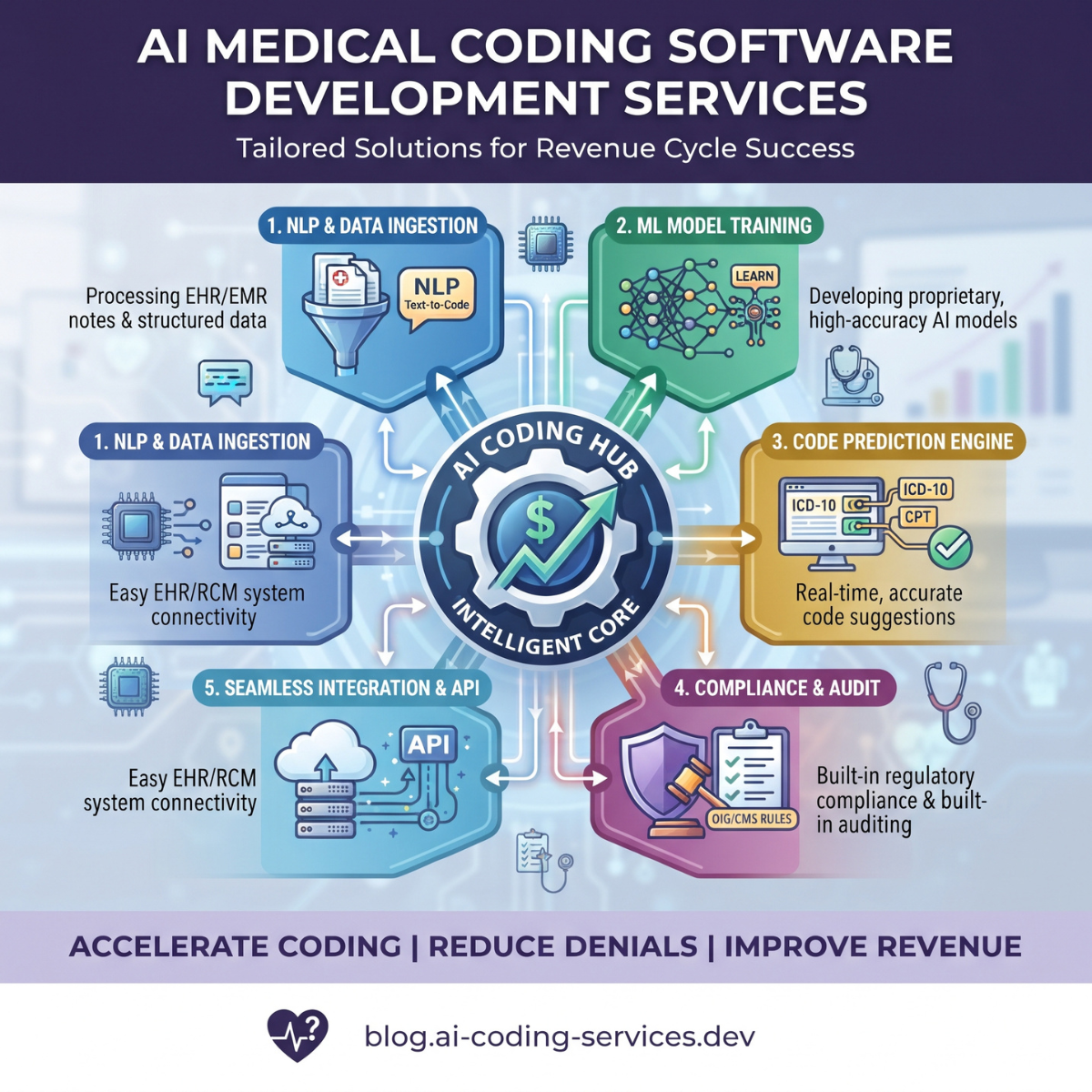
AI medical coding software development services help businesses address these challenges by creating technology that supports clinical information extraction, coding recommendations, automated validation, and integration with existing healthcare systems.
However, developing reliable medical coding software is not simply about connecting a chatbot to electronic health records.
A production-ready solution requires healthcare domain expertise, authorized coding data, specialty-specific rules, secure integrations, quality assurance, and appropriate human review.
For organizations investing in AI medical coding software development services, understanding what each service includes is essential for choosing the right project scope and evaluating its business value.
This guide explores the development services available, the technical architecture behind AI coding platforms, implementation considerations, regulatory requirements, and practical ways to measure performance.
What Are AI Medical Coding Software Development Services?
AI medical coding software development services involve designing, building, integrating, customizing, and maintaining applications that use artificial intelligence to support medical coding workflows.
These applications may analyze clinical documentation, identify relevant medical concepts, recommend diagnosis and procedure codes, and flag potential billing errors.
Depending on the healthcare organization's requirements, development services may include:
- Custom AI medical coding application development
- Natural language processing and clinical data extraction
- Computer-assisted coding software
- Medical coding API development
- Coding terminology integration
- Specialty-specific rules engines
- EHR and practice management integration
- Automated charge capture support
- Claim scrubbing and coding validation
- HIPAA security engineering
- AI model testing and performance monitoring
- Healthcare SaaS modernization and maintenance
These services may support independent coding applications or modules within a larger revenue cycle management platform.
The appropriate combination depends on the customer's users, specialties, coding volumes, existing systems, and operational goals.
Why Healthcare Organizations Need AI Coding Development Services
Traditional coding workflows depend on professionals reviewing clinical records and selecting codes supported by the documented services.
This expertise remains essential.
However, manual processes may require repetitive documentation searches, code lookups, and validation tasks.
AI-assisted systems can make these activities more efficient.
For example, software can highlight relevant diagnoses in a physician's note, retrieve coding references, and identify missing documentation before the claim reaches the billing department.
A well-designed system can also help prioritize complex encounters for experienced coders.
Potential benefits include better coding workflow visibility, faster information retrieval, more consistent validation, and reduced repetitive administrative work.
These benefits should be validated through testing rather than assumed.
AI-generated suggestions can be incorrect, and poorly implemented automation may introduce additional coding errors.
The objective of development services is to create reliable tools that support accurate coding and improve actual RCM performance.
1. AI Medical Coding Consulting and Product Discovery
A successful software project begins with understanding the healthcare organization's coding problems.
AI development consulting helps identify which activities are suitable for automation and which require professional judgment.
For example, a medical billing company might need automated validation of existing codes rather than AI-generated diagnosis suggestions.
A multi-specialty practice may need a documentation review assistant that identifies missing procedure details.
A healthcare SaaS company may need a standalone coding API for external customers.
During discovery, the development team should examine encounter volumes, specialty requirements, current coding workflows, denial patterns, available integrations, and data governance obligations.
Typical deliverables: A requirements specification, workflow map, prioritized feature backlog, feasibility assessment, proposed architecture, initial risk register, and measurable success criteria.
This phase helps prevent expensive development of features that do not solve an actual business problem.
2. Custom AI Medical Coding Software Development
Custom development services create coding applications tailored to specific operational requirements.
Instead of adopting a generic product, healthcare organizations can define how their software handles clinical records, code suggestions, review queues, approvals, and billing integrations.
A custom platform may offer a coding dashboard, encounter management, validation alerts, documentation clarification requests, and reporting.
For example, a medical billing company serving several specialties may require different rules and review pathways for dermatology, cardiology, orthopedics, and primary care.
The application should accommodate those differences without creating inconsistent coding standards.
Typical deliverables: Application architecture, user interfaces, backend services, integration connectors, automated tests, deployment documentation, and administrator controls.
Custom development is most appropriate when existing platforms cannot adequately support the organization's workflow or product strategy.
3. Clinical NLP Development Services
Natural language processing, or NLP, helps software interpret information contained in unstructured clinical notes.
Healthcare documentation may include symptoms, diagnoses, examination findings, procedures, historical conditions, and treatment plans.
NLP systems identify relevant information and organize it into structured concepts for coding review.
However, simply recognizing medical terminology is insufficient.
The system must distinguish active conditions from medical history, confirmed diagnoses from suspected conditions, and completed procedures from planned treatment.
For example, a note stating that a patient has no evidence of pneumonia should not trigger a confirmed pneumonia diagnosis.
Clinical NLP services may include entity extraction, negation detection, document classification, terminology normalization, and evidence highlighting.
Typical deliverables: A clinical information extraction pipeline, validated output schema, supporting text references, and performance reports based on reviewed test records.
4. AI-Assisted Code Recommendation Systems
Code recommendation services use machine learning or other AI methods to suggest codes based on clinical documentation.
The system may propose relevant ICD-10-CM diagnosis codes or appropriate procedure coding candidates for review.
A qualified development team should design the application to distinguish an AI suggestion from an approved coding decision.
Recommendations must be checked against documentation and authoritative coding references.
The application should also allow an uncertain result.
For example, when a procedure note lacks information needed to determine the correct code, the system should flag the missing documentation rather than invent a specific procedure.
Typical deliverables: A recommendation service, evidence links, validation flags, review controls, and an evaluation report covering supported and unsupported suggestions.
AI should assist with accurate code selection, not generate the maximum possible number of codes.
5. Medical Coding API Development and Integration
Medical coding APIs allow healthcare applications to access coding functions through standardized interfaces.
Depending on the intended product, an API may support code lookup, code validation, terminology mapping, code recommendation, or documentation review.
FHIR terminology services provide established operations for code lookup, validation, value set processing, and concept mapping.
However, a terminology API is not automatically a complete claim editing system.
A code may be technically valid without being supported by the patient's clinical record.
Medical coding API development should therefore distinguish terminology functions from clinical interpretation and payer-specific billing rules.
Typical deliverables: Versioned API endpoints, authentication controls, developer documentation, error handling, audit records, and integration tests.
The system should also manage service interruptions without silently approving unvalidated coding information.
6. ICD-10-CM, CPT, and HCPCS Validation Services
Medical coding software depends on current and authorized coding references.
ICD-10-CM supports diagnosis reporting, CPT describes medical procedures and professional services, and HCPCS Level II covers applicable products, supplies, and other services.
The correct code version depends on the service date and relevant reporting requirements.
For example, FY 2027 ICD-10-CM codes are effective beginning October 1, 2026, for applicable encounters.
A platform reviewing a historical claim must use the appropriate historical code set rather than validating everything against the newest release.
Code validation services should identify invalid codes, effective-date conflicts, insufficient specificity, and other relevant issues.
Typical deliverables: A managed terminology repository or licensed integration, effective-date validation, update procedures, and historical code support.
Code validity is necessary but does not establish medical necessity or guarantee reimbursement.
7. CPT Licensing and Authorized AI Integration
CPT licensing is a critical part of medical coding software development.
The American Medical Association owns the copyrighted CPT code set, and appropriate licensing is required for covered software uses.
Its July 2026 licensing guidance addresses artificial intelligence applications specifically.
Under the AMA's stated AI licensing terms, using the CPT Standard Data File to train, fine-tune, or improve AI models is prohibited.
Certain retrieval-based AI uses are permitted when authorized by the applicable license and approved product scope.
This distinction affects how developers design their systems.
A compliant architecture may need to retrieve authorized CPT information at the point of use instead of embedding licensed CPT content into model weights.
Typical deliverables: A licensing requirements assessment, approved data access design, documentation of usage rights, and controls governing licensed content.
A development company should never assume that buying a coding dataset permits unrestricted AI training.
8. Specialty-Specific Coding Automation
Different medical specialties require different documentation and validation workflows.
Dermatology coding may depend on lesion dimensions, anatomical locations, and procedure details.
Cardiology coding may involve diagnostic interpretations and professional or technical components.
Orthopedic coding may require laterality, injury characteristics, and global surgical considerations.
Behavioral health coding may depend on documented service duration and appropriate service distinctions.
A specialty-aware rules engine identifies missing information and potentially incompatible coding combinations.
However, it should not automatically assign modifiers to bypass billing edits.
Typical deliverables: Specialty configuration modules, documentation checklists, coding validation rules, representative test cases, and coder review workflows.
Specialty-specific validation should be developed progressively, with each specialty tested against its actual clinical documentation patterns.
9. AI-Powered Charge Capture Support
Charge capture connects performed clinical services to the billing system.
Incomplete or delayed charge capture can result in unbilled services and missed reimbursement opportunities.
AI can assist by identifying potentially reportable services documented within completed encounters.
For example, a system may flag a procedure record that has no corresponding charge entry.
However, the application must verify that the service was actually performed and is separately billable before creating or recommending a charge.
An ordered test is not automatically a completed test.
Similarly, a documented activity may already be included in another billed service.
Typical deliverables: Completed-service reconciliation, potential missing-charge alerts, exception work queues, and documented review decisions.
The goal is accurate charge integrity, not indiscriminately generating additional claim lines.
10. Claim Scrubbing and Coding Rules Engine Development
Coding validation becomes particularly valuable before insurance claim submission.
A claim scrubbing engine reviews submitted information for potential errors or inconsistencies.
It may check code validity, modifier combinations, billing units, diagnosis relationships, and selected payer-specific requirements.
CMS's National Correct Coding Initiative includes procedure-to-procedure edits and medically unlikely edits relevant to Medicare coding.
These files receive periodic updates, including quarterly releases.
A development service may incorporate applicable edit data and connect it to claim preparation.
However, automated rules must distinguish hard errors from issues requiring documentation review.
Typical deliverables: A configurable editing engine, claim-level alerts, override permissions, rule versioning, and an audit trail of resolutions.
Claim scrubbing can reduce preventable errors but cannot guarantee that a payer will approve every claim.
11. EHR and Practice Management Integration
AI coding software delivers limited value if employees must repeatedly copy clinical data into separate applications.
EHR integration services connect encounter documentation, diagnosis information, procedures, and relevant workflow events to the coding system.
Integration mechanisms may include HL7 FHIR, vendor-specific APIs, or other approved interfaces.
A typical workflow is:
Completed Encounter → EHR Data Exchange → AI Coding Review → Validated Codes → Billing System.
The integration should preserve encounter identifiers, documentation versions, provider information, and applicable service dates.
It should also account for changed or amended documentation.
Typical deliverables: Secure integration adapters, data mapping specifications, synchronization controls, error queues, and tested data exchange workflows.
The objective is to reduce duplicate work without losing clinical context or data integrity.
12. RCM Workflow Automation Services
AI coding becomes more valuable when integrated into the full revenue cycle.
An effective workflow may connect documentation, coding, charge capture, claim scrubbing, clearinghouse submission, and denial analysis.
For example, a coding exception should be routed to the appropriate reviewer rather than remaining hidden in the billing system.
Once resolved, the approved information can move into claim preparation.
For standard electronic U.S. professional and institutional claims, the adopted transaction standard includes ASC X12N 837 Version 5010.
A software architecture may therefore use FHIR to support clinical data exchange while preparing X12 claims for submission through the appropriate billing infrastructure.
Typical deliverables: Workflow orchestration, task routing, status tracking, integration events, and exception handling.
AI coding should support the wider revenue cycle, not operate as an isolated feature.
13. Human-in-the-Loop Coding Review Interfaces
Human oversight is a core requirement for responsible AI-assisted coding.
Medical coding professionals must be able to review clinical evidence, assess recommendations, resolve uncertainty, and make supported decisions.
An effective review interface displays relevant documentation alongside suggested codes, rule alerts, and code descriptions available under appropriate licenses.
Reviewers should be able to approve, reject, or modify suggestions.
The platform should preserve who made each decision and when.
For example, if the AI recommends an additional procedure without sufficient documentation, the coder should be able to reject it and record the reason.
Typical deliverables: A coding workbench, role-based approval workflows, documentation clarification queues, and auditable decision histories.
Human review should be designed into the product architecture rather than treated as an emergency fallback.
14. HIPAA Security and Healthcare Data Protection
AI medical coding systems may process electronic protected health information.
When an application serves a HIPAA-covered entity or business associate, applicable HIPAA obligations must be addressed.
Development services should include a security risk assessment, appropriate access controls, audit mechanisms, secure communication, credential management, and data protection procedures.
External AI and cloud services require particular attention.
A vendor that creates, receives, maintains, or transmits PHI on behalf of a regulated organization may be a business associate, requiring appropriate contractual arrangements.
A Business Associate Agreement does not automatically establish that a system is compliant.
Security responsibilities must be implemented and maintained in practice.
Typical deliverables: Data-flow mapping, security architecture, risk findings, remediation records, vendor assessments, and security testing results.
A healthcare AI development partner should provide evidence of safeguards rather than unsupported claims of official HIPAA certification.
15. AI Model Evaluation and Quality Assurance
AI medical coding software must be evaluated against independently reviewed reference cases.
Testing should examine whether suggested codes are accurate, supported by clinical documentation, and appropriate for the encounter.
Important measurements include precision, recall, unsupported suggestion rate, omitted code rate, and reviewer override frequency.
A platform should also be tested on incomplete notes, negative findings, ambiguous documentation, and complex specialty cases.
For example, an AI system that suggests an additional diagnosis when the record explicitly rules it out has made a serious error.
Evaluation should also distinguish code-level accuracy from complete encounter-level accuracy.
Typical deliverables: A reviewed test dataset, evaluation methodology, specialty-level results, failure analysis, and documented release criteria.
High accuracy claims should always be supported by an explanation of how performance was measured.
16. Healthcare SaaS Development and Multi-Tenant Architecture
Some organizations want AI medical coding software as an internal tool.
Others plan to offer it as a commercial SaaS platform serving multiple healthcare customers.
Multi-tenant applications require additional architectural controls.
Different customers must have appropriately isolated patient information, configurations, workflows, and access permissions.
The system may also need separate organizational settings, subscription management, usage reporting, and customer administration.
For medical billing companies, customer-level configuration may be necessary to support different specialties and approved workflows.
Typical deliverables: Tenant isolation, organizational access management, configuration services, monitoring dashboards, and scalable deployment infrastructure.
The architecture should support future growth without compromising security or coding quality.
17. AI Coding Maintenance and Continuous Improvement
Medical coding software requires ongoing support after deployment.
Coding systems change, payer policies evolve, healthcare practices introduce new services, and AI performance may shift as documentation patterns change.
Development support should include code-set maintenance, regression testing, security updates, monitoring, and incident management.
Model updates must be evaluated before they affect production coding recommendations.
For example, a model that performs well on primary care documentation should not automatically be released for complex surgical coding.
A controlled release process should preserve the ability to investigate errors and revert unsuccessful changes.
Typical deliverables: Maintenance procedures, update schedules, monitoring reports, support agreements, and documented model release controls.
Long-term support is part of the product, not an optional consideration after launch.
Choosing the Right AI Medical Coding Development Service
Healthcare organizations should select services based on a clearly defined operational problem.
A practice with frequent invalid code errors may primarily need terminology validation and claim editing.
An RCM company with coding backlogs may benefit from NLP-assisted documentation review and coder work queues.
A healthcare software provider building a commercial product may require custom AI services, secure APIs, multi-tenant infrastructure, and extensive integration capabilities.
Before commissioning development, define the intended users, coding functions, specialties, integration requirements, compliance responsibilities, and measurable success criteria.
A discovery project should also identify which features can be implemented using existing licensed services and which genuinely require custom development.
Building every component from scratch is rarely necessary.
A Practical Development Roadmap
A phased implementation reduces the risk of deploying an unreliable coding platform.
Phase 1: Discovery and Requirements
Document current workflows, target users, specialties, error patterns, and available systems.
Assess data availability, licensing, privacy obligations, and integration feasibility.
Phase 2: Architecture and Prototype
Design the clinical information pipeline, terminology layer, rules engine, AI services, and reviewer interface.
Use synthetic or otherwise appropriately authorized data to test core functionality.
Phase 3: Minimum Viable Product
Implement a narrow set of coding functions for one specialty or defined encounter group.
Include code validation, documentation evidence, and human approval controls.
Phase 4: Independent Validation
Compare system recommendations with decisions from qualified coding professionals.
Test accuracy, unsupported suggestions, integration failures, and security controls.
Phase 5: Controlled Production Pilot
Deploy to a limited group of users with enhanced monitoring.
Evaluate turnaround time, coder corrections, claim quality, and workflow reliability.
Phase 6: Expansion and Maintenance
Add specialties, advanced automation, or additional customers only after the existing workflow meets defined acceptance criteria.
The timeline and budget depend on technical complexity, data access, licensing, and the scope of the required validation.
How Much Do AI Medical Coding Software Development Services Cost?
Development costs vary significantly between projects.
A narrow terminology validation integration is not comparable to a custom, multi-specialty AI coding SaaS platform.
Cost drivers include product discovery, AI model integration, clinical data preparation, code-set licensing, EHR connectivity, specialty rules, security engineering, testing, and ongoing maintenance.
Organizations should request itemized proposals rather than accepting a single fixed price without defined requirements.
A practical proposal should specify the functions being delivered, integrations included, data and licensing responsibilities, acceptance criteria, exclusions, support terms, and estimated ongoing operating expenses.
Businesses should also account for coding professionals who will review outputs during validation and production.
The lowest development quote is not necessarily the lowest total cost of ownership.
Measuring Return on Investment
ROI should be based on verified operational and financial outcomes, not model response speed alone.
Important metrics include:
- Coding turnaround time
- Encounters completed per reviewer hour
- Unsupported coding suggestion rate
- Coder override rate
- Coding-related denial rate
- Claim correction frequency
- Cost per approved coded encounter
- Total software operating costs
For example, suppose an organization currently requires 15 minutes of coding and review time per eligible encounter.
After deploying an AI-assisted workflow, the comparable process takes 10 minutes, with coding quality maintained.
That represents five minutes saved per encounter.
The financial value depends on actual labor costs, encounter volume, review quality, implementation expenses, and whether the time savings translate into productive capacity.
These figures are illustrative, not a promised outcome.
A credible business case should account for development, licensing, infrastructure, validation, security, and ongoing support costs.
Common Development Mistakes to Avoid
Healthcare organizations should be cautious of development projects that prioritize impressive AI demonstrations over reliable clinical and billing functionality.
Common mistakes include using unlicensed CPT content, training models on unverified historical claims, overlooking specialty requirements, ignoring service-date code versions, and generating unsupported modifiers.
Other problems include sending unnecessary PHI to external model providers, failing to preserve coding decisions, and deploying autonomous workflows before adequate validation.
A coding system that produces more recommendations is not necessarily better.
The relevant measure is whether its approved outputs accurately represent documented, reportable services.
Development teams should design systems to identify uncertainty, request clarification, and prevent unsupported recommendations from reaching billing.
Frequently Asked Questions
What services are included in AI medical coding software development?
Services may include AI consulting, NLP development, coding recommendations, terminology integration, rules engines, EHR connectivity, claim editing, security engineering, SaaS development, testing, and maintenance.
Can AI coding software be integrated into an existing RCM platform?
Yes, when compatible interfaces and permissions are available. The implementation should account for data mapping, coding review, charge capture, claim preparation, and security requirements.
Does AI medical coding software eliminate the need for coders?
No. AI can support coding tasks, but complex or uncertain decisions require appropriate review. The level of automation should depend on validated performance, workflow risk, and organizational controls.
Can AI coding software reduce claim denials?
It may reduce certain coding-related errors, but it cannot prevent every denial. Eligibility, authorization, coverage, documentation, and payer processing issues still affect reimbursement.
How long does custom AI medical coding development take?
Timelines vary with project scope, data readiness, integrations, coding licenses, specialty complexity, testing requirements, and security review. A narrow pilot and a production-grade enterprise platform require very different efforts.
What should healthcare companies look for in a development provider?
Look for verified medical coding expertise, healthcare integration experience, secure architecture, appropriate licensing, credible evaluation methods, and ongoing maintenance capabilities.
Final Thoughts
AI medical coding software development services can help healthcare organizations modernize clinical documentation processing, coding review, charge capture, and revenue cycle workflows.
However, successful development requires more than integrating an advanced language model.
A dependable solution combines clinical information extraction, authorized coding references, date-specific validation, specialty-aware rules, secure APIs, human oversight, and rigorous quality assurance.
Organizations should begin with clearly defined problems and select development services that directly address those needs.
They should also evaluate coding accuracy, security, licensing, integration quality, and long-term maintenance before investing in broad deployment.
The value of AI medical coding software is not measured by how many codes it generates automatically. It is measured by how reliably it supports accurate, documented, compliant coding decisions and efficient revenue cycle operations.
With the right architecture, validation, and implementation strategy, AI-assisted medical coding can become a valuable component of modern healthcare software.