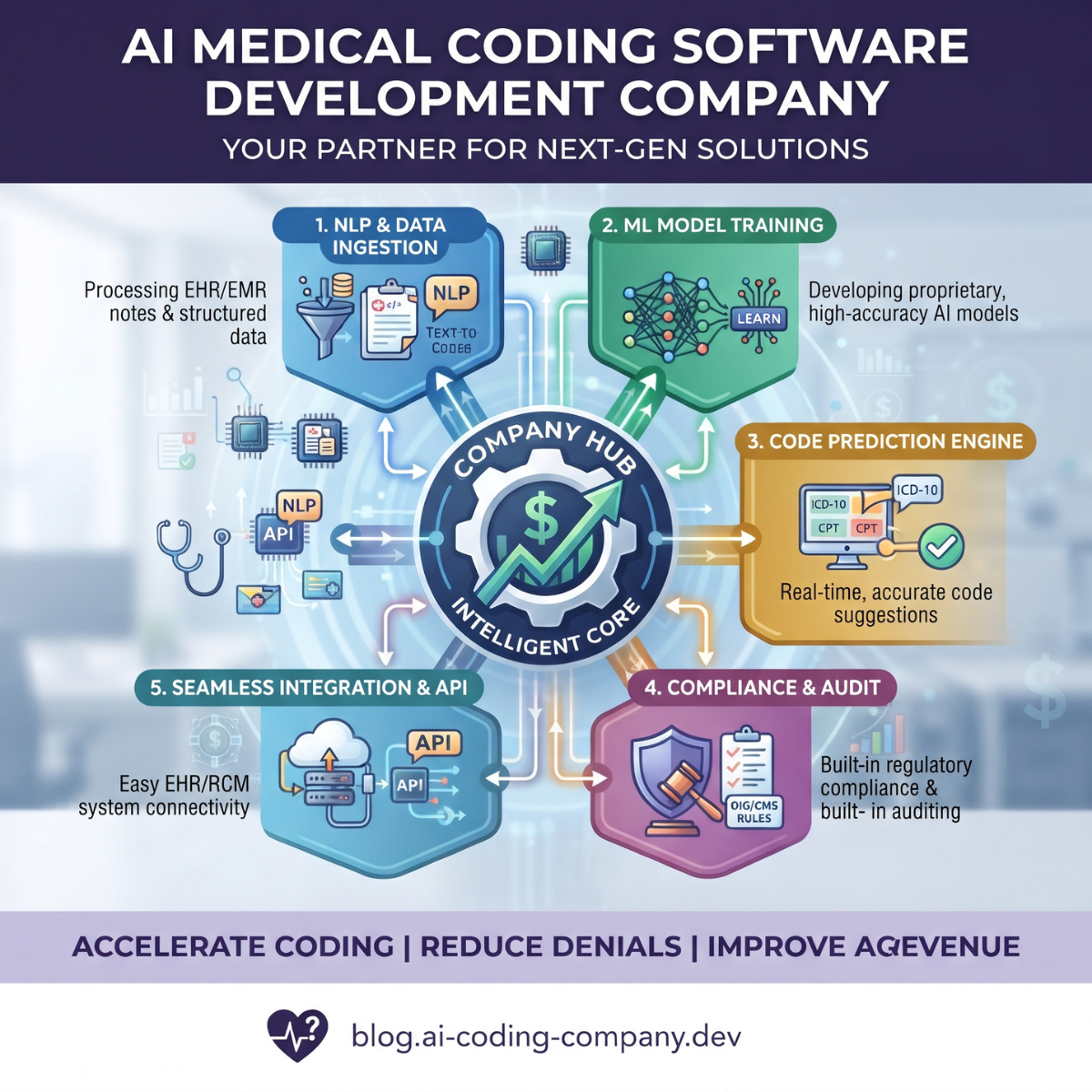
Artificial intelligence is transforming healthcare software development, particularly in medical coding, medical billing, and revenue cycle management.
Healthcare organizations process large volumes of clinical documentation every day. Physicians document patient encounters, coding professionals identify reportable diagnoses and procedures, and billing teams prepare claims for insurance reimbursement.
This process requires accuracy, consistency, specialized coding knowledge, and compliance with constantly evolving requirements.
When coding workflows rely heavily on manual documentation review, healthcare organizations may experience coding backlogs, delayed claim preparation, inconsistent data entry, and administrative rework.
AI-powered medical coding software offers opportunities to streamline these workflows.
However, developing an accurate medical coding system requires much more than integrating a large language model with an electronic health record.
The development team must understand clinical documentation, ICD-10-CM, CPT, HCPCS, specialty-specific coding requirements, payer rules, data security, and the wider revenue cycle.
This is why selecting the right AI medical coding software development company is a critical technology and business decision.
A capable development partner should combine artificial intelligence expertise with healthcare domain knowledge, secure software architecture, medical coding validation, and practical EHR and RCM integration experience.
This guide explains what AI medical coding development companies do, which capabilities matter, how to evaluate potential partners, and what businesses should consider before investing in custom healthcare AI software.
What Is an AI Medical Coding Software Development Company?
An AI medical coding software development company is a technology provider that designs, builds, integrates, and maintains applications using artificial intelligence to support medical coding activities.
These solutions may analyze clinical documentation, extract relevant medical information, recommend diagnosis and procedure codes, identify documentation gaps, and validate coding decisions.
Depending on the product, the development company may build:
- Custom AI-powered medical coding platforms
- Computer-assisted coding applications
- Medical coding APIs
- Clinical documentation analysis tools
- Specialty-specific coding engines
- Coding validation and rules engines
- Medical billing and claim scrubbing integrations
- RCM analytics dashboards
- Coding review and approval workspaces
Some companies develop standalone coding applications.
Others build AI coding modules within existing electronic health record systems, practice management platforms, or revenue cycle management software.
The right development approach depends on the customer's operational needs, existing infrastructure, specialty mix, and compliance requirements.
Why Healthcare Businesses Invest in AI Medical Coding Development
Medical coding is a specialized, detail-oriented process.
Coders must analyze clinical records, identify relevant diagnoses and procedures, select accurate codes, evaluate documentation, and follow applicable coding guidance.
Growing practices and billing companies may face increasing volumes of encounters without corresponding increases in coding capacity.
AI-assisted coding can help manage certain repetitive activities.
For example, software may identify clinical concepts in physician notes, retrieve relevant code candidates, and flag missing information before a coder completes the encounter.
Potential business benefits include faster documentation review, improved coding consistency, more efficient work queues, and earlier identification of errors.
AI coding can also help organizations standardize processes across multiple locations or specialties.
However, these benefits depend on verified software performance.
An AI system that produces unsupported codes or excessive false alerts can increase rework rather than reduce it.
Development companies should therefore prioritize measurable accuracy and operational value over claims of complete automation.
1. Healthcare Domain Expertise Should Come First
A development company may have excellent machine learning engineers but little understanding of medical billing.
That is a serious limitation.
Medical coding requires interpreting clinical information according to established classification systems, reporting instructions, and payer-specific requirements.
A diagnosis mentioned in a medical record is not automatically reportable.
A procedure discussed in a treatment plan is not necessarily a service that has already been performed.
A valid CPT code does not guarantee that a payer will reimburse it.
Qualified development teams must understand these distinctions.
Look for companies that involve medical coding specialists, healthcare workflow analysts, and experienced compliance professionals during product development.
Ask potential vendors to demonstrate how their software handles incomplete documentation, unsupported diagnoses, complex procedures, and coding uncertainty.
A technically sophisticated interface is not evidence of reliable medical coding.
2. Choose a Company That Understands Medical Coding Standards
Accurate medical coding software depends on appropriate coding references.
For U.S. healthcare applications, important systems include:
ICD-10-CM: Diagnosis and medical condition reporting.
CPT: Reporting medical procedures and professional services.
HCPCS Level II: Reporting applicable supplies, products, medications, equipment, and services.
ICD-10-PCS: Procedure classification for applicable inpatient hospital reporting.
The development company should understand which coding systems apply to the product's intended setting.
It must also support historical code versions and effective dates.
For example, the fiscal year 2027 ICD-10-CM release applies to relevant services beginning October 1, 2026.
An application reviewing an older claim should use the code version applicable to that claim's service date.
Ask vendors how coding references are updated, tested, and deployed.
Without controlled code-set maintenance, automation can quickly become unreliable.
3. Verify CPT Licensing Before Development
CPT licensing is one of the most important legal and commercial considerations in AI medical coding development.
The American Medical Association owns the CPT code set.
Software companies using CPT content need appropriate licensing for their intended products and uses.
This requirement becomes especially important when integrating artificial intelligence.
In July 2026, the AMA published updated information explaining permitted and prohibited uses of CPT Standard Data File content in AI applications.
According to that guidance, using the CPT Standard Data File to train or fine-tune AI models is prohibited under the applicable AI licensing terms.
Retrieval-based AI use may be permitted within the scope of an appropriate agreement.
This means developers should not simply upload CPT datasets into an AI model or use them for model training without verifying the relevant rights.
Before hiring a development partner, request a documented explanation of its coding-data licensing strategy.
Also confirm who will own the required licenses and whether the proposed product's distribution and monetization model is authorized.
4. Evaluate the Company's AI and NLP Capabilities
Natural language processing is central to many AI medical coding solutions.
Healthcare documentation often contains unstructured text, abbreviations, treatment descriptions, clinical findings, and complex terminology.
The software must distinguish relevant information from unrelated content.
For example, the phrase "patient has no evidence of pneumonia" should not generate a confirmed pneumonia diagnosis.
Likewise, a condition described only as historical should not automatically be treated as an active condition.
Development teams should demonstrate their ability to handle negation, uncertainty, temporality, anatomical details, and clinical context.
Machine learning and large language models may support information extraction and code suggestions.
However, these models can also generate unsupported recommendations.
A trustworthy development company should use structured validation, appropriate terminology references, and evidence-based review rather than relying exclusively on generative AI output.
5. Look for a Hybrid AI and Rules-Based Architecture
The strongest architecture for medical coding usually separates clinical language interpretation from deterministic coding validation.
A typical workflow may include:
Clinical Documentation → NLP Extraction → AI Code Suggestions → Coding Rules Engine → Coder Review → RCM Integration.
The NLP system extracts relevant clinical concepts.
The AI model proposes candidate diagnoses or procedures.
A terminology service checks whether the codes exist and are valid for the applicable date.
A rules engine evaluates coding instructions, procedure relationships, units, and relevant restrictions.
A qualified reviewer handles uncertain or high-risk decisions.
This architecture is easier to evaluate and maintain than a system that asks one model to perform every task.
It also enables development teams to update coding rules without retraining the entire AI model.
When interviewing vendors, ask which outputs come from AI inference and which are determined by validated rules.
6. Require Explainable Coding Recommendations
Medical coders need to understand why the software recommends a particular code.
A system that displays a code without supporting evidence creates unnecessary review work.
A useful coding application should connect suggestions to relevant passages in the clinical record.
For example, if an AI system recommends a diagnosis, the reviewer should be able to inspect the documented findings that support it.
The software should also distinguish between confirmed information, incomplete documentation, and uncertain suggestions.
An effective interface may show the suggested code, clinical evidence, validation warnings, code version, and review status.
Confidence scores can help prioritize cases, but they should not be presented as proof of correctness.
When evidence is insufficient, the application should abstain or request clarification.
Explainability supports safer review, easier auditing, and more efficient correction of model errors.
7. Evaluate Specialty-Specific Coding Expertise
Different medical specialties require different coding workflows.
An AI model suitable for straightforward office visits may not perform reliably on complex surgical encounters.
For example:
Dermatology: Lesion dimensions, locations, biopsy types, excisions, and procedures performed at separate sites.
Cardiology: Diagnostic tests, interpretations, monitoring, and professional or technical components.
Orthopedics: Anatomical specificity, laterality, fractures, surgical services, and global period considerations.
Behavioral Health: Psychotherapy time, psychiatric evaluations, and distinctions between therapy and E/M services.
Gastroenterology: Endoscopic procedures, multiple techniques, and procedure bundling.
A development company should demonstrate how it handles the specific specialties the customer needs.
Do not accept a generic statement that the AI supports every medical specialty.
Request documented specialty-level testing and representative examples instead.
8. Confirm EHR Integration Capabilities
AI coding software must work with the systems healthcare organizations already use.
Most practices do not want employees copying clinical notes manually between an EHR and a separate AI application.
The development company should evaluate available EHR interfaces and determine how clinical records will enter the coding workflow.
Possible integration mechanisms include HL7 FHIR APIs, vendor-specific APIs, and other approved healthcare interfaces.
The integration may retrieve encounter identifiers, provider documentation, diagnoses, procedures, relevant dates, and other authorized information.
It should preserve the connection between each coding recommendation and its source encounter.
The system must also account for documentation changes.
If a physician amends a note, affected coding suggestions may need to be regenerated or reviewed.
A successful integration should reduce duplicate work without compromising record integrity.
9. Integrate AI Coding With the Entire RCM Workflow
Medical coding does not operate independently from the rest of the revenue cycle.
Its output affects charge capture, claim preparation, claim scrubbing, submission, payment posting, and denial management.
An integrated platform may follow this workflow:
EHR → AI Coding → Coding Validation → Human Approval → Charge Capture → Claim Scrubbing → Clearinghouse → Payer.
The development company should understand how approved codes move into billing.
It must also distinguish a completed procedure from a planned or ordered service.
The existence of a code does not establish that the service is separately billable.
Likewise, software should not add modifiers automatically to increase reimbursement.
A well-integrated coding system improves the accuracy of information entering the billing process while preserving appropriate coding and payment controls.
10. Include Claim Editing and Validation Capabilities
An AI medical coding product should identify meaningful errors before claims are submitted.
Useful checks include invalid code status, missing specificity, incorrect billing units, procedure relationships, and modifier combinations requiring review.
For Medicare-related workflows, the National Correct Coding Initiative provides relevant procedure-to-procedure and medically unlikely edits.
CMS updates applicable NCCI edit files at least quarterly.
A development company should explain how it manages these updates and applies them to the correct claims.
However, coding edits do not replace payer-specific coverage policies.
A valid CPT code may still require authorization or fail medical necessity requirements.
If the product promises payer-aware validation, ask whether it maintains current payer rules and how those rules are verified.
11. Require Strong HIPAA Privacy and Security Controls
AI medical coding platforms often process sensitive patient information.
When the application operates for a HIPAA-covered entity or business associate, applicable HIPAA obligations must be addressed.
Security requirements influence application architecture, data storage, cloud hosting, access permissions, logging, and vendor relationships.
A qualified development partner should perform or support the necessary security risk analysis and implement appropriate safeguards.
These may include strong authentication, role-based authorization, protected network communications, encryption, audit controls, backup procedures, and incident response capabilities.
The company must also evaluate whether third-party AI providers or cloud services process protected health information.
Where required, appropriate Business Associate Agreements must be in place.
A development company should never claim that HIPAA compliance is guaranteed simply because it uses an established cloud provider.
Compliance depends on the complete system and its operating practices.
12. Ask How Patient Data Is Used by AI Providers
Data governance is especially important for generative AI applications.
Before sending clinical documentation to an external model provider, the development team should understand what happens to that information.
Questions should address whether prompts or outputs are stored, who can access them, whether customer information is used for model improvement, and which subcontractors process the data.
The answers must be supported by applicable contracts and technical controls.
Developers should minimize unnecessary patient information in model requests.
For example, a terminology validation request may not require the patient's identity.
An advanced clinical note analysis service may require additional data, making vendor and security review more important.
Production PHI should not be submitted to unapproved consumer AI tools.
A qualified partner should document the entire data flow rather than provide only generic statements about secure AI.
13. Evaluate the Company's Coding Review Interface
Coding accuracy depends partly on the quality of the human review workflow.
An AI application that generates suggestions quickly but forces employees to search through multiple screens may not improve productivity.
An effective review workspace should show the relevant clinical record, candidate codes, supporting evidence, validation warnings, and approval controls together.
Coders should be able to accept, reject, or modify suggestions according to their permissions.
The software should preserve an audit trail of decisions and changes.
It should also support escalation when documentation is insufficient.
For example, an encounter missing required procedure details should enter a clarification workflow rather than automatically generate the most likely code.
Good user experience design supports accuracy and efficient operations.
It should not conceal coding uncertainty behind a polished interface.
14. Demand Measurable Testing and Validation
A development company should demonstrate product performance through structured evaluation.
Marketing claims about accuracy are not enough.
Ask how test cases were selected, who established the reference coding decisions, and whether evaluation cases were independent of training data.
The test population should represent the customer's specialties, encounter types, documentation patterns, and coding complexity.
Useful measures include precision, recall, code-level agreement, unsupported suggestion rate, missed code rate, coding turnaround time, and reviewer override frequency.
Results should be reported by specialty and task.
A single overall accuracy percentage can hide serious weaknesses.
For example, high performance on common primary care encounters does not establish safe performance on complex inpatient procedures.
The vendor should also test situations where the correct response is to request clarification or make no recommendation.
15. Assess the Technology Stack and Scalability
The technology stack should support secure, maintainable, and scalable development.
Depending on the product, a development team may use Python-based AI services, API frameworks, structured databases, healthcare interoperability libraries, and cloud infrastructure.
The exact tools matter less than the architecture and implementation quality.
A suitable design should support modular services, versioned APIs, reliable processing queues, secure secrets management, controlled deployments, and monitoring.
For multi-tenant SaaS products, tenant isolation is essential.
The system must prevent one healthcare customer's users from accessing another customer's patient information.
The application should also handle interruptions.
If an AI service becomes unavailable, the system should not silently assign unvalidated codes.
A controlled fallback or manual review process should preserve billing accuracy.
16. Evaluate Post-Launch Maintenance and Support
AI medical coding software requires continuous maintenance.
Code sets change, payer policies evolve, healthcare organizations add specialties, and software integrations are updated.
AI models may also perform differently when clinical documentation patterns change.
The development company should provide a clear plan for ongoing support.
This should cover code-set updates, security maintenance, model monitoring, regression testing, incident response, and integration support.
Customers should know who is responsible for updating coding rules and validating those changes.
Ask whether the vendor maintains historical code versions for corrected claims and appeals.
Also establish clear service-level expectations for critical failures.
A company that can build an impressive prototype but cannot maintain it reliably may not be an appropriate long-term healthcare technology partner.
17. Understand Custom Development vs Ready-Made Software
Healthcare organizations generally have two approaches.
They can purchase an existing coding platform or commission custom AI medical coding software.
Ready-made software may be appropriate when its existing features, supported specialties, integrations, and licensing fit the organization's requirements.
Custom development may be justified when the customer needs unique clinical workflows, proprietary interfaces, specialized review processes, or a branded SaaS product.
However, custom software introduces development responsibility, ongoing maintenance, validation costs, and integration complexity.
The best decision depends on the expected business value.
A billing company with standard coding needs may benefit more from configuring a mature platform.
A healthcare SaaS business developing a differentiated coding product may require custom engineering.
Before selecting either option, define the requirements that cannot be satisfied through available solutions.
18. What Does AI Medical Coding Software Development Cost?
The cost of developing AI medical coding software varies substantially.
There is no reliable universal price because projects differ in scope, regulatory requirements, data availability, and technical complexity.
A basic coding assistance prototype may have fewer requirements than a production platform supporting multiple medical specialties and EHR integrations.
The most important cost drivers include:
- Product discovery and requirements analysis
- Clinical data preparation
- AI model development or integration
- CPT and other coding-data licensing
- Specialty-specific rules
- EHR and RCM integrations
- Security and compliance engineering
- Coder review interface development
- Quality assurance and clinical validation
- Cloud and model processing costs
- Ongoing maintenance and support
A responsible development company should provide an itemized estimate after reviewing the product specification.
Be cautious of fixed-price promises made without understanding the intended coding functions or integration requirements.
Low initial development costs can become expensive if the system later requires major architectural changes.
19. How to Evaluate an AI Medical Coding Development Company
Vendor selection should use consistent, evidence-based criteria.
The following scorecard is a practical starting point.
| Evaluation AreaSuggested Weight | |
| Healthcare and medical coding expertise | 25% |
| AI accuracy and evaluation methods | 20% |
| HIPAA security and data governance | 20% |
| EHR and RCM integration experience | 15% |
| Coding-data licensing and regulatory readiness | 10% |
| Support, scalability, and commercial fit | 10% |
These are suggested evaluation weights, not industry standards.
For each area, request evidence.
This might include a relevant product demonstration, documented architecture, testing report, security documentation, integration examples, or licensing explanation.
A company should not receive a high technical score simply because its team has experience building general-purpose AI chatbots.
Medical coding requires specialized capabilities.
The final selection should reflect the organization's risk profile, intended users, budget, and workflow requirements.
20. Questions to Ask Before Hiring a Development Partner
A structured vendor interview helps expose weaknesses before contracts are signed.
Ask prospective development companies:
- Which medical coding systems and specialties have you implemented successfully?
- How do you validate suggested codes against clinical documentation?
- How is CPT content licensed for the proposed AI use case?
- Can the system handle historical code versions?
- How do you prevent unsupported diagnoses and procedure recommendations?
- Which EHR and RCM integrations have you delivered?
- How do you protect PHI when using third-party AI services?
- What percentage of cases require manual review under your proposed workflow?
- How do you test model performance by specialty?
- Who maintains coding rules, security controls, and integrations after launch?
Request written responses where possible.
The purpose is to identify evidence of implementation capability, not simply obtain assurances.
If a vendor cannot explain its coding validation approach, licensing rights, or data flow, that is a material concern.
21. A Practical Development and Implementation Roadmap
An effective AI coding project should use controlled development phases.
Phase 1: Product Discovery
Define target customers, supported specialties, user roles, coding workflows, and business objectives.
Identify the existing EHR and RCM environment.
Assess licensing, security, and regulatory considerations.
Phase 2: Architecture and Data Preparation
Design the integration layer, coding knowledge base, AI services, rules engine, databases, and review interface.
Prepare authorized development and evaluation data.
Phase 3: Minimum Viable Product
Begin with one specialty or a narrow set of encounter types.
Implement documentation extraction, coding suggestions, validation, and human review.
Phase 4: Independent Validation
Evaluate results against qualified coder-reviewed reference cases.
Test unsupported recommendations, ambiguous notes, historical code versions, and system failures.
Phase 5: Controlled Pilot
Deploy to a limited set of users and monitor coding accuracy, review time, override patterns, and operational problems.
Phase 6: Production Expansion
Expand to additional specialties or locations only after performance and security controls are validated.
This phased approach reduces the risk of deploying an unproven system across the entire revenue cycle.
22. Measure ROI Using Real Revenue Cycle Outcomes
An AI coding project should be evaluated against actual business performance.
Processing more clinical notes per minute is not sufficient proof of value.
A healthcare organization should first establish a baseline for coding turnaround time, manual review effort, claim corrections, and coding-related denials.
After implementation, compare results using consistent definitions and comparable encounter populations.
Useful metrics include:
Coding turnaround time: Time between completed documentation and approved coding.
Productivity: Encounters appropriately completed per coder or review hour.
Unsupported code rate: Recommendations lacking adequate documentation support.
Coder override rate: Frequency of changes to AI recommendations.
Coding-related denial rate: Denials attributable to defined coding issues.
Cost per coded encounter: Total relevant coding costs divided by completed encounters.
Net financial benefit: Verified savings and incremental collectible reimbursement minus technology and operating costs.
Illustrative financial models should include software costs, licensing, integration maintenance, and human oversight.
Gross charges should not be confused with incremental collectible revenue.
23. Common Mistakes When Selecting a Development Company
Healthcare organizations can avoid expensive mistakes by recognizing common vendor selection failures.
Choosing solely on price: May overlook coding expertise, security, and maintenance requirements.
Believing unsupported accuracy claims: Creates unrealistic expectations about automation.
Ignoring CPT licensing: Introduces material contractual and intellectual property risks.
Skipping specialty-level testing: Allows important workflow errors to remain undiscovered.
Treating HIPAA as a marketing badge: Overlooks actual safeguards and organizational responsibilities.
Expecting AI to replace all coders: Removes necessary oversight before performance is validated.
Underestimating integrations: Leads to manual workarounds and inconsistent patient information.
Failing to define support obligations: Creates problems when coding rules or systems change.
A qualified development partner should be transparent about limitations and should demonstrate how the product will be evaluated before broad deployment.
Frequently Asked Questions
What does an AI medical coding software development company do?
It develops applications that use AI, clinical data processing, terminology resources, and coding validation tools to assist medical coding and related RCM workflows.
Can an AI coding system work with an existing EHR?
Often, yes. Integration depends on the EHR's available interfaces, access permissions, data structures, and vendor requirements.
Can AI coding software replace human medical coders?
AI can assist with coding tasks and may support carefully validated automation in defined workflows. Complex or uncertain cases still require appropriate professional review and governance.
Is AI medical coding software automatically HIPAA compliant?
No. HIPAA obligations depend on the organization's role, information flows, safeguards, contracts, and operating procedures.
How should a healthcare business choose an AI coding development company?
Prioritize medical coding expertise, validated AI performance, secure architecture, appropriate CPT licensing, integration experience, and long-term support.
Does AI medical coding guarantee fewer claim denials?
No. Properly implemented software may reduce certain coding-related errors, but eligibility, authorization, payer coverage, and other factors can still cause denials.
Final Thoughts
Selecting an AI medical coding software development company is a decision that affects coding quality, compliance, operational efficiency, and revenue cycle performance.
The right development partner needs more than software engineering experience.
It should understand clinical documentation, coding standards, specialty-specific workflows, licensed terminology, payer rules, healthcare interoperability, and data security.
The company must also be able to validate its AI system through representative testing and support it after launch.
Organizations should avoid choosing vendors based solely on attractive demonstrations, low prices, or claims of fully autonomous medical coding.
Instead, they should evaluate the product architecture, coding accuracy, human review workflows, regulatory considerations, and measurable operational outcomes.
The best AI medical coding software development partner is not the company that promises to eliminate human coders. It is the company that can demonstrate accurate, secure, maintainable, and clinically supported coding workflows.
When implemented responsibly, AI coding technology can help healthcare organizations reduce repetitive administrative work, improve coding consistency, identify potential errors earlier, and strengthen RCM operations.
The ultimate objective is to build software that healthcare professionals can trust, maintain, and use to support accurate reimbursement.