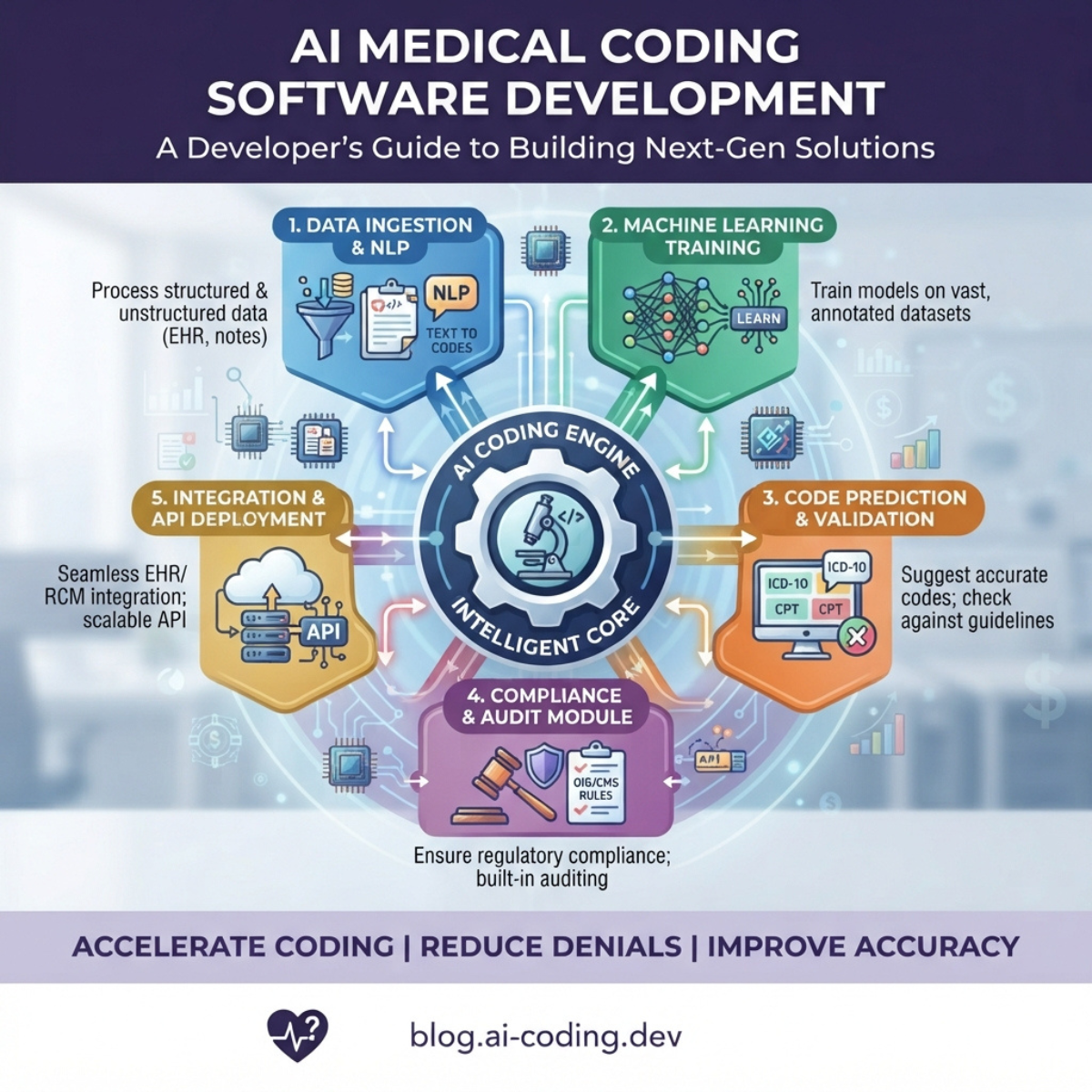
Artificial intelligence is changing how healthcare organizations manage medical documentation, coding, billing, and reimbursement. As healthcare systems process increasing volumes of clinical information, traditional medical coding workflows can become time-consuming, expensive, and difficult to scale.
A healthcare provider documents a patient encounter, a medical coder reviews the record, appropriate diagnosis and procedure codes are assigned, and the billing team prepares the insurance claim.
Every step requires accuracy.
An incorrect diagnosis code, unsupported procedure, outdated coding reference, or missing modifier can lead to claim rejections, payment delays, and compliance problems.
This is where AI medical coding software development offers significant opportunities.
AI-powered coding solutions use technologies such as natural language processing, machine learning, and large language models to interpret clinical documentation and recommend relevant medical codes.
More advanced platforms combine these capabilities with coding databases, documentation validation, specialty-specific rules, and revenue cycle management integrations.
However, developing reliable medical coding software requires more than connecting an AI model to patient records.
The system must understand clinical context, use authorized coding references, account for changing regulations, protect patient information, and provide appropriate human oversight.
This guide explains how AI medical coding software works, the technologies behind it, essential product features, development architecture, compliance considerations, and implementation strategies.
What Is AI Medical Coding Software?
AI medical coding software is a healthcare technology application that assists with translating clinical documentation into standardized medical codes.
Traditional coding workflows rely heavily on trained professionals reviewing physician notes, diagnoses, operative reports, and procedure documentation.
AI systems can support this process by extracting relevant clinical information, identifying potential code matches, and flagging inconsistencies requiring review.
Common medical coding systems include:
ICD-10-CM: Used for diagnosis classification in U.S. healthcare settings.
CPT: Used to describe medical procedures and professional services.
HCPCS Level II: Used for applicable medical products, supplies, equipment, medications, and services.
ICD-10-PCS: Used for procedures in applicable U.S. inpatient hospital settings.
AI software may help identify candidate codes from these systems, but the final selection must follow applicable coding guidelines and documented clinical facts.
For example, a physician's note may describe a patient's chronic condition, treatment decisions, and completed procedure.
The software can extract these details and suggest relevant coding options.
A coding professional or appropriately validated workflow then determines which codes are supported and reportable.
Why Healthcare Organizations Are Investing in AI Coding
Medical coding involves extensive documentation review and specialized knowledge.
Coders must interpret clinical terminology, select appropriate codes, understand procedural distinctions, and follow changing coding requirements.
For growing healthcare practices, increasing patient volumes can create coding backlogs and delayed claim submission.
AI-assisted coding can help reduce repetitive work and direct professional attention toward complicated encounters.
Potential advantages include:
- Faster clinical documentation review
- Improved identification of coding candidates
- Earlier detection of incomplete documentation
- More consistent code validation
- Reduced repetitive code searches
- Better visibility into coding exceptions
- Support for specialty-specific coding workflows
- Improved integration with claim preparation
These benefits are potential outcomes, not guaranteed results.
The financial value depends on the software's accuracy, the quality of clinical records, the organization's existing processes, and how effectively employees use the technology.
1. Understand How AI Medical Coding Works
An AI medical coding system generally follows several stages.
First, clinical information is collected from an electronic health record, clinical documentation system, or another authorized source.
The system then processes that information to identify relevant medical concepts.
These may include diagnoses, symptoms, procedures, anatomical locations, medication administration, and treatment details.
Next, the software identifies candidate medical codes using a combination of trained models, terminology resources, and coding rules.
Those candidates are validated against applicable code sets and documentation requirements.
Finally, results are presented for review or transferred to another authorized coding workflow.
A simplified process looks like this:
Clinical Documentation → AI Information Extraction → Candidate Code Identification → Coding Rule Validation → Human Review → Claim Preparation.
Not every application provides all these functions.
A basic computer-assisted coding product may suggest codes, while a more comprehensive platform may also support documentation review, charge capture, and claim validation.
2. Use Natural Language Processing to Understand Clinical Notes
Natural language processing, or NLP, is one of the foundational technologies used in medical coding automation.
Healthcare providers frequently document encounters using free-text notes.
These records contain abbreviations, specialized terminology, clinical findings, and descriptions of treatment.
NLP helps identify meaningful information within this text.
For example, a medical record might describe a patient with a history of diabetes, current foot pain, and a completed diagnostic evaluation.
The software must distinguish between historical conditions, active diagnoses, symptoms, and services actually performed.
This distinction matters because not every condition mentioned in a record is reportable for the encounter.
Medical NLP systems also need to recognize negation, uncertainty, temporality, and context.
For example, "no evidence of infection" should not be interpreted as a confirmed infection.
Similarly, a procedure discussed as a future possibility should not automatically be reported as completed.
Reliable coding requires contextual interpretation rather than simple keyword matching.
3. Incorporate Machine Learning and Large Language Models
Machine learning models can identify patterns in clinical documentation and coding decisions.
Large language models can help interpret complex narratives, identify candidate diagnoses, summarize relevant evidence, and explain why a coding recommendation may require review.
However, LLMs can generate plausible but unsupported information.
In medical coding, this creates substantial risk.
An AI system might recommend a diagnosis that was never documented or suggest a procedure code that does not accurately describe the service performed.
Such errors can create compliance problems and inaccurate claims.
Developers should therefore avoid treating LLM output as authoritative coding guidance.
A more reliable architecture combines AI-generated suggestions with trusted coding references, deterministic validation, and evidence from the clinical record.
Every suggested code should be traceable to documented information.
When the available evidence is insufficient, the application should flag the encounter for clarification instead of inventing missing details.
4. Choose a Hybrid AI and Rules-Based Architecture
A dependable coding platform should not rely on a generative model alone.
A hybrid architecture combines AI capabilities with structured coding rules and validation engines.
For example, NLP can identify that a provider documented a procedure.
A coding terminology service can retrieve relevant authorized code information.
A rules engine can evaluate code validity, required specificity, applicable bundling edits, and other coding considerations.
Finally, an authorized coding professional can review exceptions.
This division of responsibilities reduces dependence on any single technology.
AI is useful for interpreting unstructured information.
Deterministic rules are useful for validating established requirements.
Professional review remains important for uncertain clinical or coding decisions.
A hybrid architecture also makes software behavior easier to test and audit because different components can be evaluated independently.
5. Build the Medical Coding Knowledge Base
Medical coding software requires reliable terminology and code-set information.
The application should support the code systems relevant to its intended users.
This may include ICD-10-CM, CPT, HCPCS Level II, and ICD-10-PCS.
Developers must also maintain the correct code versions.
For example, the fiscal year 2027 ICD-10-CM codes became effective October 1, 2026, for the relevant reporting period.
Code validation should use the applicable service date rather than automatically applying the latest code release to every historical claim.
CPT licensing requires particular attention.
The American Medical Association owns the CPT code set and requires appropriate licensing for electronic products that use it.
Its July 2026 licensing guidance also addresses AI-related use of CPT content.
Importantly, the AMA states that using its CPT Standard Data File to train or fine-tune AI models is prohibited under the applicable AI licensing terms.
Developers should verify authorized retrieval-based uses and other licensing permissions before implementing CPT-powered AI features.
6. Prepare High-Quality Training and Evaluation Data
AI coding performance depends heavily on the quality of its data.
Historical coding records can provide useful examples, but they should not automatically be treated as correct.
Previous claims may contain coding errors, unsupported modifiers, outdated codes, or payer-specific compromises.
Training an AI model on unverified historical claims risks reproducing those mistakes.
A stronger approach uses reviewed clinical documentation paired with coding decisions validated by qualified professionals.
The dataset should represent the settings and specialties the application will support.
It should include complex encounters, incomplete documentation, negative findings, and scenarios where no additional code is appropriate.
Training, validation, and test datasets should be separated carefully.
Where possible, patient-level and time-based separation can reduce leakage between evaluation datasets.
Clinical data use must also comply with relevant privacy, contractual, and licensing restrictions.
De-identification and synthetic examples can support development, but they do not eliminate the need to validate performance against realistic clinical documentation.
7. Develop Specialty-Specific Coding Capabilities
Different medical specialties require different coding logic.
A general coding model may identify common diagnoses, but specialty-specific services introduce additional requirements.
Dermatology: Coding may depend on lesion location, size, biopsy method, excision details, and distinct procedures.
Cardiology: Diagnostic services may require professional and technical component review.
Orthopedics: Coding may involve anatomical specificity, laterality, fracture characteristics, and surgical rules.
Behavioral Health: Certain psychotherapy services require accurate time documentation and appropriate service distinctions.
Gastroenterology: Multiple endoscopic procedures may involve specialized coding and bundling considerations.
Primary Care: Same-day E/M services and minor procedures require careful review of separately identifiable services.
AI software should use specialty-specific documentation checks and coding rules rather than assuming one generic workflow is sufficient.
These capabilities should be developed and validated using representative encounters from each supported specialty.
8. Integrate AI Coding Software With EHR Systems
Electronic health record integration is essential for incorporating AI coding into actual clinical workflows.
Without integration, employees may have to copy clinical notes between applications manually.
That creates inefficiencies and increases the risk of mismatched information.
An EHR integration can supply relevant encounter documentation, structured diagnoses, procedure records, and service details.
FHIR, or Fast Healthcare Interoperability Resources, supports standardized exchange of healthcare information.
Developers may also use approved vendor-specific interfaces or other interoperability mechanisms.
The application should preserve encounter identifiers, document versions, timestamps, and relevant clinical context.
When a provider updates a note, the coding system should recognize whether previous recommendations need to be reviewed again.
The integration should retrieve only the information necessary for the authorized coding purpose.
9. Build a Medical Coding API Layer
A coding API allows external systems to access coding functions without duplicating the entire application's internal logic.
Potential API capabilities include:
- Retrieving coding suggestions
- Validating code status
- Checking applicable code versions
- Identifying documentation gaps
- Returning coding review status
- Accessing authorized terminology references
- Recording coding decisions
The API layer should enforce authentication, authorization, request validation, and usage controls.
FHIR terminology services may support code lookup, validation, and concept mapping.
However, terminology validation is not equivalent to full medical coding validation.
A code may be valid but unsupported by the clinical record.
A procedure may be accurately coded but subject to payer coverage requirements.
The API architecture should clearly separate terminology functions, AI suggestions, coding rules, and payer-specific validation.
10. Design an Effective Coder Review Interface
The user interface is a critical component of AI medical coding software.
Even a technically sophisticated AI system can fail operationally if coding professionals cannot understand or efficiently review its recommendations.
A useful coding workspace should display the clinical evidence supporting each proposed code.
It should distinguish accepted codes, unresolved suggestions, and documentation deficiencies.
Coders should be able to approve, reject, or modify recommendations.
The interface should also show relevant validation warnings and code-set information.
For example, when an AI system suggests a diagnosis code, the reviewer should be able to examine the supporting documentation without searching through the entire record repeatedly.
Confidence scores may help prioritize reviews, but they should not be presented as proof of coding correctness.
The software should support professional judgment and preserve the rationale behind final coding decisions.
11. Integrate Coding With Charge Capture and RCM
AI medical coding software becomes more valuable when connected to the wider revenue cycle.
After coding review, validated information can move into charge capture and claim preparation.
A typical workflow is:
EHR → AI Coding Engine → Coding Rules → Coder Approval → Charge Capture → Claim Scrubbing → Clearinghouse → Payer.
The system should distinguish between services ordered, planned, performed, and separately billable.
A procedure mentioned in a physician's plan should not automatically generate a charge.
Likewise, the presence of a valid code does not establish payer reimbursement eligibility.
Claim scrubbing should evaluate other information, including patient eligibility, provider details, authorizations, modifiers, and claim formatting.
For standard U.S. electronic professional and institutional claims, the applicable HIPAA transaction standard includes ASC X12N 837 Version 5010.
AI coding is one component of claim preparation, not a substitute for the entire RCM workflow.
12. Include NCCI and Coding Rule Validation
The National Correct Coding Initiative, or NCCI, supports Medicare coding integrity through applicable procedure-to-procedure and medically unlikely edits.
These edits can identify certain code combinations and billing-unit concerns.
For example, two individually valid procedure codes may not be separately reportable when performed together.
The coding system should flag the combination and evaluate whether applicable rules permit separate reporting.
However, it should never automatically add Modifier 59 simply to bypass a bundling edit.
Clinical documentation must support any distinct-service modifier.
CMS publishes quarterly updates to NCCI edits, making version control important.
AI applications should use these edits as part of a broader validation system while recognizing that commercial payer policies may differ.
13. Make HIPAA Security Part of the Architecture
AI coding platforms may process electronic protected health information.
If the software operates for a HIPAA-covered entity or business associate, the applicable privacy and security requirements must be addressed.
Security measures should include appropriate access controls, authenticated connections, audit mechanisms, risk assessment, and protection of sensitive information.
The application should minimize unnecessary PHI transmission.
For example, a code lookup may require only the code and version, not a patient's complete clinical history.
When third-party AI services process PHI on behalf of a covered entity or business associate, vendor responsibilities must be evaluated.
A Business Associate Agreement may be required.
Cloud hosting does not automatically make a product HIPAA compliant.
Developers must also review how AI providers retain data, handle logs, use prompts, and manage subcontractors.
Production patient information should not be sent to consumer AI services without an appropriate legal and security assessment.
14. Address Regulatory and Software Governance Requirements
Medical coding software development involves more than HIPAA.
Developers should also consider coding standards, contractual obligations, intellectual property rights, and applicable software regulations.
Software used solely for administrative medical coding is not automatically an FDA-regulated medical device.
However, an application that also provides clinical recommendations or performs medical functions may require a separate regulatory assessment.
The FDA's January 2026 Clinical Decision Support Software guidance explains how certain software functions are evaluated under medical device requirements.
Developers should assess the intended functions rather than assume that every healthcare AI product has the same regulatory classification.
AI governance should also address model changes, approved use cases, access permissions, data retention, performance monitoring, and the ability to investigate incorrect recommendations.
Regulatory compliance should be evaluated throughout development, not only before launch.
15. Test AI Coding Accuracy Before Deployment
Testing is one of the most important stages of development.
An AI model may perform well on simple cases while producing errors on complex specialty encounters.
Evaluation should include representative clinical scenarios, rare conditions, incomplete notes, and ambiguous documentation.
Important measurements include:
Precision: How many AI-suggested codes are correct under the defined evaluation standard?
Recall: How many applicable reference codes are successfully identified?
Code-Level Agreement: How closely do suggestions match independently reviewed coding decisions?
Unsupported Code Rate: How frequently does the system suggest codes without sufficient documentation?
Manual Review Rate: How often must a coder intervene?
Processing Time: How quickly does the software complete the intended task?
Overall accuracy alone is insufficient.
Developers should analyze incorrect additional codes, missed codes, wrong specificity, sequencing errors, and specialty-specific mistakes separately.
Testing should include coded examples that require the system to abstain rather than produce an unsupported recommendation.
16. Manage AI Confidence and Human Oversight
Not every coding recommendation should move through the same workflow.
Straightforward, well-documented encounters may require less review than complicated surgical or multi-condition cases.
Developers can introduce risk-based review categories based on validated model performance and rule checks.
For example, an encounter with missing documentation or conflicting coding evidence should be routed to a qualified coder.
A system should also be capable of returning "insufficient information" instead of forcing a code recommendation.
Fully automated code release should not be enabled merely because a model reports high confidence.
Before any autonomous workflow is considered, the organization needs rigorous validation, documented governance, monitoring, and compliance controls.
Human oversight remains particularly important for complex E/M decisions, procedure coding, modifier use, and clinical documentation clarification.
The goal is to improve productivity without sacrificing coding integrity.
17. Monitor AI Performance After Deployment
AI coding software requires continuous monitoring because clinical workflows, code sets, and documentation patterns change.
A model validated using historical records may perform differently after a new specialty joins the practice.
Coding updates can also affect recommendations.
Performance dashboards should track:
- Coding-related denial trends
- Coder override rates
- Unsupported code recommendations
- Average coding turnaround time
- Documentation clarification requests
- Claim correction frequency
- Model performance by specialty
- API availability and response time
Developers should establish model versioning and maintain audit trails of coding recommendations.
When performance deteriorates, the organization should investigate before expanding automated processing.
Denial data can help identify potential coding problems, but payer denials should not automatically be treated as proof that the original coding was incorrect.
18. Common AI Medical Coding Development Mistakes
Several mistakes can undermine an AI coding platform.
Using an LLM without a rules engine: Creates unnecessary dependence on model-generated answers.
Training on unverified claims: Can reproduce historical coding errors.
Ignoring CPT licensing: Creates intellectual property and contractual risks.
Using outdated coding data: Produces errors involving inactive or revised codes.
Automatically assigning modifiers: May create unsupported billing.
Ignoring specialty-specific requirements: Reduces coding reliability.
Sending unnecessary PHI to external services: Increases privacy exposure.
Removing human review too early: Makes complex errors harder to detect.
Measuring only processing speed: Overlooks coding quality and compliance.
Ignoring performance drift: Allows accuracy to deteriorate after deployment.
The corrective approach is consistent: use verified data, authorized coding references, structured validation, qualified review, and measurable quality controls.
19. A Practical Development Roadmap
AI medical coding development should follow a phased approach.
Phase 1: Requirements and Feasibility
Identify the intended customers, specialties, coding systems, and operational problems.
Determine whether the product supports coding suggestions, documentation review, or more advanced workflows.
Assess licensing, HIPAA applicability, and integration requirements.
Phase 2: Architecture and Data Preparation
Design the AI pipeline, terminology services, rules engine, databases, APIs, and coder review interface.
Prepare approved training and evaluation datasets.
Define security and audit requirements.
Phase 3: MVP Development
Build a limited workflow supporting one specialty or carefully selected encounter types.
Implement clinical concept extraction, code suggestions, code validation, and human review.
Phase 4: Testing and Validation
Evaluate performance against independently reviewed reference cases.
Test unsupported recommendations, incomplete notes, code versions, and integration failures.
Phase 5: Controlled Deployment
Introduce the system with a limited group of qualified users.
Monitor overrides, coding accuracy, operational performance, and security events.
Phase 6: Expansion and Optimization
Add specialties and advanced capabilities only after validating existing workflows.
Update coding references, improve rules, and monitor results.
Development timelines vary substantially with integration complexity, regulatory requirements, and product scope.
20. How AI Medical Coding Software Supports Business Growth
For healthcare technology companies, AI coding software can provide value as an independent product or as part of a broader RCM platform.
Potential applications include coding assistance for physician practices, documentation quality review, specialty coding workflows, coding API services, and pre-submission claim validation.
Multi-specialty clinics may particularly benefit from a unified platform that applies appropriate rules across different provider groups.
However, businesses should evaluate product value using measurable customer outcomes.
These may include coding turnaround time, reduction in manual review effort, accuracy of coding suggestions, and changes in avoidable coding-related denials.
Claims such as "eliminates denials" or "guarantees reimbursement" should be avoided because coding automation cannot control every payer decision.
A credible product demonstrates validated performance and clearly communicates its limitations.
Frequently Asked Questions
What is AI medical coding software?
It is software that uses artificial intelligence to assist with interpreting clinical documentation, identifying coding candidates, and supporting standardized medical code assignment.
Can AI automatically assign ICD-10-CM and CPT codes?
Some systems can generate code recommendations and support automated workflows. However, accurate reporting requires documented evidence, current coding references, validation, and appropriate oversight.
Is AI medical coding software HIPAA compliant?
Not automatically. Compliance depends on the organization's role, product architecture, information flows, safeguards, vendor relationships, and actual operating practices.
Can AI medical coding software reduce claim denials?
It may reduce certain preventable coding-related errors. Denials involving eligibility, authorization, coverage, and payer decisions can still occur.
How much does AI medical coding software development cost?
Costs depend on development scope, model strategy, coding licenses, data preparation, EHR integrations, security requirements, and the number of specialties supported. A reliable estimate requires a defined product specification.
What is the difference between AI coding and computer-assisted coding?
Computer-assisted coding broadly refers to technology that helps professionals select codes. AI coding may use machine learning, NLP, or generative models as part of that assistance. The terms can overlap.
Final Thoughts
AI medical coding software development offers meaningful opportunities to improve healthcare coding workflows.
NLP and machine learning can help interpret documentation. Large language models can assist with candidate identification and evidence review. Coding databases and deterministic rules can support validation.
However, reliable software requires more than a powerful AI model.
It needs accurate clinical data, authorized code sets, specialty-specific logic, secure integration, effective testing, and professional oversight.
For healthcare organizations, the greatest value comes from connecting AI coding capabilities to the wider revenue cycle, including documentation, charge capture, claim scrubbing, and denial analysis.
The objective of AI medical coding software is not to generate the maximum number of codes. It is to support accurate, documented, compliant, and efficient medical coding decisions.
Healthcare technology companies that prioritize reliability, explainability, privacy, and measurable performance will be better positioned to develop coding solutions that medical practices can responsibly adopt.
AI can accelerate medical coding.
But accuracy, compliance, and accountability must remain at the center of the process.