Dermatology is one of the most procedure-intensive medical specialties. A single patient encounter may involve an evaluation and management (E/M) service, skin biopsy, lesion destruction, excision, or another dermatologic procedure.
Each service must be documented, coded, and billed according to applicable requirements.
For dermatology practices in Layton, Utah, even small coding inconsistencies can create reimbursement delays, claim denials, repayment obligations, and compliance concerns.
Examples include assigning an incorrect biopsy code, reporting an unsupported Modifier 25, billing a cosmetic lesion removal as medically necessary, or separately reporting services already included in another procedure.
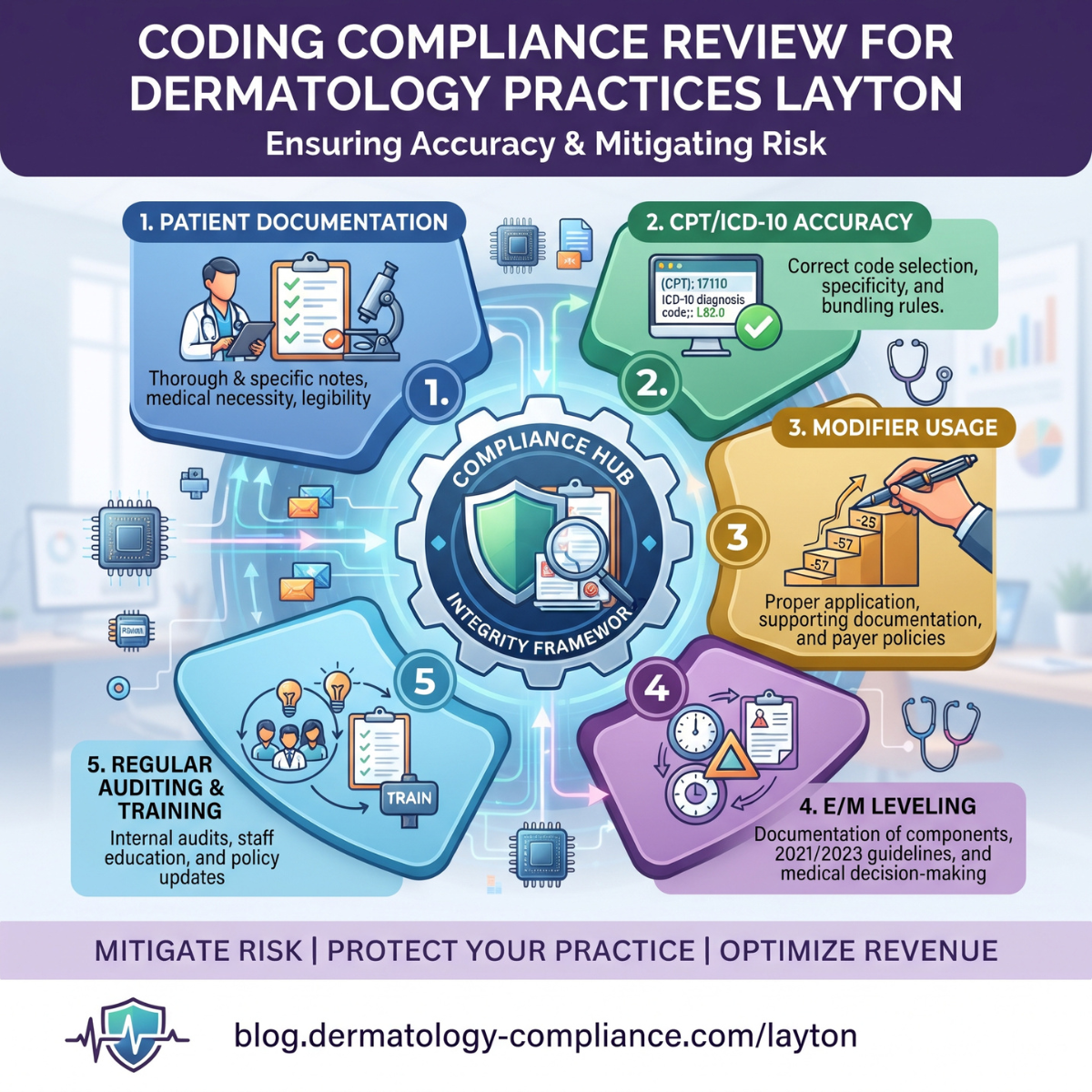
These issues make regular coding compliance reviews for dermatology practices in Layton an important part of revenue cycle management.
A compliance review examines the relationship between clinical documentation, diagnosis codes, procedure codes, modifiers, medical necessity, and payer requirements.
Unlike a routine claim scrub, a structured review evaluates whether the medical record actually supports what was billed.
This guide explains the essential components of a dermatology coding compliance review, common areas of billing risk, local Medicare considerations, and the steps practices can take to strengthen coding accuracy and reduce preventable errors.
What Is a Dermatology Coding Compliance Review?
A dermatology coding compliance review is a systematic examination of medical records, coding decisions, and submitted claims to determine whether billing accurately represents documented services.
The review typically evaluates:
- ICD-10-CM diagnosis code selection
- CPT and HCPCS procedure coding
- E/M level selection
- Modifier application
- Medical necessity documentation
- Skin biopsy coding
- Lesion destruction and removal
- Benign and malignant lesion excisions
- Mohs micrographic surgery
- Surgical repair and closure coding
- National Correct Coding Initiative (NCCI) edits
- Medicare and payer-specific billing requirements
The objective is to identify unsupported charges, missing reportable services, incorrect coding relationships, and weaknesses in documentation or workflows.
A compliance review differs from a purely financial audit.
A financial audit may focus on collections and reimbursement performance, while a coding compliance review evaluates whether billed services are accurate and supportable.
Both can be valuable, but they answer different questions.
Why Dermatology Practices in Layton Need Coding Reviews
Dermatology billing presents challenges because many procedures can occur during the same encounter.
For example, a dermatologist may evaluate a new complaint, biopsy one suspicious lesion, and treat a separate actinic keratosis during the visit.
These services may involve different CPT codes, documentation requirements, and editing rules.
The coding team must determine which services are separately reportable and which are included in other procedures.
Practices in Layton and surrounding Davis County must also consider the requirements of the payers they serve.
For Medicare fee-for-service Part B claims, Utah falls under Noridian Healthcare Solutions' Jurisdiction F.
Utah Medicaid has its own coverage and prior authorization resources, while commercial insurers may maintain additional policies.
A compliant coding process therefore requires more than checking whether a CPT code exists.
It must evaluate documentation, procedure relationships, medical necessity, code-set effective dates, and applicable payer requirements.
1. Evaluation and Management Coding Compliance
E/M coding is a significant area of dermatology compliance risk.
Office and outpatient E/M services generally require code selection using the applicable medical decision-making or qualifying time rules.
The documentation must support the reported level.
A longer clinical note does not automatically justify a higher-level visit.
Similarly, a visit involving multiple skin conditions does not necessarily meet the requirements for a particular E/M level.
Reviewers should examine the documented problems addressed, relevant data, management risk, and any time-based elements used for code selection.
For example, a patient presenting for a complex evaluation of several changing lesions may require a different level of decision-making than a routine, uncomplicated follow-up.
The reviewer should identify the services actually performed rather than infer complexity from the number of diagnosis codes.
Compliance focus: Verify that each sampled E/M code is supported by the applicable code-selection criteria and clinical documentation.
2. Modifier 25 Compliance Reviews
Modifier 25 deserves particular attention in dermatology.
Dermatologists frequently perform minor procedures during office visits.
Under Medicare global surgery rules, the routine E/M work associated with a minor procedure is generally included in the procedure payment.
A separate E/M service may be reportable when a significant, separately identifiable evaluation and management service is documented.
For example, a patient may receive a scheduled lesion destruction procedure and also undergo a medically necessary evaluation of an unrelated, worsening skin condition.
If the separate E/M work meets applicable reporting requirements, Modifier 25 may be appropriate.
However, routine assessment, consent, and work inherent in performing a planned minor procedure do not automatically justify an additional E/M charge.
A different diagnosis is not always required, but the separately identifiable work must be supported.
A compliance review should examine whether the practice routinely applies Modifier 25 without considering the documented circumstances.
Compliance focus: Confirm that billed E/M services represent distinct, supported work beyond the usual procedure-related care.
3. Why OIG Has Examined Dermatology E/M Billing
Dermatology E/M billing has received specific federal oversight.
In a report published in November 2025, the HHS Office of Inspector General reviewed Medicare payments for E/M services provided on the same date as minor dermatologic procedures.
The audit found that 90 of 100 sampled services met Medicare requirements, while 10 did not.
OIG estimated broader overpayments associated with noncompliant E/M claims and recommended improvements in oversight and education.
This finding should not be interpreted as evidence that most dermatologists bill incorrectly.
The majority of the sampled services were compliant.
However, the report shows why same-day E/M documentation is an appropriate target for risk-based auditing.
CMS also published specific dermatology billing guidance in June 2026 emphasizing that separate E/M payment requires qualifying work.
Compliance focus: Include same-day E/M claims in the audit sample and investigate repeated unsupported modifier patterns.
4. Skin Biopsy Coding Compliance
Skin biopsies are common dermatologic procedures, but their coding depends on the technique and circumstances.
Relevant CPT families include codes for tangential, punch, and incisional skin biopsies.
The documentation should identify the biopsy technique, lesion location, and number of separately biopsied lesions.
For example, a tangential biopsy should not automatically be coded as a complete lesion excision.
The distinction depends on the clinical purpose and procedure performed.
A biopsy performed to obtain tissue for diagnosis is not equivalent to therapeutic removal of an entire lesion.
A compliance review should also determine whether additional biopsy codes are supported for multiple lesions.
An additional specimen does not necessarily represent an additional separately reportable lesion.
Compliance focus: Verify technique, lesion identification, procedure purpose, add-on codes, and correct units.
5. Biopsy and Lesion Destruction on the Same Date
Performing a biopsy and destroying another lesion on the same day creates an important coding review scenario.
For Medicare, the 2026 NCCI Policy Manual addresses edits involving selected skin biopsy codes and lesion destruction codes.
The rules distinguish services performed on separate lesions from services involving the same lesion.
For example, if a dermatologist biopsies a suspicious lesion on the back and destroys a separate actinic keratosis on the face, separately reporting the procedures may be appropriate when all requirements are met.
However, a modifier should not be used merely to bypass an edit when the procedures are not genuinely separate.
The medical record must make the distinction clear.
Useful documentation includes individual lesion locations, descriptions, procedures, and associated treatment decisions.
Compliance focus: Verify that Modifier 59 or an applicable X modifier is supported by distinct procedures, lesions, or encounters under the relevant edit.
6. Benign Lesion Removal and Medical Necessity
Benign lesion removal is a particularly important area of Medicare dermatology compliance.
A patient may request removal of a skin tag, mole, or other benign lesion for cosmetic reasons.
However, Medicare generally does not cover procedures performed solely for cosmetic improvement.
Some benign lesion removals may be medically necessary when applicable coverage criteria are satisfied.
For instance, documentation may establish qualifying symptoms, functional problems, concerning changes, or other supported clinical indications.
Simply recording that a patient wants a lesion removed is not sufficient evidence of medical necessity.
Nor should a coder change a diagnosis to make a cosmetic procedure appear covered.
For Layton practices, the applicable Noridian Local Coverage Determination and related billing article should be reviewed for the service date and procedure.
Compliance focus: Confirm that medical records establish a covered indication and that claims accurately distinguish cosmetic from medically necessary services.
7. Lesion Excision Coding Accuracy
Dermatology practices frequently perform excisions of benign and malignant skin lesions.
The correct code depends on several factors, including lesion classification, anatomical location, and the relevant excised diameter.
Documentation must support the measurements and procedure reported.
For example, an excision code should not be selected solely based on the visible lesion size when the applicable coding instructions require the excised diameter, including margins.
A compliance review should evaluate whether the operative note includes the relevant anatomical details and measurements.
The reviewer should also verify that pathology and diagnosis reporting are consistent with the applicable coding rules and available documentation.
Where a diagnosis is uncertain, coders should not automatically report a confirmed malignancy unsupported by the record.
Compliance focus: Verify lesion classification, measurement methodology, anatomical site, procedure type, and diagnostic support.
8. Lesion Destruction and Actinic Keratosis Coding
Lesion destruction may involve methods such as cryotherapy, electrosurgery, or other appropriate techniques.
The coding approach depends on the lesion category and the applicable CPT instructions.
For example, treatment of premalignant lesions may use different coding structures from destruction of certain benign lesions.
The number of lesions treated may also affect code selection and billing units.
The procedure note should identify the lesions treated, their locations, and the method used.
One common weakness is documenting only that multiple lesions were frozen without sufficient information to establish the count and nature of the services.
The reviewer should confirm that documented lesion counts correspond to the claim.
Compliance focus: Evaluate lesion type, total number treated, method, diagnosis support, and correct procedural reporting.
9. Mohs Micrographic Surgery Compliance
Mohs micrographic surgery is a specialized procedure used for selected skin cancers.
Its billing requires accurate documentation and careful consideration of Medicare coverage rules.
Relevant CPT codes describe different stages and other aspects of Mohs surgery.
The medical record should establish the clinical reasons for choosing Mohs and support the work performed.
For example, documentation may address a lesion's location, size, recurrence, poorly defined borders, or other relevant characteristics.
The operative report should identify the number of stages and specimens or blocks as required by the applicable coding instructions.
Mohs coding also depends on the surgeon performing the required surgical and histologic functions.
A compliance review should examine associated pathology billing to identify potential duplication.
Compliance focus: Review medical necessity, operative details, stages, blocks, histology documentation, and correct reporting of bundled services.
10. Surgical Repair and Closure Coding
After removing a lesion, the dermatologist may close or reconstruct the resulting defect.
However, not every closure service is separately billable.
Simple closure is generally included in many lesion removal procedures.
Intermediate or complex repairs may sometimes qualify for separate reporting when supported by current coding instructions.
Special rules and exceptions apply to particular procedures and small excisions.
For example, the Medicare NCCI Policy Manual contains specific restrictions involving certain benign lesion excisions with small excised diameters.
A compliance review must distinguish simple closure from intermediate repair, complex repair, adjacent tissue transfer, or grafting.
The documentation should describe the technique performed and include measurements required for appropriate code selection.
Compliance focus: Verify that repairs are separately reportable and adequately supported rather than automatically adding closure codes.
11. Modifier 59 and X Modifier Reviews
Modifier 59 and certain X modifiers are frequently relevant to dermatology procedures.
They may communicate that procedures are distinct under the applicable coding rules.
However, they must not be used simply because the claim editing system rejected a code combination.
The reviewer should identify the actual clinical reason supporting separate reporting.
For example, two procedures performed on clearly distinct lesions may qualify under applicable instructions.
By contrast, using a modifier to separately bill an included component of a single procedure may be inappropriate.
A compliance audit should compare modifier usage with clinical documentation and NCCI rules.
High modifier utilization is a reason for investigation, not automatic proof of misconduct.
Compliance focus: Confirm each modifier's documented rationale and review recurring modifier patterns across providers.
12. Global Surgical Period Compliance
Dermatology practices should understand Medicare's global surgery rules.
Certain postoperative services are included within a surgical payment.
A routine follow-up associated with a previously performed procedure may therefore not qualify for separate E/M billing.
However, appropriately documented services unrelated to the original procedure or circumstances covered by another applicable modifier may be separately reportable.
Reviewers should examine the procedure's global period and subsequent encounter documentation.
For example, a postoperative wound check may be included, while a separately evaluated unrelated condition may require different analysis.
The practice must also distinguish ordinary postoperative care from complications or additional procedures subject to specific rules.
Compliance focus: Audit E/M and procedure claims occurring within global periods and verify the applicable modifier requirements.
13. Dermatology Diagnosis Coding Compliance
Accurate ICD-10-CM coding is as important as procedure coding.
Dermatology encounters may involve acne, dermatitis, psoriasis, actinic keratoses, benign lesions, malignant neoplasms, or other skin conditions.
Each diagnosis should be supported by the medical record and reported according to applicable outpatient coding guidelines.
A coder should not infer a confirmed diagnosis from a pathology test that has been ordered but not completed.
Likewise, a historical condition should not automatically be coded as an active diagnosis.
When site, laterality, or other specificity matters, documentation should provide the necessary information.
The coding team should also use the correct version of ICD-10-CM for the service date.
Compliance focus: Confirm diagnosis accuracy, specificity, code sequencing, and consistency with the documented clinical findings.
14. Noridian Medicare Requirements for Layton Practices
Layton dermatology practices submitting Medicare fee-for-service Part B claims operate within Jurisdiction F, administered by Noridian Healthcare Solutions.
This makes Noridian's active Local Coverage Determinations, billing and coding articles, and medical review guidance particularly relevant.
Examples of services requiring careful policy review include benign skin lesion removal and Mohs surgery.
The audit team should verify which policies were effective on the dates the reviewed services occurred.
This is especially important when reviewing historical claims because coverage documents and billing guidance can be revised.
A reviewer should not apply a newly published rule retroactively without establishing its effective date and applicability.
Similarly, a Noridian Medicare policy should not automatically be treated as the controlling rule for every commercial insurance claim.
Compliance focus: Use the correct payer, jurisdiction, policy version, and service date.
15. Utah Medicaid and Commercial Payer Compliance
Dermatology practices in Layton may serve patients enrolled in Utah Medicaid or commercial insurance plans.
These payers can have requirements that differ from Medicare fee-for-service.
Utah Medicaid maintains provider manuals and a Coverage and Reimbursement Lookup Tool.
Some services may require prior authorization or documentation supporting medical necessity.
Practices should verify these requirements for the applicable procedure and patient coverage.
Commercial insurers may also impose specific authorization, coverage, and billing rules.
A compliance review should include relevant payer contracts and current policies rather than rely entirely on Medicare standards.
Compliance focus: Verify payer-specific medical necessity, coverage, authorization, coding, and claim submission requirements.
16. What Happens During a Dermatology Coding Audit?
A structured compliance audit follows a documented process.
Phase 1: Practice Assessment
The reviewer examines the practice's specialty services, providers, payer mix, claim volume, coding workflows, and known billing concerns.
Phase 2: Claim Sampling
A sample of encounters is selected for review.
The sample may include random claims alongside higher-risk cases involving modifiers, multiple procedures, Mohs surgery, or denied claims.
Phase 3: Documentation Review
The reviewer examines the relevant clinical notes, procedure reports, pathology information, and other available supporting records.
Phase 4: Coding Validation
The assigned diagnosis codes, procedure codes, modifiers, units, and medical necessity are compared with the record and applicable rules.
Phase 5: Findings and Risk Classification
Issues are categorized according to their nature, potential impact, and frequency.
Phase 6: Corrective Action
The practice receives recommendations for coding correction, documentation improvement, training, and additional investigation where necessary.
The review should produce evidence and practical recommendations, not merely a list of denied claims.
17. What Should a Coding Compliance Review Report Include?
A useful audit report should be understandable to dermatologists, coders, billing staff, and practice leadership.
Recommended sections include:
| Report componentPurpose | |
| Audit scope | Identifies dates, providers, payers, and procedures reviewed |
| Sampling methodology | Explains how records were selected |
| Coding accuracy findings | Shows supported and unsupported coding decisions |
| Modifier review | Identifies modifier-related exceptions |
| Medical necessity findings | Highlights documentation and coverage gaps |
| Financial exposure assessment | Estimates verified or potential billing implications |
| Root-cause analysis | Explains recurring sources of error |
| Corrective action plan | Assigns improvements, owners, and deadlines |
| Follow-up review | Verifies whether changes were effective |
An audit should distinguish confirmed errors from findings that require additional documentation or legal interpretation.
It should also identify missed legitimate charges rather than focusing exclusively on potential overpayments.
18. How Often Should Dermatology Practices Conduct Coding Reviews?
There is no universal federal rule requiring every dermatology practice to complete a full independent coding audit at a particular fixed interval.
Audit frequency should reflect the practice's risk profile, payer requirements, compliance program, and previous findings.
A practical approach may include periodic coding reviews, focused audits after relevant policy changes, and follow-up testing when recurring problems are discovered.
For example, a practice with unusually frequent Modifier 25 denials may benefit from a targeted review sooner than its next scheduled general audit.
New providers or coding employees may also require additional education and monitoring.
Organizations should