Healthcare organizations operate in one of the most highly regulated industries in the United States. Medical practices, hospitals, billing companies, nursing facilities, and other healthcare businesses must navigate complex requirements involving federal healthcare programs, medical billing, financial relationships, documentation, and fraud prevention.
A coding error may result in an improper Medicare payment. An organization may unknowingly hire an excluded individual. A physician compensation arrangement may raise questions under federal fraud and abuse laws.
When these risks are not identified and addressed, healthcare organizations may face repayment obligations, financial penalties, investigations, and reputational damage.
This is where OIG compliance services become important.
These services help healthcare organizations develop, evaluate, and maintain compliance programs aligned with applicable federal healthcare requirements and guidance from the U.S. Department of Health and Human Services Office of Inspector General (HHS-OIG).
An effective compliance program does more than create policies or conduct annual training.
It establishes clear responsibilities, identifies operational risks, monitors billing accuracy, screens relevant individuals and entities, investigates potential misconduct, and ensures that corrective actions are implemented.
However, organizations must distinguish between guidance issued by OIG and services offered by private compliance consultants.
OIG's General Compliance Program Guidance provides a voluntary, nonbinding framework. It does not replace mandatory laws, regulations, contractual obligations, or specific program requirements.
This guide explains what OIG compliance services include, the seven elements of an effective compliance program, and how healthcare providers can strengthen regulatory oversight and reduce preventable risks.
What Are OIG Compliance Services?
OIG compliance services are professional services designed to help healthcare organizations assess and address risks related to federal healthcare program requirements.
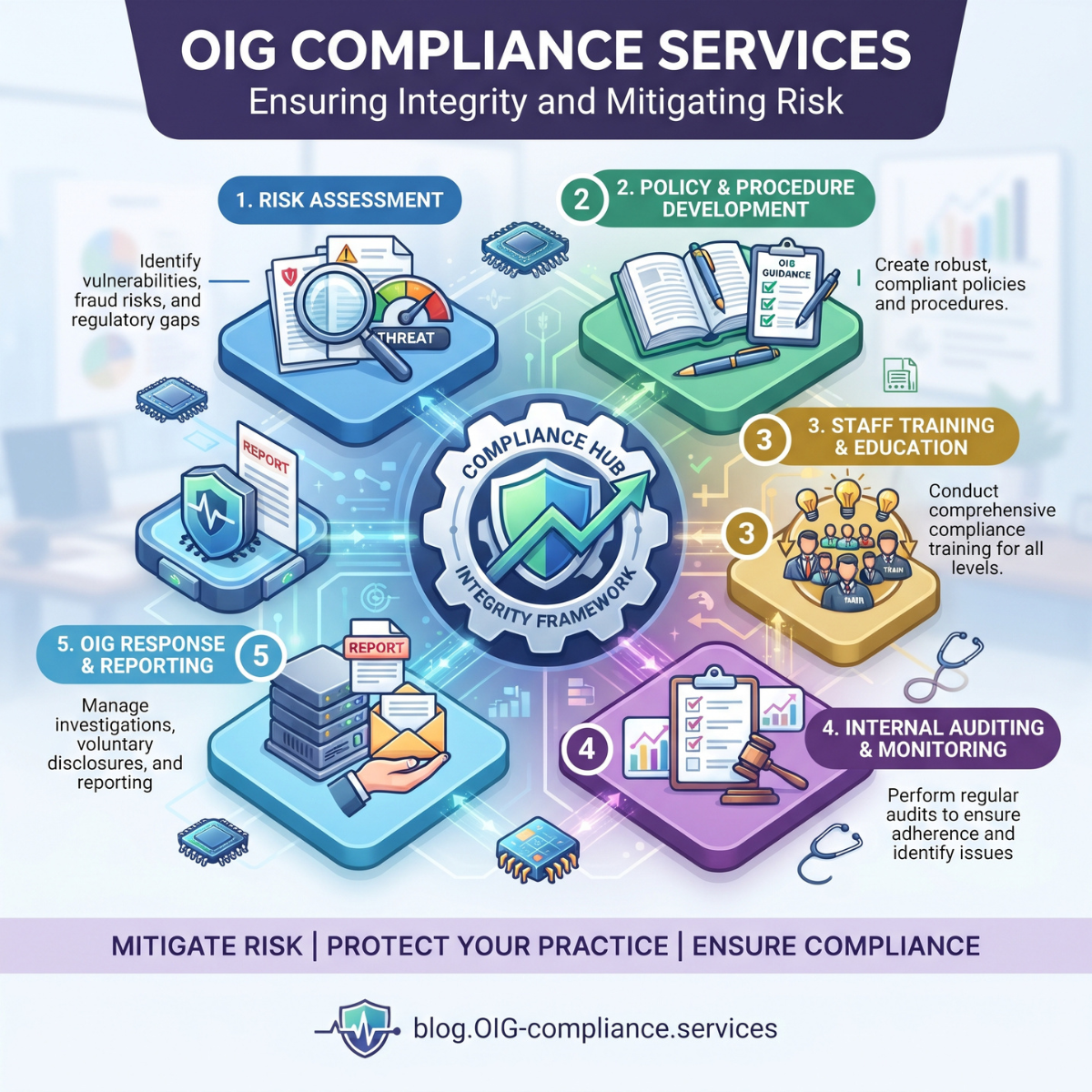
They typically focus on compliance program development, auditing, exclusion screening, training, risk monitoring, and corrective action.
Organizations may obtain these services from healthcare compliance consultants, legal advisors, auditing firms, or specialized compliance technology providers.
Common services include:
- Healthcare compliance program development
- Compliance risk assessments
- Medicare and Medicaid billing audits
- Medical coding and documentation reviews
- OIG exclusion screening
- Fraud, waste, and abuse prevention
- Compliance officer support
- Employee training and education
- Referral and compensation arrangement reviews
- Compliance monitoring and reporting
- Internal investigation support
- Corrective action planning
- Regulatory change monitoring
A qualified provider should tailor these activities to the organization's services, operational structure, and risk exposure.
For example, a small primary care practice may need focused billing audits and screening controls, while a multi-location healthcare organization may require a more formal compliance governance structure.
Why OIG Compliance Matters in Healthcare
OIG works to protect the integrity of HHS programs, including federal healthcare programs.
Healthcare organizations participating in these programs must comply with applicable rules governing billing, reimbursement, financial arrangements, and participation.
Noncompliance can have serious consequences.
Potential risks include improper payments, repayment obligations, civil monetary penalties, exclusion from federal healthcare programs, and enforcement proceedings.
Not every billing error constitutes fraud.
However, repeatedly submitting claims that lack documentation, knowingly retaining improper payments, or ignoring identified compliance risks may create more serious exposure depending on the circumstances.
A structured compliance program helps organizations detect issues before they become widespread.
It also creates a documented process for responding to concerns.
The purpose is not to guarantee that regulators will never investigate.
The purpose is to establish reasonable, effective controls that support lawful operations and timely correction of identified problems.
Understanding the HHS-OIG Compliance Framework
In November 2023, HHS-OIG released its General Compliance Program Guidance (GCPG).
The guidance discusses federal healthcare fraud and abuse laws, compliance infrastructure, organizational governance, and important risk areas.
It applies broadly as a resource for healthcare industry participants.
OIG also publishes Industry Segment-Specific Compliance Program Guidance (ICPG) for particular healthcare sectors.
As of November 2026, available industry-specific guidance includes the Nursing Facility ICPG issued in November 2024 and the Medicare Advantage ICPG issued in February 2026.
Organizations should review the guidance relevant to their sector alongside applicable laws and program rules.
The GCPG itself is voluntary and nonbinding.
That distinction matters because a consultant should not describe every recommendation within the guidance as a universal legal requirement.
At the same time, separate federal statutes, regulations, program conditions, and contractual obligations may require specific compliance activities.
The Seven Elements of an Effective OIG Compliance Program
OIG's compliance framework identifies seven foundational elements that organizations can use when designing and maintaining an effective compliance program.
These elements provide the structure for many healthcare compliance services.
1. Written Policies and Procedures
Healthcare organizations should establish clear standards explaining how employees are expected to comply with applicable requirements.
Policies may address medical coding, billing, documentation, exclusion screening, reporting concerns, and financial relationships.
They should reflect actual operations rather than generic templates.
For example, a billing company needs specific procedures for handling unsupported codes, duplicate claims, and potential overpayments.
2. Compliance Leadership and Oversight
Organizations should establish responsibility for administering the compliance program.
Depending on size and structure, this may involve a compliance officer, compliance committee, and direct reporting to senior leadership or the governing body.
Compliance personnel need appropriate authority and access to information.
A program is ineffective if leadership ignores identified risks.
3. Training and Education
Employees should understand the rules relevant to their responsibilities.
Coding employees need different training from scheduling staff, clinical providers, or executives.
Training should address recurring compliance risks and meaningful regulatory changes.
Completion records and knowledge assessments can help demonstrate whether training has been delivered effectively.
4. Effective Communication
Employees and other relevant individuals need accessible ways to raise compliance concerns.
Reporting channels may include designated contacts, confidential reporting systems, and established escalation procedures.
Organizations should encourage timely reporting and protect individuals from retaliation consistent with applicable requirements.
5. Consistent Enforcement of Standards
Compliance policies must be applied consistently.
Organizations should explain expectations and establish appropriate consequences for misconduct or failure to follow compliance procedures.
Enforcement should be fair, documented, and proportionate to the circumstances.
6. Risk Assessment, Auditing, and Monitoring
Effective compliance programs identify risks and test whether controls are working.
This includes periodic assessments, targeted billing audits, transaction reviews, and ongoing monitoring of identified high-risk activities.
7. Response and Corrective Action
When a compliance issue is identified, the organization should investigate, contain the problem, determine its scope, and take appropriate corrective action.
Depending on the circumstances, this may include staff retraining, process changes, repayment, legal review, or disclosure through an applicable government process.
Together, these elements provide a practical foundation for healthcare compliance management.
1. OIG Compliance Risk Assessment Services
A compliance risk assessment evaluates where an organization may be exposed to regulatory or operational problems.
The process should begin by understanding the healthcare entity's services, payer participation, staffing arrangements, financial relationships, and billing practices.
Risk assessments may examine:
- Medicare and Medicaid billing patterns
- Medical coding and documentation
- Provider enrollment
- Referral arrangements
- Claims involving excluded individuals
- Compensation agreements
- High-risk procedures
- Compliance training gaps
- Existing audit findings
- Previous corrective actions
Not every risk has the same likelihood or potential impact.
A consultant may use a risk matrix to prioritize concerns based on severity, occurrence, and the effectiveness of existing controls.
Expected deliverable: A documented risk assessment identifying priority issues, existing safeguards, corrective recommendations, and responsible owners.
2. Medical Billing and Coding Compliance Audits
Medical billing compliance is one of the most important areas of healthcare regulatory oversight.
Claims submitted to federal healthcare programs must accurately represent the services provided and comply with applicable coding and payment rules.
Common audit risks include:
- Unsupported evaluation and management levels
- Incorrect CPT or HCPCS codes
- Inappropriate modifier usage
- Duplicate claims
- Incorrect billing units
- Insufficient medical necessity documentation
- Unbundling of procedures
- Improper billing during global surgical periods
For example, a practice may routinely add Modifier 25 to E/M services performed on the same day as minor procedures.
An audit should determine whether the clinical documentation actually supports a significant, separately identifiable E/M service.
The solution is not to remove every modifier automatically.
It is to evaluate individual claims against current coding instructions and documented services.
A strong audit identifies overbilling and underbilling, measures error patterns, and recommends specific corrective actions.
3. OIG Exclusion Screening Services
Exclusion screening is a critical component of healthcare compliance.
HHS-OIG maintains the List of Excluded Individuals/Entities (LEIE).
Excluded individuals and entities generally cannot receive federal healthcare program payment for items or services they furnish, order, or prescribe.
Organizations may face significant liability when they employ or contract with excluded individuals whose work is connected with federally funded healthcare services.
Compliance screening services may review employees, contractors, certain vendors, and other relevant relationships against the LEIE.
The screening scope should reflect the services performed and applicable requirements.
OIG recommends screening before employment or contracting and periodically afterward.
Because the LEIE is updated monthly, OIG has identified monthly screening as a way to best minimize potential liability.
Monthly LEIE screening is an OIG recommendation, not a universal statutory requirement imposed directly on every provider. Other program or contractual requirements may still apply.
A reliable screening service should maintain evidence of screening dates, match investigation, identity verification, and resolution.
4. Fraud, Waste, and Abuse Prevention
Healthcare compliance services frequently address fraud, waste, and abuse risks.
Examples include billing for services not performed, falsifying documentation, duplicate reimbursement, improper financial inducements, and submitting claims that do not satisfy payment requirements.
However, fraud, waste, abuse, and ordinary billing mistakes should not be treated as interchangeable.
Fraud generally involves conduct with the requisite wrongful intent or knowledge under the applicable law.
A simple administrative mistake may require correction without necessarily establishing fraud.
Compliance programs should identify questionable activities and investigate the facts before reaching conclusions.
Useful controls include coding audits, separation of duties, billing exception reports, workforce training, and confidential reporting mechanisms.
The objective is to prevent improper conduct and address warning signs promptly.
5. False Claims Act Compliance
The False Claims Act is an important federal law affecting healthcare reimbursement.
It can impose liability for knowingly presenting or causing the presentation of false or fraudulent claims for federal payment.
The law's knowledge standard includes actual knowledge, deliberate ignorance, and reckless disregard.
Healthcare organizations should therefore maintain controls designed to prevent and detect inappropriate billing.
For example, a practice that discovers a recurring coding problem should investigate whether affected claims were incorrectly paid.
It should not simply update future coding procedures while ignoring previously identified improper payments.
A compliance provider may assist with claim sampling, root-cause analysis, documentation preservation, and coordination with legal counsel.
Potential false claims issues require careful legal assessment because facts, knowledge, payment conditions, and reporting obligations matter.
6. Anti-Kickback Statute Compliance
The federal Anti-Kickback Statute addresses certain improper remuneration connected with referrals or business reimbursable by federal healthcare programs.
Healthcare organizations should carefully review financial relationships involving referral sources, marketers, vendors, management companies, and service providers.
For example, a compensation arrangement that rewards referrals may raise concerns under the statute.
Not every payment arrangement is unlawful.
Specific statutory exceptions and regulatory safe harbors may apply when their requirements are satisfied.
Compliance services can help inventory arrangements, identify missing documentation, and coordinate legal review of potentially problematic agreements.
A consultant should not represent a questionable arrangement as compliant solely because it has a written contract.
The actual terms, circumstances, and applicable legal requirements must be evaluated.
7. Stark Law and Physician Relationship Reviews
The Physician Self-Referral Law, commonly called the Stark Law, is distinct from the Anti-Kickback Statute.
It generally prohibits certain physician referrals for Medicare-payable designated health services when specified financial relationships exist, unless an applicable exception is satisfied.
The law also restricts billing for certain services furnished pursuant to prohibited referrals.
Physician employment, medical directorships, equipment leases, and other compensation arrangements may require careful review.
Compliance services may support contract inventory, approval controls, document retention, and monitoring.
However, legal interpretation of Stark Law exceptions should be handled by qualified counsel.
For potential self-referral violations, CMS maintains a separate disclosure framework.
Organizations should not assume that every fraud or referral matter belongs in the same OIG self-disclosure process.
8. Provider Enrollment and Credentialing Compliance
Accurate provider enrollment is essential for legitimate healthcare reimbursement.
Organizations should verify that providers satisfy applicable licensing, enrollment, participation, and billing requirements.
Problems can arise when a newly hired provider begins furnishing services before enrollment issues are resolved or when claims contain incorrect rendering provider information.
A compliance review may examine provider rosters, enrollment records, service locations, and billing arrangements.
It should also assess whether responsibility for maintaining these records is clearly assigned.
Credentialing, enrollment, and exclusion screening serve related but different purposes.
A provider can possess a valid professional license while still having an enrollment or exclusion problem.
Separate verification controls are necessary.
9. Compliance Policies and Procedure Development
Many healthcare organizations have policies that are outdated, incomplete, or disconnected from daily operations.
A compliance service provider may create or revise policies addressing:
- Standards of conduct
- Claims submission
- Coding and documentation
- Exclusion screening
- Internal investigations
- Employee reporting
- Conflict-of-interest management
- Corrective action
- Overpayment escalation
- Records retention
- Compliance monitoring
Policies should identify who is responsible, how activities are performed, and when issues must be escalated.
For example, an overpayment policy should establish an investigation and legal review process rather than simply instruct employees to ignore disputed balances.
A policy is useful only when the organization implements it, trains employees, and tests whether it works.
10. Compliance Training and Education Services
Training should be tailored to job responsibilities and actual risk areas.
A front-desk employee may need education on accurate registration, referral documentation, and reporting unusual requests.
A medical coder may need detailed instruction on documentation support, modifiers, and code selection.
A physician may need training on clinical documentation, referral arrangements, and appropriate billing practices.
Executives should understand their oversight responsibilities and how significant risks are escalated.
Training services may include onboarding, periodic refreshers, targeted education following audits, and management workshops.
Participation should be documented.
However, training completion alone is not evidence that employees understand or consistently follow the rules.
Organizations should evaluate whether repeated compliance errors decline after training.
11. Internal Monitoring and Compliance Auditing
A compliance program needs continuous monitoring, not just an annual review.
Ongoing monitoring can identify unusual billing patterns, repeated policy exceptions, and potential control failures.
An organization might monitor:
- High-risk CPT code usage
- Modifier patterns
- Duplicate claims
- Provider billing variations
- Exclusion screening completion
- Outstanding corrective actions
- Changes in payer audit findings
- Unresolved overpayment investigations
Monitoring should be risk-based rather than based solely on which reports are easiest to generate.
For example, unusually high utilization of a particular code may justify review but does not automatically establish misconduct.
Audits should evaluate documentation and applicable requirements before drawing conclusions.
Compliance monitoring is most valuable when findings produce documented actions and measurable improvements.
12. OIG Work Plan and Regulatory Monitoring
HHS-OIG publishes a Work Plan describing selected audits and evaluations it intends to undertake.
Healthcare organizations can use the Work Plan to identify topics relevant to their operations.
For example, if OIG announces review activity involving a particular healthcare service or payment category, affected organizations may consider whether their controls deserve additional attention.
However, the Work Plan is not an exhaustive list of every enforcement risk.
An activity that does not appear in the Work Plan can still raise compliance concerns.
A compliance service provider may monitor OIG publications, CMS updates, federal guidance, and applicable state developments.
The resulting updates should be translated into practical recommendations.
Sending regulatory newsletters without evaluating their operational impact provides limited value.
13. Corrective Action Planning and Follow-Up
Identifying a compliance problem is only the beginning.
Organizations must determine why it occurred and how to prevent recurrence.
Consider an audit that identifies repeated documentation deficiencies.
Possible causes include inadequate provider training, confusing EHR templates, or insufficient coding review.
A useful corrective action plan should identify:
- The issue discovered
- Scope and potential impact
- Root cause
- Required corrective measures
- Responsible department
- Completion deadline
- Evidence of implementation
- Follow-up testing results
The organization should also assess whether previous claims or payments were affected.
Corrective actions should be closed only after sufficient evidence demonstrates implementation and, when appropriate, effectiveness.
Repeated unresolved findings are a sign of weak compliance governance.
14. Overpayment Investigation and Disclosure Support
Healthcare organizations may discover that federal healthcare programs paid claims incorrectly.
Potential causes include incorrect coding, unsupported services, provider enrollment issues, or other billing problems.
The compliance team should preserve relevant evidence and promptly investigate the issue.
If an overpayment is identified, applicable reporting and repayment obligations must be evaluated.
These obligations depend on the governing program, facts, and current law.
Some matters may also raise potential fraud or abuse concerns.
OIG maintains a Health Care Fraud Self-Disclosure Protocol for eligible matters involving its applicable authorities.
Other circumstances may involve CMS or Department of Justice processes.
A compliance consultant can organize records and investigation findings, but decisions involving potential fraud, liability, or government disclosure should involve experienced healthcare counsel.
15. OIG Compliance Services for Different Healthcare Organizations
Compliance requirements and risk profiles vary substantially by organization.
Physician Practices
Common priorities include E/M coding, procedure modifiers, documentation, medical necessity, enrollment, and exclusion screening.
Medical Billing and RCM Companies
Important risks include coding accuracy, improper claims, client oversight responsibilities, data handling, and consistent application of billing policies.
Hospitals
Relevant issues may include complex reimbursement, physician relationships, quality reporting, documentation, and organizational governance.
Nursing Facilities
Compliance programs should consider applicable reimbursement requirements alongside resident care, quality, and safety risks.
OIG's Nursing Facility ICPG provides additional sector-specific guidance.
Medicare Advantage Organizations
Relevant risks may include risk adjustment, encounter data, marketing practices, payment integrity, and compliance oversight.
OIG published Medicare Advantage industry-specific compliance guidance in February 2026.
Every program should be adapted to its organization rather than copied from a generic template.
16. Technology and Automation in OIG Compliance Services
Compliance technology can improve monitoring and documentation.
For example, an exclusion screening platform may compare employee records against the LEIE and flag potential matches.
A compliance dashboard may track training completion, audit findings, unresolved risks, and corrective action deadlines.
Medical billing analytics may identify unusual coding patterns for further investigation.
However, automation has limitations.
A potential LEIE match must be verified; a similar name alone does not establish that the individual is excluded.
Likewise, an unusual billing pattern is a reason to investigate, not proof of fraud.
Artificial intelligence may help summarize policies or organize audit findings, but it should not independently make legal compliance determinations.
Technology should support evidence-based review, accountability, and secure recordkeeping.
17. How to Choose an OIG Compliance Services Provider
Healthcare organizations should evaluate compliance consultants based on expertise and deliverables rather than marketing claims.
Look for experience with the organization's provider type, relevant Medicare and Medicaid rules, coding practices, federal fraud and abuse requirements, and internal auditing.
A qualified provider should clearly explain the scope of its services.
Ask whether it offers:
- Documented risk assessments
- Medical coding and billing audits
- LEIE exclusion screening
- Compliance policy development
- Staff training
- Corrective action monitoring
- Management reporting
- Coordination with legal counsel
The provider should also demonstrate how it protects sensitive information and manages potential conflicts of interest.
Avoid companies promising that their services eliminate audit risk or guarantee regulatory compliance.
No private consultant can ensure that an organization will never face an investigation.
18. What Should an OIG Compliance Services Package Include?
A practical compliance services package should deliver more than a written policy manual.
Depending on the organization's size and risk profile, useful deliverables may include:
Initial Risk Assessment: Identification and prioritization of relevant compliance exposures.
Compliance Program Review: Evaluation of policies, leadership accountability, reporting channels, and oversight.
Billing Audit Report: Documented findings from a defined medical billing or coding sample.
Exclusion Screening Records: Screening results, verified matches, investigations, and follow-up actions.
Training Records: Role-specific education materials and participation evidence.
Corrective Action Register: Assigned actions, deadlines, responsible owners, and verification results.
Leadership Dashboard: Summary of important compliance indicators and unresolved concerns.
Annual Monitoring Plan: Schedule for further audits, screening, training, and control reviews.
The service agreement should specify which deliverables are included and which activities require separate legal or specialist support.
19. Measuring Healthcare Compliance Program Performance
Compliance performance cannot be assessed solely by counting how many audits were completed.
Organizations need metrics that evaluate implementation and risk reduction.
Potential indicators include:
Audit Finding Rate: Frequency of identified exceptions within defined samples.
Repeat Finding Rate: Percentage of problems recurring after corrective action.
Exclusion Screening Completion: Proportion of eligible personnel and entities screened according to the organization's schedule.
Corrective Action Closure: Percentage of assigned actions completed with adequate evidence.
Training Completion: Percentage of assigned personnel completing required education.
Issue Investigation Timeliness: Time between identifying a concern and completing the appropriate initial review.
High-Risk Billing Error Trends: Changes in verified coding or documentation issues.
Compliance Reporting Activity: Evaluation of whether appropriate reporting channels are used and concerns are addressed.
A low number of reported issues does not automatically mean a healthy compliance culture.
It may indicate that employees are unaware of reporting channels or uncomfortable using them.
Management should interpret metrics alongside audit results, workforce feedback, and operational context.
20. A 90-Day OIG Compliance Improvement Plan
Healthcare organizations can use a phased approach to establish stronger compliance controls.
Days 1–30: Assess Compliance Risks
Review current policies, staffing, billing procedures, federal program participation, and prior audit findings.
Identify applicable OIG guidance.
Conduct an initial risk assessment.
Review existing exclusion screening and reporting procedures.
Days 31–60: Strengthen Controls
Update priority policies and assign compliance responsibilities.
Begin targeted medical billing audits.
Improve exclusion screening documentation.
Deliver role-specific employee training.
Establish a corrective action register and management reporting process.
Days 61–90: Validate and Monitor
Review audit findings and investigate unresolved concerns.
Verify that corrective actions have been implemented.
Monitor screening, training, and reporting processes.
Evaluate whether additional legal review, auditing, or technology is needed.
Prepare an ongoing compliance monitoring schedule.
Ninety days is an illustrative improvement framework, not a promise of complete compliance.
Some issues require longer investigations, specialized legal analysis, or additional operational changes.
Common OIG Compliance Mistakes to Avoid
Healthcare organizations often make avoidable mistakes when managing compliance.
Common examples include:
- Treating compliance as a one-time project
- Using generic policies without implementation
- Assuming every OIG recommendation is legally mandatory
- Ignoring applicable industry-specific guidance
- Failing to verify potential exclusion matches
- Treating coding denials as proof of fraud
- Overlooking referral and compensation risks
- Failing to investigate recurring billing errors
- Closing corrective actions without verification
- Assuming outsourcing transfers all compliance responsibility
- Confusing HIPAA security reviews with complete OIG compliance
- Relying on software instead of qualified professional judgment
Each weakness reduces the organization's ability to identify and manage actual risks.
The solution is a documented, risk-based compliance program supported by leadership, qualified staff, appropriate oversight, and continuous monitoring.
Frequently Asked Questions
What are OIG compliance services?
They are consulting, auditing, monitoring, screening, and training services that help healthcare organizations manage compliance risks related to federal healthcare programs and relevant OIG guidance.
Are OIG compliance programs mandatory for every medical practice?
OIG's General Compliance Program Guidance is voluntary and nonbinding. However, separate laws, contracts, and specific program requirements may impose mandatory compliance obligations.
How often should healthcare organizations perform OIG exclusion screening?
OIG recommends screening before employment or contracting and periodically afterward. Because the LEIE is updated monthly, monthly screening best minimizes certain risks. Other applicable requirements may differ.
What are the seven elements of an OIG compliance program?
They include written policies, compliance leadership, training, communication, enforcement of standards, auditing and monitoring, and response with corrective action.
Is OIG compliance the same as HIPAA compliance?
No. OIG compliance programs commonly address federal healthcare fraud, abuse, billing, and program integrity risks. HIPAA privacy and security obligations are a related but distinct compliance area.
Can an RCM company provide OIG compliance services?
An RCM company may provide appropriate billing audits, documentation reviews, monitoring, and compliance support if it has the necessary expertise. Specialized legal advice and certain independent review functions may require additional qualified professionals.
Can a consultant guarantee OIG compliance?
No. A consultant can help assess risks and improve controls, but compliance depends on the organization's actual operations and applicable requirements.
Final Thoughts
OIG compliance services play an important role in helping healthcare organizations identify regulatory risks, strengthen internal controls, and establish responsible billing and operational practices.
Effective services may include compliance risk assessments, medical coding audits, exclusion screening, fraud prevention, policy development, training, monitoring, and corrective action support.
However, successful compliance requires more than completing a checklist.
Healthcare organizations must establish leadership accountability, maintain reliable documentation, investigate warning signs, and verify that corrective actions resolve the underlying problems.
They must also understand the distinction between voluntary OIG guidance and legally enforceable requirements.
A strong healthcare compliance program is not measured by the number of policies an organization possesses. It is measured by how effectively those policies prevent, detect, and address real compliance risks.
Medical practices, hospitals, billing companies, and other healthcare entities that treat compliance as an ongoing operational responsibility are better positioned to improve billing integrity, reduce preventable errors, and support responsible participation in federal healthcare programs.